Comes in Threes

Superstition dictates that bad things come in threes, but that count is just arbitrary–until living through three bad or at least very inconvenient things. My latest three: car accident, laptop incident and recent job performance.

So, the seemingly never-ending drama started one fine Saturday, nearly three weeks ago when some jackass rear ended me.  I’m absolutely amazed how many drivers watch traffic rather than the car in front of them. The ironic thing was, I was pulling out onto the service road when he hit me.

Apparently, I was too discombobulated from that fender bender because I didn’t take a picture of his license’s plate nor the car, but I took pictures of his insurance card, driver’s license and the damage to my car. To make matters worse, it was his girlfriend’s car, yet her name didn’t appear on the insurance card.

Her insurance acknowledged that a claim was owed, but have dragged their feet about the estimate. In the meantime, I’ve already dropped off my car, picked up a rental and now playing the waiting game for everything to resolve itself.

I’m somewhat annoyed with the rental car situation. Since her insurance agency closed at 4:30 PM (Who does that? Only a business that doesn’t want to help!), I had to put down my credit card for $200 instead of $50.  I plan to get that $150 reimbursed. Then the rental car agent lead me to a bright, shiny red car, which used no keys but remote signals for everything–even to start the car if I wanted! I chose to hit the “start” button instead. The whole time he pointed out features, I just fussed, “Brode, I didn’t want all this fancy shit! I just wanted a basic, small rental car.”

He assured me that everything was going to be all right and that things change.  In that precise moment, I’d fully entered middle adulthood.  I’ve been saying for a few years that I was middle aged, but in that slick, shiny, curvaceous car, I truly felt ever bit of the middle aged woman I’d purported to be.

A few days after my accident, I had training for work.  Training always involved a 2-hour round trip commute to the office, which added to my 8-hour work shift. Thankfully, my car was operable, so I didn’t have to hassle with the car rental place and collision shop sooner.  As a matter of fact, the commute allowed me to hear a rattle that had not existed prior to the accident,  which prompted me to get it checked out despite the minimum visible damage.

Then, two days prior to dropping off my car to be repaired and rolling back with the high-tech rental, I accidentally splashed water onto my laptop when I knocked my glass off the end table. I’d been gambling with that dangerous habit for years.  I’d never heard a laptop sizzle before.  I pretty much did everything they tell you not to do: tried to shake the water out; turned it off and on; plugged it in. I instinctively knew not to put it in rice nor use a blow dryer, which were two other bad ideas that people try. I dropped off the laptop the day before I dropped off the car.

So, they retrieved the data off the hard drive, but a refurbish would cost $850! I bought a new laptop, using my tax refund. I’d had the lofty idea to use all of that refund for getting out of debt quicker, but I was getting behind in nearly every other endeavor without my almighty laptop.  Unfortunately, my work computer has limited capabilities or else, I’d not replace my personal one for months.

In the meantime, I’ve recently learned how to sell a new insurance product. It’s rather humbling to go from being a little badass with one insurance product and essentially starting from ground zero with a new one. Additionally, there are other aspects beyond my control, such as the dramatically lower call volume.

I got one of my wishes to have a tighter script, but it’s so much longer than the old one. Even when I get a call, the conversations take much longer. Seems as if the keys to selling this insurance are sticking to the script as much as possible while infusing my personality into it. Only today, I think I’m finally getting the hang of it. Just in time for them to raise our target from 2 sales to 3, despite the fact that half of us have been getting either 0 or 1 sale a day. In the spirit of staying on the right side of natural selection, I must step up my game and show improvement.

With the triumvirate of challenges, only the laptop situation has been remedied. I still have a couple of hours worth of work to do to organize things since, although my data was saved, all the folders were saved empt and their contents were saved in a huge file, labelled “All My Files.” Now, I just take a deep breath and sort that content into the appropriate file and remain grateful that all had not been lost.

(Oh, and I now keep my beverage on a saucer on the floor versus on the end table beside the couch!)

Bang Maids

I’ve known since my early 20s that I didn’t want to have kids. Yet I wasn’t turned off by marriage. As a matter of fact, there’s a part of me who visualizes myself married—as long as I don’t have to live with my husband. When I told my married sister that last part, her response was, “What’s the point of getting married?”

Considering the fact that Christian marriage began as a way to guarantee a man that his children were his, I actually don’t see much need for it. I know there are men who also don’t want to father children, or at this point in life, don’t want to father any more children; so that’s really a nonissue for me.

My biggest stopper is I don’t want to be a bang maid. I don’t want to be that woman who fills a significant part of her time with the domestic duties of attending to a man every day, having very little time to read, do art or just otherwise relax after the work day.

At any given time, I’m working on at least two different writing projects, putting together at least one on-going creative project, and reading at least four different books in rotation. In the meantime, I work a full-time job and occasionally two different freelance jobs. And did I mention that I exercise every day?

I’m not as selfish as I come across. I really do care about people, but from a distance, where it easily fits into my already busy schedule. For example, for the past seven years, I’ve made Christmas cards–very stylishly decorated, complete with a unique message, written in longhand. This takes me a lot of time to do. One might walk away with the impression that I’m some warm individual who always does such thoughtful things. Yes and no. As long as warm and fuzzy fits neatly into the master schedule, I’ll do it. Besides, since I’m not on social media, again another thing that would drain my creative schedule, my Christmas cards are a way to give a yearly update to out-of-town friends.

Now, some people think, if I just had a man, I could quit working and have all that extra time to pursue my creative projects. Yet I’m not going to base my financial stability on whether or not some man still loves me. Let’s face it: I have a strong personality, which sometimes gets on my own nerves. I can imagine how it affects other people.

However, I need my financial obligations to be met every day, not just those sunny times when I’m loved by someone else. Plus, being an adult means attending to one’s own financial responsibilities. Am I to believe that some man for whom I perform domestic duties and sex should meet my financial responsibilities? I know—you gotta give some to get some, but it just seems less complicated and time-consuming to separate money from romance.

I have a sinking suspicion that some men mistake cooking and cleaning with love since their mothers did that for them, without realizing she only did those things because he was a child. No one in the world loves you like your mama. No one. You can be loved by others, but you’ll only have one mama.

When the romantic curtain is pulled back, a woman being financially dependent on a man puts her in a precarious position. Women, who have their own, independent source of money, tend to have more control of their own life. Moreover, women have far more to contribute to society than a myriad of menial tasks.

I like setting that tone from the very beginning. When I go out on a date, I genuinely don’t expect a guy to pay. I know that all money comes with strings attached—apron strings and G-strings. Not to say that I don’t don those strings occasionally, but they’re not tied to a man’s money, but rather my own necessity.

The first Black actress to win an Oscar was Hattie McDaniel for her role as the maid, “Mammy,” in Gone with the Wind in 1940. Throughout her acting career, McDaniel played a maid in 74 movies. She once said, “I’d rather play a maid than to be one!”

Amen, Big Mama Hattie!

Moving Forward

What a weird time of my life, not just because of the recent presidential elections, but almost in spite of it. I’m working for long stretches of time, speed reading in between calls with prospective clients, exercising every day and in the “free” snatches of time, creating art. Always in motion, even when I’m sleeping.

Yet, I question if this is truly what I want out of life. Certainly, I’m living a financially sustainable life for the first time in a couple of years. And I love that I continue to hone my new-found skill of sales, especially from home. But…

Where’s that other part of my life where I work on writing projects every day? I miss that daily routine, which apparently served more than a mere routine. It was the daily expression of tapping into that level of creative thinking that is missing in my life.

Some people need their morning coffee and others need a daily vitamin. Apparently, I need a daily dose of writing. This new work schedule has displaced my writing and yet, I feel myself propelled forward, almost leaving writing behind.

I cannot be into my own head to write in between calls like I can when reading. I value getting a full night’s sleep; so waking up earlier to write doesn’t seem quite right. At the end of the day, crafting where I must sew, cut out things or glue them fit the bill perfectly at that time of day. Which only leaves the long stretches of time on the weekends as the “perfect” times to write. Even that time gets chopped into pieces with other things that need to be done, especially socializing.

I pick and choose events where I can either hang out with other creative people for inspiration or get together with the few friends I manage to have, given the fact that I’m still allergic to most forms of social media.

At this point, I know I need to return to the basics: writing in the morning. My only expectation will be to do how many minutes the morning routine allows me to do. Just like the good ol’ days when I was writing my first novel and I’d hurriedly add, edit or delete something within a minute. From there, my impossible schedule adjusted.

When Racism Becomes Unsustainable

Last Saturday, a good friend, another cerebral Black woman, and I saw “Hidden Figures.” Among the many things that uplifting film depicted, it showed how the separation of Blacks and Whites continued until it died in a final gasp of breath.

The segregation of libraries sections, water fountains, bathrooms, and even coffee pots reinforced second-class citizenship, which some people, both Black and White, internalized as proof positive of the inferiority of Blacks, rather than as an oppressive regime under which a group of intelligent people had to endure.

Yet, when the most capable mathematician at NASA had inconvenienced her White boss during her mile-long roundtrip to the colored bathroom, her situation motivated him to immediately integrate the bathrooms. Very practical. Once that parallel practice disappeared, more parallel systems vanished, but not without a trace and, of course, not without a fight.

We may take sharing public facilities for granted today, but for some Whites who lived through that transitionary time, they experienced a loss of status. They perceived a cheapening of their quality of life, for their separate services reaffirmed their social superiority. But not their intellectual superiority. At least not to strong Black people.

There’s the valuable difference. The difference that Black parents, my parents’ generation and older, knew and had inspired their number one advice to their children: you have to be twice as good as Whites to get half as much. Strong Black parents never internalized the social superiority of Whites as the true value of their position. They envisioned achieving the American dream, where being twice as good as Whites would create undeniable evidence of worth.

The bathrooms at NASA were integrated because the parallel system could no longer be sustained.  Socially constructed separation deteriorated because a black female mathematician, who, by any standards, was a genius. Having ready access to her math skills outgrew the importance of prohibiting her access to the closest bathroom.

Those bathroom scenes made me reflect upon the success of the bus boycotts and sit-ins. At the end of the day, the White owners of those businesses were losing money every day protests and boycotts took place rather than transactions. Every business plan must include making money. When racist practices disrupt cash flow, money wins in the end.

Granted, some use money to maintain their separation, but for those who cannot literally afford it, they must live an integrated life. If such people could see the bigger picture, they’d realize that they have more in common with someone of their own socioeconomic status than someone of their same socially constructed “race.”

Nonetheless, as we enter the next exciting chapter of our great American social experiment, I wonder which other divisive practices will go extinct.

Dreaming of My Wedding

This past Monday, one of my friends texted me about her dream where she had attended my wedding.  I texted her back, “Good thing I’m not superstitious. My grandmother used think a wedding dream meant a funeral.”

Once I had a moment to look it up, I “discovered” that a single woman dreaming of another woman getting married meant that the dreamer will find true love. Well, good for her! In the meantime, I think my theme for 2017 continues to be “Three Black Men.”

Walking in the parking garage with a coworker and my plus one, en route to the venue where my office holiday party was being held, three fine black men crossed our path. They weren’t with the company, but at least pointed us in the correct direction to where the party was.

Thanks to New Year’s Eve, where I danced with three different black men, I’m going to remark every time I interact with a trio of black men. I’ve not noticed before that they come in three’s here in Austin. What has been noted is the disappearing black population within this growing city. I may be onto something.

Decades ago, all the rage was about black men becoming an endangered species. I believed that was a bunch of hype then, but I know they are scarcer in this town. I’ve only half noticed since, when it comes to dating, I appreciate a wide variety of handsome, but even more so, I enjoy intellectual stimulation, which can be found among all races.

The fun part is that I can continue playing I-Spy for a trio of black men. Of course, the rule will be I will have to talk, or otherwise engage, with them in order for it to “count.” One thing I don’t think will happen is finding my future husband. I’m not against marriage. I just don’t want to live with a husband.

Cheating and Cursing: An Alternative Approach to Bikram Yoga

Hot yoga. The longer you practice, the more the superficial complaints melt away: the sweat, the smell, the heat, the humidity. Even your slowly cooking reptilian brain calms down after several classes, where it’s no longer preoccupied with craving thoughts of food, fighting and sex. Initially, the practice dredges up arguments and emotions long past. Causes one to hunger for meat and carbs. And as far as sexual musings go, that’s just a given in a hot room where people glisten with sweat, in such a state of undress, they’re barely recognizable in their regular clothes.

So, even when you comprehend the intermediate bikram yoga instructions like, “rotate your femurs forward while maintaining both sit bones evenly on the floor,” yet your body cannot follow, just breathe deeply, curse under your breath and cheat your way through the posture.

Oh, yes—curse and cheat. This is an upgrade from the “fake it ‘til you make it” advice. Release those curse words like steam through a valve in a pressure cooker, but much quieter. After all, you must celebrate or suffer throughout your yoga practice without distracting your neighboring yogis from their own misery or joy. It’s a shared practice, but the journey is individual and you never really know where the other yogis are.

Just be true to yourself: curse and cheat. You know you’re going to do it. It’s much worse to lie to yourself than to admit your humanness. Every time you willfully ignore the sage advice of “never sacrificing form for depth,” you’re essentially saying, “To hell with form, I know I can go deeper if I disregard the basic set up of the posture.” Then you modify, however you please, for the gratifying illusion that you’re doing the posture rather than cheating your way through the posture.

Sometimes, you enter the room very ego-heavy. Check yourself out in the mirror just a little too often or a little too long. You’re either thinking, “Damn, I look good!” or “Damn, I suck at this!” Or you got this hot and heavy inner dialogue going on with yourself. Whether your ego distraction is external or internal, you’re not the least bit burdened by what the yoga teacher is saying. Some don’t even consider being ahead or behind the script as cheating.

And who hasn’t mentally cursed the instructor for going off script and making them hold those excruciating postures precious seconds longer than regulation, especially when the instructor chooses to make corrections? Is there not a special place in hell for that? There is if the silent f-bomb dropping yoga students had their way. As they fake the intensity the instructor wants or truly live up to the spirit of “fuck this,” and defiantly come out of the posture, perhaps groaning audibly so the yoga student ensures that the yoga teacher knows his/her dissatisfaction.

So why bother?

During final savasana, or the last corpse pose at the end of class, after every muscle, ligament and fascia have been stretched, and you’re lying drenched in the hard work of your own sweat, you finally get to close your eyes and in the vacuum created by the exodus of the curse words, cheating strategies and other excreted toxins, a sense of serenity flows inward, filling the void. The torture chamber transforms into the rejuvenation space. In that moment, you are renewed from the inside out. Then you go home and put that wind-removing pose to good use.

Stray Shoe

A stray shoe along a road, an intersection

Orphaned by some traumatic event

Someone’s sandal, boot, stiletto, athletic footwear

Never a pair of shoes

Just one

Missing its sole mate

Always that lone shoe

Because if it were two

Someone would surely take them

But the one left behind

Like the sad lover who stayed

While his/her heart went away

Bears witness

They were there

Together in that moment

Before fate separated them

Perhaps forever

It’s only for the poets and storytellers

To ponder the tragic tale

Unlike bad human relationships

Shoes are paired up for a reason

No one ever tells you, I’m so glad you kicked that left shoe to the curb. She was just bringing you down. Or I’m so happy you’re no longer with that right shoe. He was an asshole and you can do so much better.

Did some modern-day Cinderella flee

Praying that one day her prince would find

That shoe and save her from dire circumstances?

Or was it that old woman

Who finally tired of living

With all those kids

In the cramped conditions of that shoe?

Or did someone throw that shoe at another

As an insult

Like that reporter did to Dubya?

Is the half shod person

Walking around in circles

Like someone in a rowboat with one oar

Looking for that missing shoe?

Every stray shoe has a rhyme or reason

Every stray shoe was part of the shuffle

Every stray shoe helped create

The characteristic rhythm of the bearer’s gait

If the shoe’s owner died with the remaining shoe on

People who find the body

Will inevitably think

Where’s the other shoe?

And if all the storytelling speculators

From both sides of the separated shoes

Got together

Would their stories match jigsaw style

Or be entangled like something in

A craft box?

Spinning Wheels

1-spinning-wheel

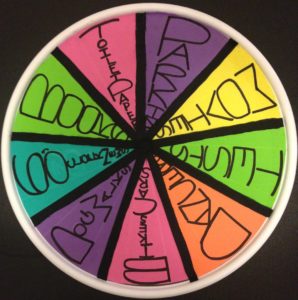
After having dinner with a boisterous group of women at a restaurant, I came across a swag table, sponsored by a local radio station. Since “free” is my price, I grabbed the only meaningful thing among a sea of junk: a book.

As I sped read the back copy, the guy working the table informed me that I had to spin the wheel and whatever it landed on, that was the swag I’d receive. Instead of looking at the wheel, I leveled my eyes at him and gave him a look that communicated, “I’m not going to spin your fucking wheel.”

I drew the book closer to my chest and protected it with the folding of my arms. In my best Southern-woman-bless-his-heart voice, I said, “But I want this book.”

Fortunately, this guy wasn’t in the mood to be a dick. He reached over, manipulated the wheel so that it appeared to have landed on “books,” and then he fake cheered and congratulated me on winning.

On the drive home, I wondered how often are people trying to force me to spin wheels that have nothing to do with the outcome of the situation?

Like the time while I taught at a prestigious private school in Mexico, our principal assigned the teachers’ parking because students had performed so poorly on a national standardized test. The result: A sharp increase in teachers arriving tardy. Most had only arrived early for a good parking space. The assigned parking vanished as quickly as it had begun. A few days afterward, some official discovered that the wrong answer key had been used and our students had actually performed quite well.

Now, it may be obvious that there’s no connection between designated teachers’ parking and standardized tests scores, but so many people in the US have been duped into believing that the way to close the achievement gap is by testing the hell out the students.

You know what makes teachers, districts, students and schools exemplary? Money! And plenty of it. With money comes smaller classroom sizes, better resources and richer experiences both inside and outside the classroom. It’s no coincidence that students in districts with the most money score higher on standardized tests nor is it merely an excuse to note that students in cash-poor districts struggle with passing standardized tests. The achievement gap is a direct reflection of the inequity of school funding, AKA the money gap. Why doesn’t anyone ever clamor to close that?

Or how about the everyday ridiculously illogical spinning wheel of how to hang the toilet paper? Some will argue the right way is where the toilet paper hangs over the roll because, not only is it more aesthetically pleasing, but it works better since to hang it the other way will cause it to spool uncontrollably on the floor.

After 11 years of living in developing countries where I never left home without my own toilet paper stash in my purse, had perfected how to hover over a toilet, a hole, a trench or behind foliage, I knew the most important aspect to toilet paper is having it. No matter how the paper is hung, it won’t be softer, more absorbent nor more tear-proof.

Here’s another everyday illogical argument: cars vs. bikes. This great city of ours tries to remedy the shared road conflict. Each side blames the other for being dangerous and inconsiderate. They paint a vivid picture of one another’s traffic violations when it comes to who has the right of way, bikes or cars. You know which side is right? Neither! Assholes can operate a car or bike. It doesn’t matter what the mode of transportation is. Remedy the assholes, solve the traffic problems.

Another type of vehicle is movies. Movies can transport us to another time and space, delivering racism along the way. First example: Back in the 70s when no one even dreamt of an “Oscars So White” movement, my older sisters, who were teenagers at the time, could legally take me to R-rated horror movies. Inevitably, while the maniacal killer was on the loose, the actors, who were all white, would stop to have sex. Or there’d be some lone white woman running in the woods or house and fall.

One of my sisters would scoff at such scenes and mutter something to the effect, “Look at those stupid white people! Always got to have sex or fall down instead getting away.”

Of course the only reason those cliché scenes existed wasn’t due to the stupidity of white people, but the low quality of the scripts and no minorities were hired to act in them. But as a child, I really thought white people would have sex anywhere, under any circumstances and couldn’t run well, thanks to those horror movies.

Second cinematic example: When I taught ESL in Seoul, South Korea, I had a new set of adult student classes every month. So, every month I told them a little about myself and par for the course, I’d get questions about my dreads, there was always one person who’d yell out, “Michael Jordan!” whenever I said that I’d graduated from Carolina, but in one class, I experienced this little gem: one student said to me, “You must be a good dancer.”

Intrigued, I asked him why. He replied, “In the movies, all the black people are good dancers.”

I smiled, again that dangerous Southern woman smile, and said, “You know why all the black people in movies dance so well?”

He shook his head and said no.

“Because they don’t hire the black people who can’t dance.” The whole class looked amazed at one another, nodding their heads in agreement. In that moment, a part of me was furious at them, but I had to remember myself.

Wasn’t I the little girl, who, when eating dinner with her family while the news was on TV, wondered where they got THOSE black people. You know the ones who didn’t speak proper English, didn’t own a comb or brush and were always witnessing or committing crimes.

Despite the fact that most of my family and extended family are black and a significant number of friends were black, we were different than those six o’clock news blacks. I don’t recall ever seeing positive six o’clock news blacks unless they were entertainers or famous athletes.

So, during my freshman year in college when a white coed complimented me by saying, “Teresa, you don’t talk like a black person,” perhaps she’d grown up watching the six o’clock news while eating dinner with her family too.

Now I don’t want to end on such a dismal note since other species have their illogical moments as well. I live in a very pet-friendly neighborhood. Once I passed a neighbor who was walking his dog. The dog was in the position, but it couldn’t shit because it was barking at me instead. I just laughed and said to the dog, “You can’t bark and shit at the same time.”

That’s the real message here: do your business and let the bullshit pass you by.

Fear of Being Swallowed, Ch. 4


1-group-shot-copy

The bustling streets of Kolspace were like a wonderful super-organism ready to swallow Rehema alive. This city’s rhythm was a cacophony.   The ancient labyrinthine stonewalls, which used to channel water, then later protect against enemy attacks now hustled people to and from the heart of the city.

Craig was right. She would’ve been mugged in a minute. Instead, she shared a taxi with him to his usual hotel. They could have negotiated the crowds much faster on foot, but he didn’t want to lose her in the confusion. The temperature inside the run-down taxi increased as if they’d entered a crucible. Although Rehema enjoyed the prolonged opportunity to look at the exotic vibrant-colored fabric, which the native women wore, and smell the sweet musty stench from the food vendors, she also longed for a cold shower and a breath of fresh air.

Rehema attempted to distinguish among the “tribes,” as Craig called them. Certainly, she’d blend in with her native-looking skin, but she’d been raised elsewhere. Her clothes and accent were dead giveaways.

A horrible thought suddenly sat on her head: she’d never been a foreigner before. For some stupid reason, she figured she’d returned to her gene pool and instinctively know what to do. As if her genetics would guide her.

“How long does it usually take you to trade gems?” Rehema asked, trying to mask her panic.

“Oh, the Montiers are a strange lot. Usually, they feed you and try to get you drunk before they conduct any serious business. If you can hold your liquor, then they’ll do business with you.”

“And if you can’t hold your liquor?”

“They’ll rob you.”

Rehema gasped.

“I’m joking. I negotiate on behalf of different clients who have particular gem interests. The Montiers try their damnedest to get me off track, though.”

“I bet you get a lot of requests for big diamonds.”

“Nope.” Craig reached into his leather backpack and pulled out a small black velvet bag. He tossed Rehema a sparkling, lavender, oval gem.

She held the gem with both hands although it would have easily fit into one. As she stroked it with her thumbs, a cooling sensation pulsed through her. Marveling at her interaction with the gem, Rehema held it closer to the window for inspection. Purple and cyan glints sparkled in the sunlight as a sense of well-being cascaded over her. She closed her eyes, smiling.

“Good, isn’t it?”

“Yeah,” Rehema said dreamily. “Is this an amethyst?”

“No, it’s a peace stone. Only Montier stones cause those feelings.”

“How much?”

Craig laughed. “That’s the problem with Montier stones—they’re addicting as hell! I doubt if you can afford that one. Tell you what: I’ll get you another one, lower quality, but it’ll still work pretty good.”

Reluctantly, Rehema handed over the stone, giving it a final, hard rub. Her heart sank as the taxi stopped at the hotel. The monstrosity looked like a fortress—not at all as romantic as she’d hoped.

“Ah, finally for fuck’s sake.” Craig wiped the sweat from his face and blew his nose in a handkerchief. “Nah, don’t bother. It’s on me.” He waved away Rehema’s attempt to pay. “I feel chivalrous today.”

As Craig checked them in, the clerk who obviously knew him, winked and said, “A double suite today, Mr. Ford?”

“Nah, one single and my usual suite.” The clerk raised both eyebrows in surprise, but said nothing.

Rehema looked around aimlessly until she met the determined gaze of a well-dressed predator with his fine silky shirt, linen pants and sharp eyes. She couldn’t break the spell until Craig asked, “Ready?”

He’d startled her, and then saw why. “Jonathan! I didn’t expect to see you here.” Craig crossed the dull, gray, marble floor of the lobby to shake hands and kiss the other man on the cheeks.

Rehema attempted to complete her hotel check-in, but the clerk had pulled a disappearing act. She uselessly clicked her fingernails on the marble counter, longing to escape to her hotel room.

Jonathan leaned in and whispered, “Introduce us,” while looking directly at Rehema.

Craig strode three quick steps over to Rehema and touched her shoulder, causing her to jump. “Sorry. What’s your last name?”

She nervously glanced at Jonathan who seemed obviously entertained. “Jones. Why?”

He grasped her elbow and escorted her closer to Jonathan. “Jonathan Montier, Rehema Jones.” Craig hated doing “shit like this,” but since Jonathan was his main trading partner, deemed it a necessary business evil.

“Pleasure to meet you,” Jonathan said. He brought the back of her sweaty hand to his mouth and kissed it.

Wide-eyed, Rehema thought, “I don’t believe this is happening.”

Jonathan flashed her a wry smile.   The thought, “Believe it,” struck her.

To Craig, he said, “Our meeting place has been changed due to circumstances beyond our control. A driver will pick you up at seven tonight.” Then he added, “Both of you.”

Having recovered a little composure, Rehema squeaked out a “thank you.”

The two men shook hands and embraced again. Then, Jonathan enclosed Rehema’s hand in both of his. “I look forward to seeing you tonight.”

Nervously, Rehema nodded and pressed a smile on her face.

Once Jonathan was out of earshot, Rehema turned to Craig and said, “I’m not going.”

“What? You’ve got to go!”

“I don’t know that guy!”

Craig rolled his eyes. “Most women in this town would kill to be invited to have dinner with him.”

“I. . . I don’t like being set up on blind dates,” Rehema added nervously.

“Look, just drink some booze. Do you have fancier outfit than that?” Craig gave her dark green T-shirt, jeans and Tevas the once over with disapproval.

“I had no reason to pack a fancier outfit than this.”

He huffed, “Don’t worry. I’ll get you something.”

“Where?” Rehema demanded.

Craig, irritated with his new matchmaking role, returned to the front desk where the clerk had miraculously reappeared. Rehema trailed behind him. “Nabu she needs a fancy outfit by six tonight.” He indicated, stabbing his thumb in Rehema’s direction behind him. Nabu nodded, sizing her up. “We’re having dinner at the Montier’s.”

This time, Nabu nodded knowingly.

“Christ, I hate mixing business with someone else’s pleasure!” Craig cursed under his breath.

Dipped My Big Toe

Twenty-fifteen was the year I unintentionally dipped my big toe into poverty. I didn’t attempt to be a poor, starving artist, but since necessity is the mother of invention, I reinvented myself many times, juggling jobs in this great circus act called the gig economy: editor, writer, tutor, adult basic education instructor, call center agent, insurance agent, spoken word and storytelling producer, painter. Everything I needed to be to exist in a financial niche.

I actually thought I’d make it as a freelance editor and writer, especially since I had some money saved up for the in between contract times. What I discovered, like being an entrepreneur, it’s harder than first blush.

Just before running out of money, I landed a part time job, teaching Adult Basic Education in the evenings. I absolutely loved being back in the classroom with the added benefits of motivated, adult students, my mornings free, very little lesson planning, virtually no grading, and a less than 10 minute commute.

I still had the fantasy of landing a freelance writing/editing job or going full time with the teaching gig. As months rolled by, neither happened. One way I responded to the financial reality of my underemployed situation was by reducing my grocery budget from $50 a week to $30.

The beauty of being a math teacher was that I understood chunking. For a grocery budget of $30, I’d buy 15 $2-items. If I knew I had to buy an item that cost more than $2, then I’d buy fewer than 15 items. I always celebrated the weeks when my grocery bill was under $25. Then, as far as math was concerned, I could buy up to $35 worth of groceries for the following week although I’d still only write 15 items on my list.

I had a list of weekly grocery lists on my phone. I never put more than three nonedible things on one list. So if I were running low on shampoo, conditioner, toothpaste and toilet paper, I’d have to make a decision about which three out of four things I’d buy. I became much better at portion control since using a little less of everything was better than having none of anything.

I applied that logic with edible things as well. Gone were the days of two-egg omelets when one egg would do. As a matter of fact, my cheap sources of protein became eggs and peanut butter. Not together, mind you. I embellished ramen noodles, a cheap carbohydrate, with a scrambled egg, fresh produce sautéed in toasted sesame oil, a toss of frozen peas, and a drizzle of sriacha. Of course, I’d only use half of that ramen noodle flavor packet because of how much sodium it contained.

In reality, all cheap foods are bad for you. What makes them so inexpensive is the low nutritional content. I’ve never read that correlation on any nutrition label. I just know it to be true. This country despises poor people and wants to help us shorten our lifespans through poor diet—among other things.

I’d buy most of my spices and grains in the bulk aisle. I clipped coupons and based my weekly meals on which grocery specials were available. I’d already had the habit of cooking one big meal a week and packing it up in Tupperware to take to work for lunch. Yet, the ante was upped since all my meals had to be rationed out. I marveled at how preoccupied with food I became. Even when I wasn’t actually hungry, I still thought about food.

I knew my rent would be paid, I still maintained my yoga membership since I could go in the mornings, but I stopped training capoeira. Part of the reason was the conflict of scheduling since most the classes were in the evenings when I worked and I was ageing out, but financially, it was another monetary sacrifice, especially since I could still practice some moves on my own at the fitness center in my apartment complex. Trips to get a mani/pedi fell by the wayside along with getting my car washed, dance classes, and thank goodness, I’ve never liked shopping.

Even shopping for costumes to host my show became a creative opportunity to see how economically I could make them. This pursuit was aided by some of my female students since we’d trade clothes among ourselves. I’d always maximize the costuming angle with every piece of clothing someone gave me, along with sacrificing clothes and material I’d had for years but hardly ever wore.

Anytime I started to throw a private pity party, I reminded myself that I other people, especially other women, have come back from much more extreme circumstances. I was merely a middle class, college-educated woman who was temporarily underemployed. I had students who couldn’t control the number of children they birthed. Students, who were employed, but lived out of their car because they had to make the decision between paying rent and maintaining a car. You see, a car will take you to a job, but an apartment won’t.

I had a student who’d be chronically hungry and had to leave class a little early in order to find a safe place to park her car so she could sleep in peace and still, she struggled with passing the English reading and writing tests. I always gave her the optimistic advice that with more reading practice, she’d eventually be successful. Yet, I suspected that chronic stress suppressed her academic achievement.

So, I know I’ve not sank as financially low as I could possibly go. There is no bottom limit. I’ve dipped my big toe into poverty. I’ll spend the rest of my life, avoiding a bigger plunge. This experience has helped confirm two ideas I’ve always thought: first, money does buy happiness when you have the right set of priorities; and secondly, poverty sucks!