Starting a new project is always exciting even if the medium is the same. Unlike continuing a set mold, one can branch out and grow from past experiences.
Case in point, my third and newest podcast, “Discovering the ‘T,'” has motivated me to try new things with the very first episode. I wanted to add more texture to the audio by adding background music. I also wanted to see if the music would mask the abrupt edits. It didn’t, but I also didn’t re-edit the episode.
This is part of my “learn from errors instead of dwelling on them to attain perfection.” I like the addition of background music, but I have to continue using techniques, like crossfades, to reduce the popping/glitching sounds caused by editing.
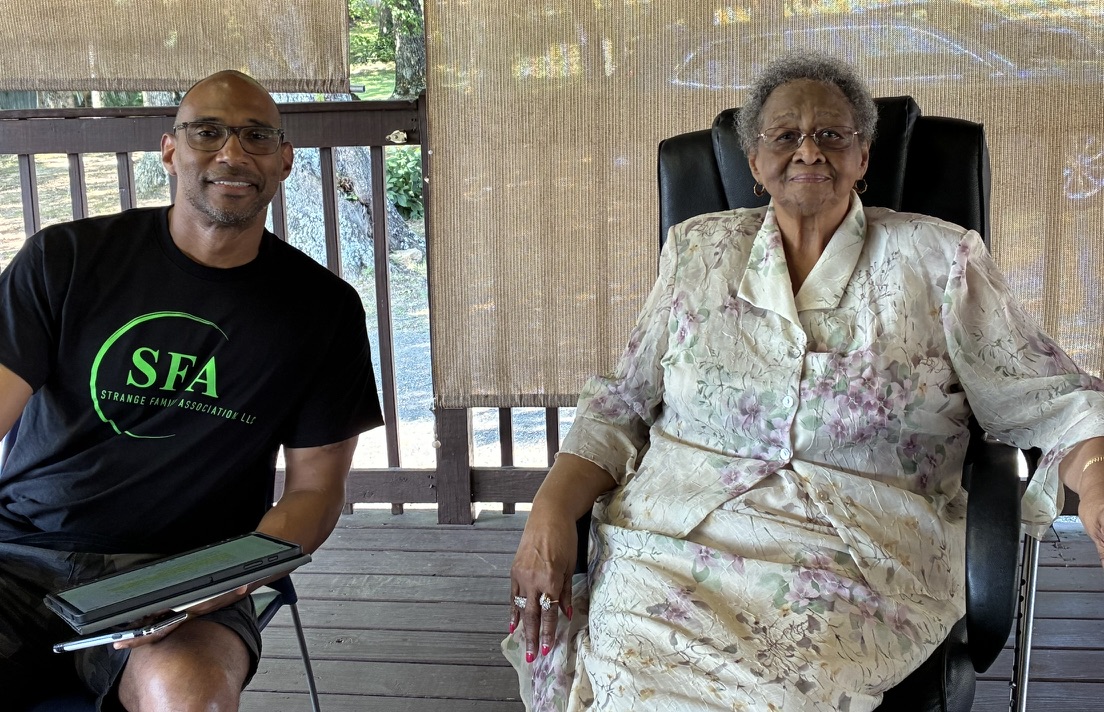
Another new thing I’m doing with this new podcast is following a thread. One of my aunts intrigued me about the variation of how our surname is spelled. This has already produced one episode, which sent me researching through my parents’ file cabinet for clues/answers to more questions, especially my father’s birth certificate, where his father’s surname appears as “Roberson” and Dad’s first name is spelled “Karl.”
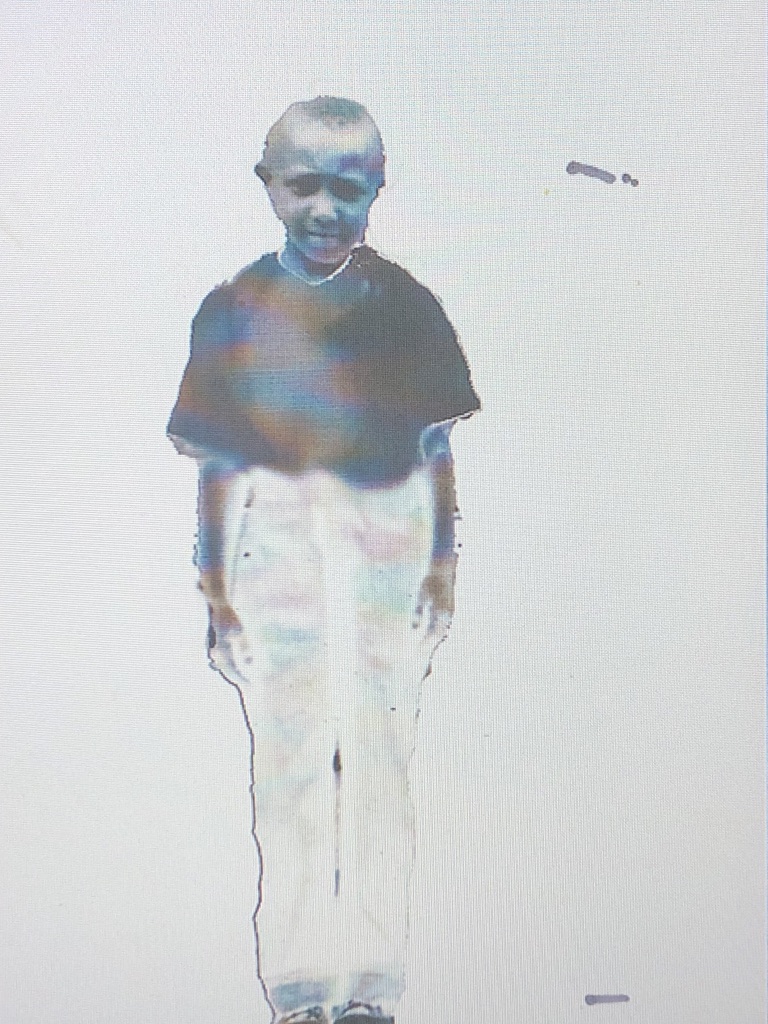
After that first episode dropped, one of my cousins texted me a picture of Dad when he was a junior in high school. Yet another spelling variation of his name appeared: Carl Robertson.
I then resumed my file cabinet search, mainly to pinpoint when my father switched from spelling his name “Carl Robertson” to “Karl Roberson.” The archaeological hunt through my parents’ lives via medical/home maintenance/insurance/military/funeral papers revealed how little I knew them as people.
Mom had done a fabulous job of squirreling away funeral programs, where one section gives a mini biography for the deceased. I took pictures along the way of all the interesting finds, not ever finding a copy of my parents’ marriage license.
I joked with Mom. “I think ya’ll have been lying to us for 65 years about being married.”
She assured me that she’d taken their marriage license with them back in 2019 when we vacationed on a family cruise. Plausible explanation since I hadn’t come across their recent passports either. Now, when I have another “researcher moment,” I’ll have to go through other drawers where Mom has squirreled away that information.
During this journey about both my aunt’s and father’s name variations, I uncovered not just a personal history of my relatives, but also the context of the times in which they lived.
For example, during the first episode, my aunt revealed that she was the last in our family to go to a one-room school. My father and all of his siblings were educated by dedicated teachers within a substandard system that deemed “separate but equal” was legal from 1896 until 1954, the year my youngest aunt was born.
That legal designation may have changed, but the attitude has persisted. Instead of the government separating citizens based on race, people segregated themselves. The proliferation of private religious schools provided the protective mask racial bigots with money sought to hide behind in order to separate their children from attending an integrated school.
When parents with the most resources withdrew their kids, public school was systematically left to languish with minimal funding. The one- or two-room school system may have ended, but not the disdain of educating Black students.
I marvel at how much people in my parents’ generation and earlier have achieved. That’s why it’s important to me to capture as much personal history from both sides of the family as possible. One thread at a time, weaving the fabric of our past together.
Whenever I juggle creative projects, inevitably, tech issues arise. The more ambitious I am, the more challenges rush in even faster. Over the years, I’ve learned that unless I have a firm deadline, I will embrace new technology in the mornings and set it aside in the evenings, so as not to interfere with a good night’s sleep. Unless it’s an emergency, which is not a button I push too often.
Whether the challenge isn’t having enough laptop storage because of too many videos or I can no longer update my blog because my version of WordPress is “outdated.” Surprising since the platform regularly updates automatically.
I am a continuing education student of YouTube videos and AI-generated solutions. As a last resort, I reach out to “customer service.” Speaking to a live human is almost a thing of the past. Not only are companies downsizing to shrink their overhead, but they are attempting a technological ol’ Jedi trick: you can empower yourself 24/7 with all the answers at your fingertips.
Once I’ve already tried virtual solutions, I don’t want yet another disembodied entity. At that point, I want to be connected with a person, so we can brainstorm together versus typing out my experience with an interweb bot.
I have spent many frustrating hours, spread over a few days, looping around the “advice” AI gave me. Finally, the planets aligned correctly and the voodoo worked, where I established an account that allowed me access to several commonly used professional office platforms.
When I couldn’t access my blog, which I’d been faithfully posting once a week since January 2011, I tried all of the options I understood before calling BlueHost. Shout out to BlueHost for still having live customer service people!
That rockstar agent resolved the issue within five glorious minutes. I didn’t have to wait on hold for a long time to be connected with her either. Usually I skip the “quick survey at the end,” but I gave her all fives as fast as my opposable thumbs could, then continued with the rest of my life.
Until the next tech issue that’s just waiting in the wings to jump out at me like a B-movie horror villian.
I started my first podcast in 2020, interviewing ten friends about their experience with CBD. Inspired by the conversation, I’d write a summary in the form of a poem. I called my inaugural podcast “CBD & Poetry.”
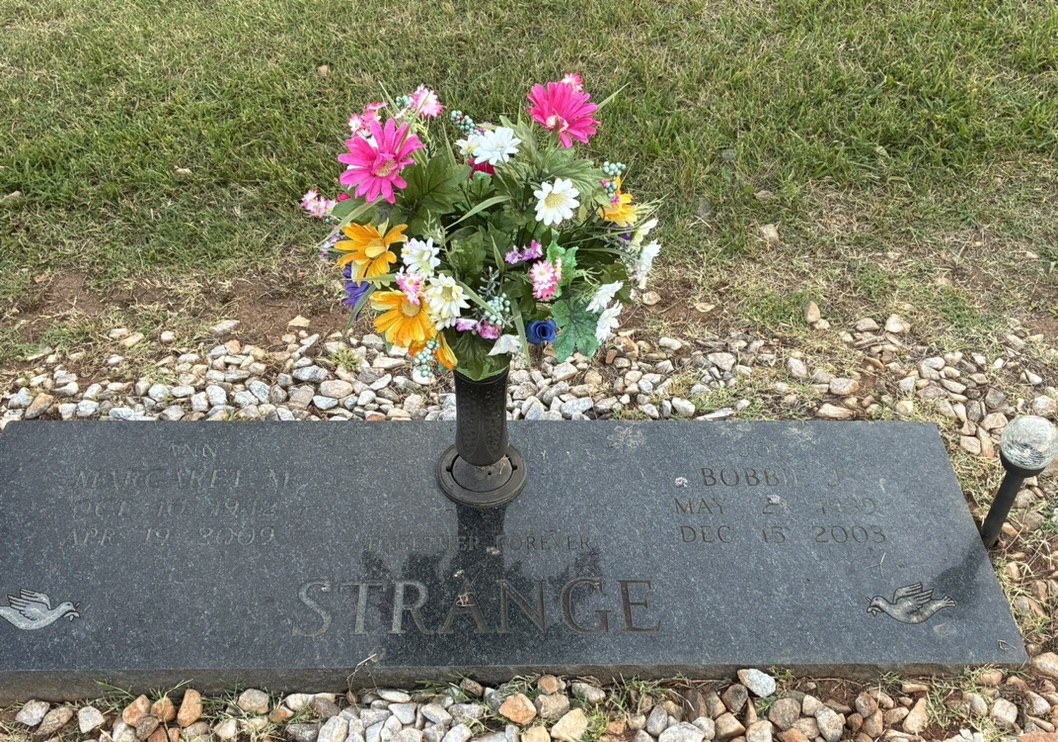
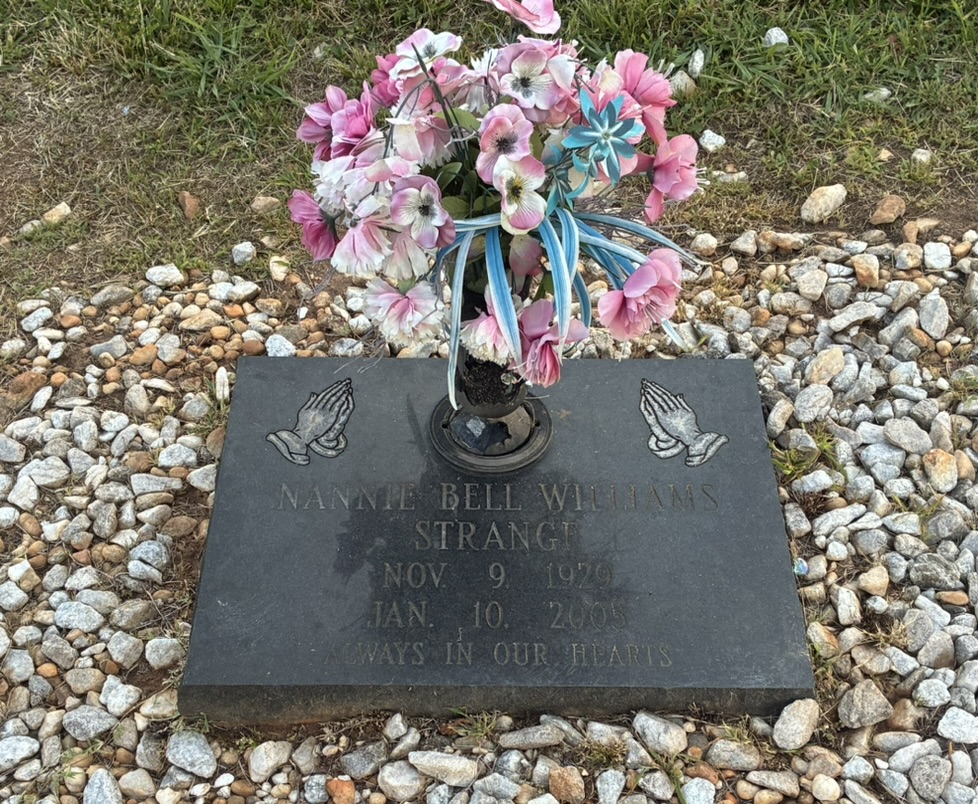
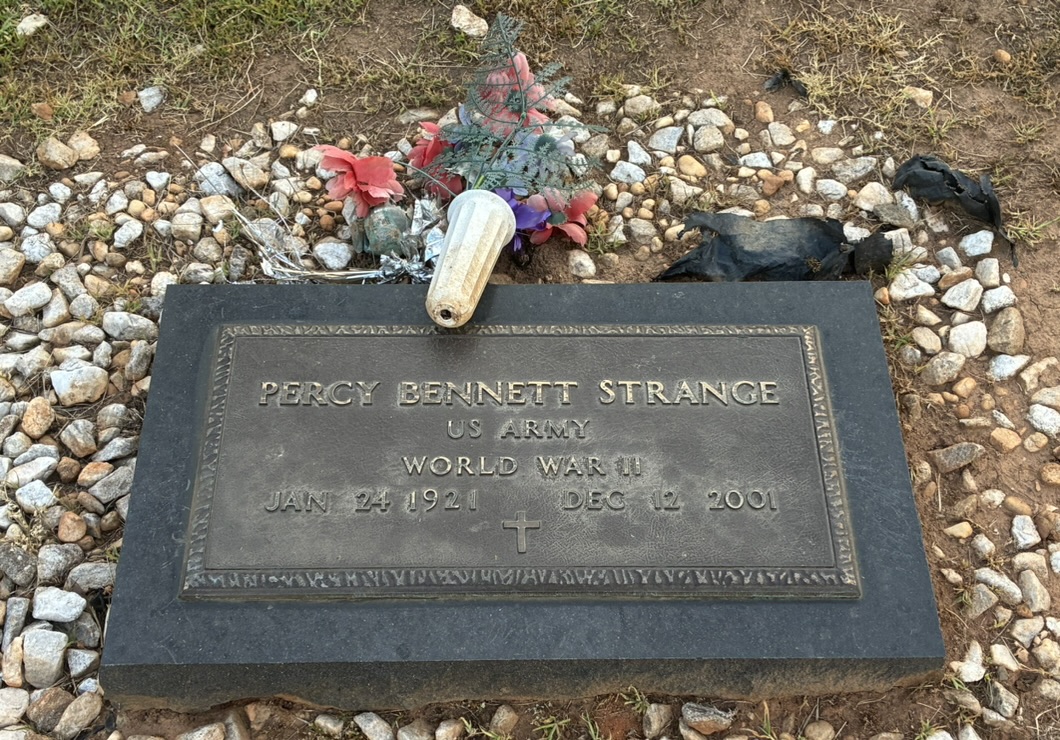
Although I only conducted ten interviews, the experience led me to launch a more meaningful podcast where I interviewed descendants of my maternal great grandfather, Jesse Strange. Unlike my first podcast, I didn’t plan to start “Strange Family Folklore.”
During my usual Saturday morning phone call with Mom, the conversation turned to family history. I felt energized by the information. Since I was driving at the time, I couldn’t jot down notes.
What I didn’t realize at the time was that I could have recorded the call. Instead, once I got home, I had a Zoom call with Mom and I recorded our conversation.
Those were the humble days where I thought in order to do a podcast that I needed two pricey microphones for in-person interviews. While it’s always a good thing to capture the best quality sound, I’ve not allowed the lack of the best equipment stop me from getting things done. More often than not, I conduct interviews via Zoom or simply recording an in-person conversation with my phone.
Fast forward six years and 30-odd episodes later, I had another intriguing, brief conversation with one of my aunts on Dad’s side of the family.
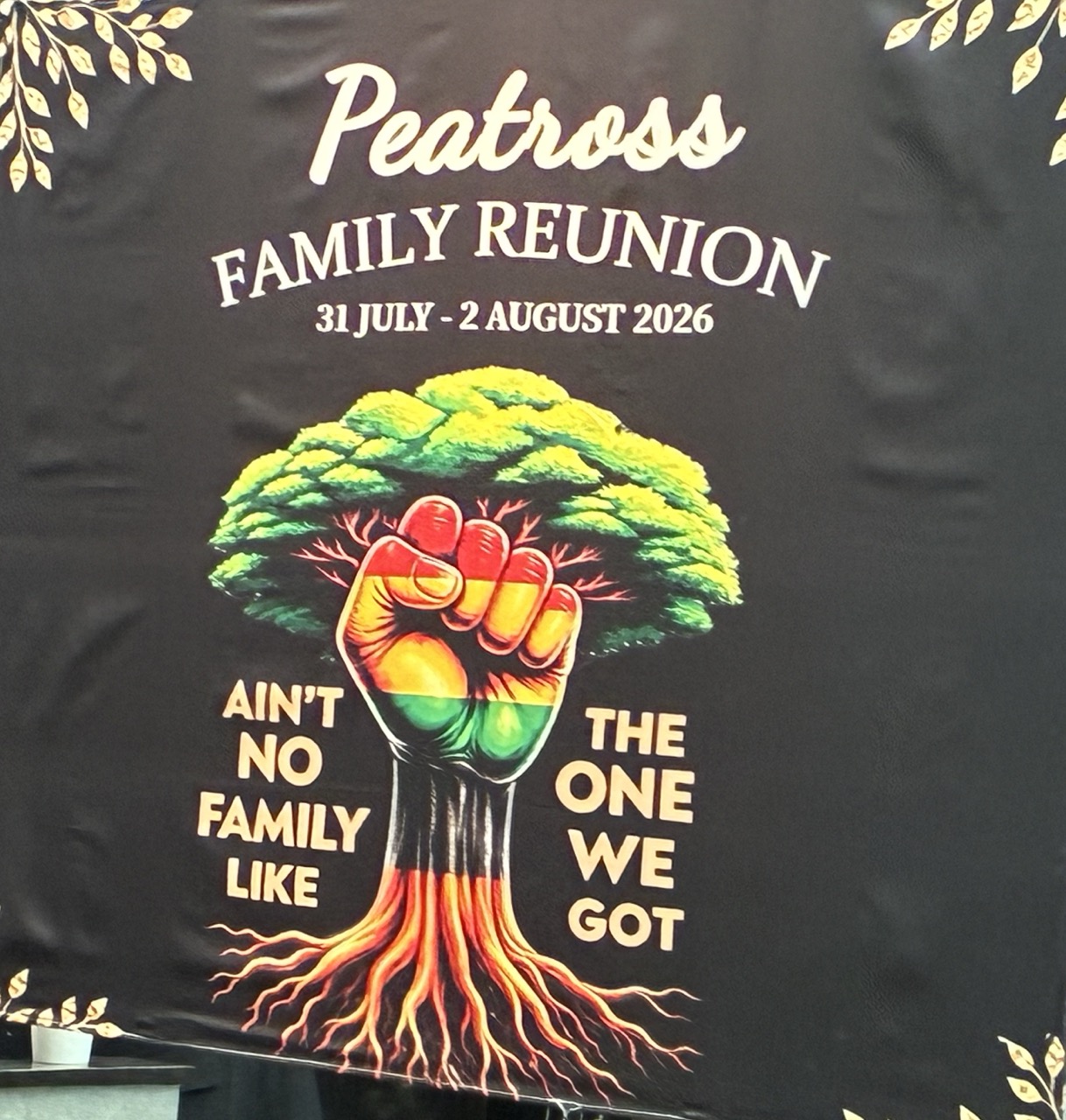
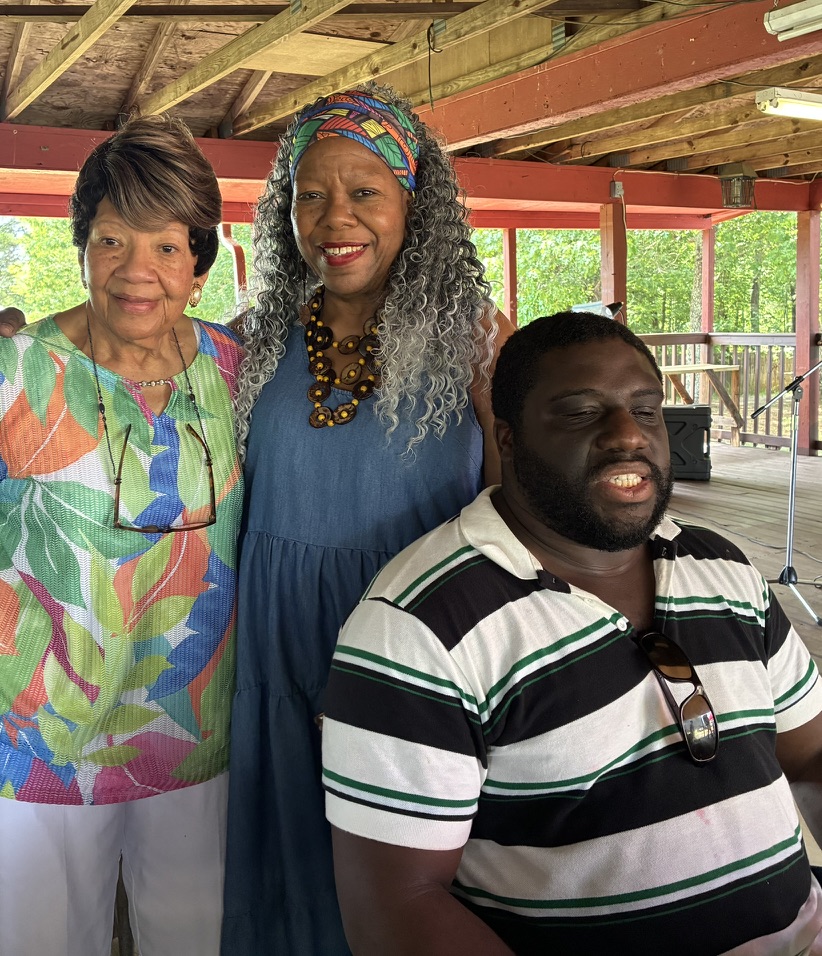
Unlike Mom’s extended family who’ve had 85 consecutive reunions, Dad’s extended family have rarely united, which is unfortunate because we always have a good time when we get together. As a matter of fact, we had such a good time on the first evening during our most recent reunion that some random guy at the hotel joined in with my male cousins, drinking and playing chess.
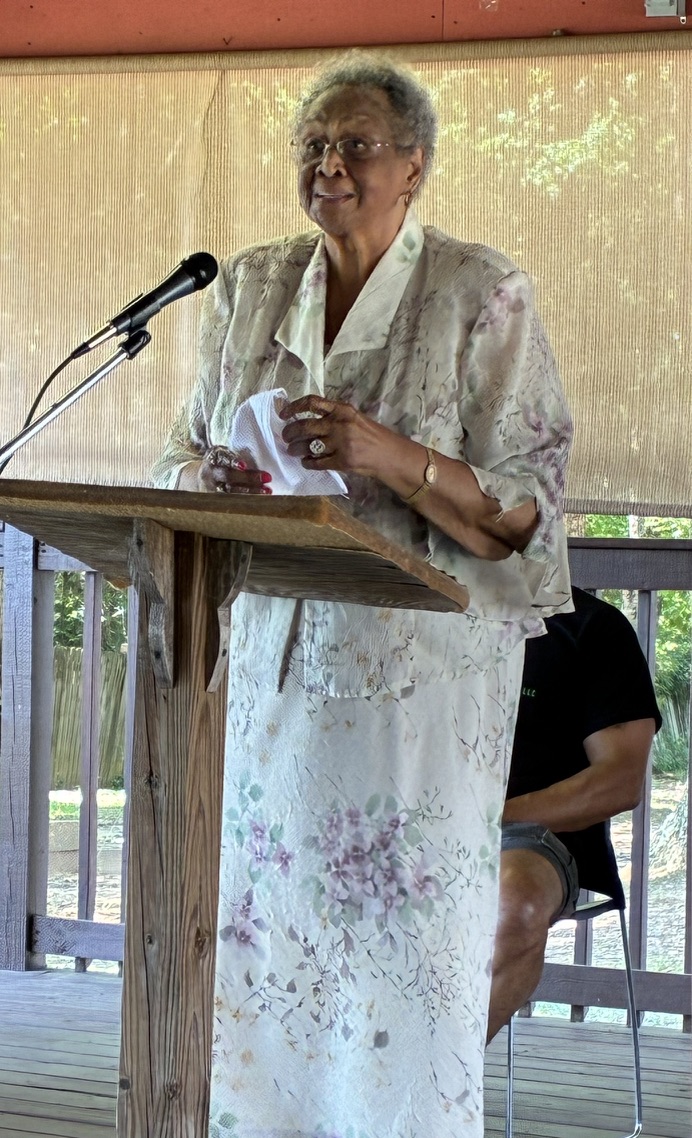
On the second evening during our hotel-catered dinner, my cousin invited a spokesperson from each table to introduce ourselves and answer a question or two. Of course, my table elected me as spokesperson.
Not only did I answer two questions, but I requested that people write down as much of our family tree as they knew. I received four family trees, which came from two-thirds of the tables. Not a bad start.
I immediately noticed that my aunt had spelled her son’s surname as R-O-B-E-R-T-S-O-N instead of the way the rest of us spelled our surnames: R-O-B-E-R-S-O-N. When I questioned if she’d inadvertently misspelled his last name, my aunt smiled and said there was a long story involved.
I decided on the spot that her explanation of that surname variation would be the subject of my first episode for Dad’s side of the family. Didn’t take long for me to come up with the podcast name either: “Discovering the T.”
People commonly say, “spill the tea,” to mean telling the truth about something, which I’m going to task Dad’s side of the family to do. I’m already in post production for my first episode with my aunt. My fondest wish is that other family members who hear that episode will be motivated to reach out to be interviewed. It’s long overdue for this side of the family to start recording our history for preservation purposes.
Whenever I use precious paid time off (PTO), I make the most out of the day, like a quintessential Virgo. Since I’d taken a Friday off to attend Dad’s family reunion, I’d scheduled to get my car inspected at 8:15 AM. Plenty of time for the mechanics to perform a state inspection, then I could go grocery shopping before returning home to hit the road with my family.
That whole plan must’ve made the devil smile.
As usual, I had a backpack with my laptop and iPad to work on a few creative projects as I waited. The silver lining was having PLENTY of time to get a lot of things done. Even my concierge smiled as she broke the news to me: “Things can never be simple, can it?”
From there, she informed me that my car wouldn’t pass inspection unless they put four new tires on. In addition, they didn’t have the tires in stock, but could get them from someplace down the road within 15 minutes. My concierge knew that I’d planned to go out of town that morning and she worked hard to have everything ready by lunch time, a mere three hours later than I’d expected. At least everyone was ready to go by the time I arrived home.
Mom drove the first leg of the trip and my sister drove the last leg with me playing navigator while riding shotgun the entire way. We made good time until we hit the hotel lobby. A long line awaited.
Apparently, the hotel computers were down globally. Instead, they used analog technology, resulting in guests reporting to occupied rooms.
Our reservations for two rooms under my sister’s and mother’s names, magically turned into reservations under mom’s and my name. Despite the fact that our names appeared in two separate places, the room numbers were the same: 340.
At least the four of us shared a suite. A small consolation, but I had been looking forward to having a break from my nephew. Our temperament clash makes seeing one another during the holidays and other rare occasions ideal. Given our current long-term living arrangement, we’d already banked an entire lifetime’s worth of “holiday time” together.
By the time we returned downstairs, the extended family were in the throes of BINGO and I was hangry. Rarely do I eat dinner past 8 PM. Fortunately, the kitchen was still open. I enjoyed a cabbage-based Asian salad with sauteed shrimp. Only after I’d inhaled most of the dish did I remember the growing outbreak of explosive diarrhea linked to salad. But that was just iceberg lettuce, right?
Next morning, Mom, my sister and I went down for breakfast. Of course my nephew had slow-assed around, so we left him behind. Not to worry, finding his way to food was definitely one of his top three skills.
As we checked in for breakfast, the surname associated with our room number was incorrect. We informed the hotel employee of our last name and how many of us were in the suite. Too bad I hadn’t noted the name that she’d had on the printout because, later on, I couldn’t access Wi-Fi, given my surname and room number.
Nonetheless, we enjoyed breakfast, complete with reacquainting ourselves with relatives and in-laws. The last reunion on this side of the family was in 2017, which I hadn’t attended. Unlike previous reunions, I was far more determined to play an active role in documenting our history, thanks to the organization and longevity of Mom’s family reunions.
We reconvened after breakfast around 9:45 to load up on a tour bus, headed for DC. Before we exited the hotel parking lot, our bus driver, who doubled as the tour guide, started his informative talk.
A vast fountain of information, the tour guide/driver overflowed with historical narratives, jokes, facts, and stats all the while navigating expertly through highway traffic and narrow DC streets.
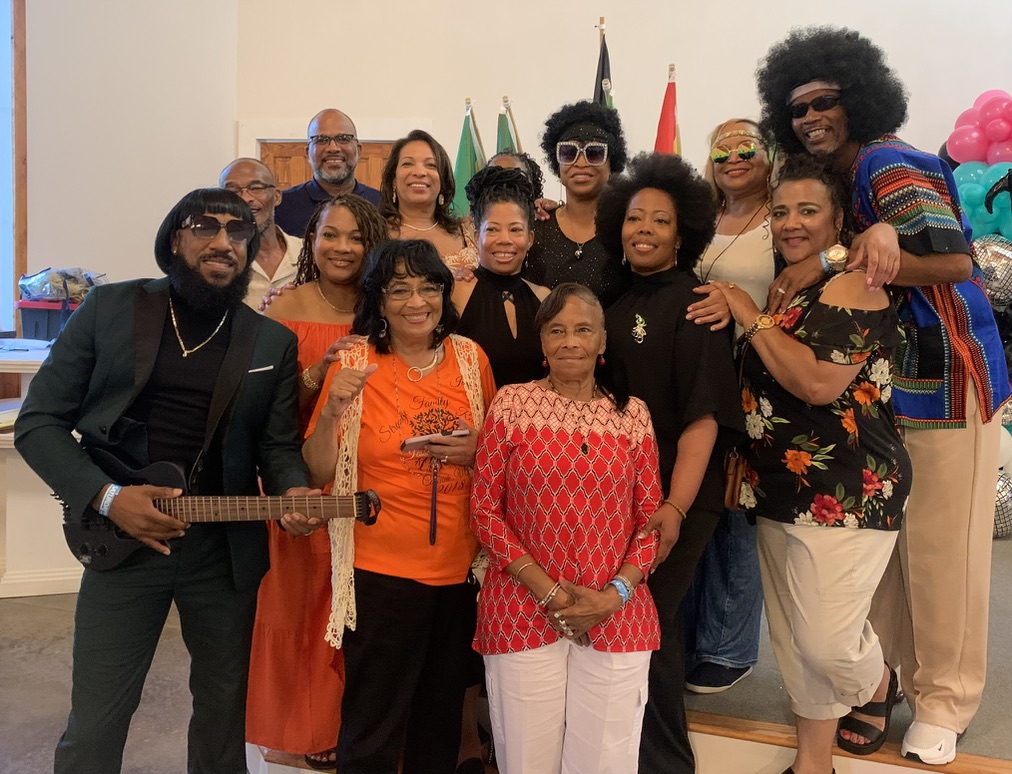
Our first stop was at the MLK carving where we took a series of group family photos. Then, we loaded back on the bus and dropped off family members who’d already purchased their tickets for the African American Museum.
The rest of us remained on the bus to eat a cold cut six-inch sub lunch while continuing our bus tour of historical sites. Normally, I would have busy-bodied myself with taking pictures and jotting down notes, but a professional photographer alleviated me of all that, so I truly enjoyed taking in the sights.
Hours later, we collected family members from the African American Museum and went to a reasonably priced and well-stocked souvenir shop that also had clean bathrooms. Technically, there was a bathroom stall on the bus, but we were also on the bus.
Everyone in my suite napped except for me. I relaxed by working on my digital illustrations while watching TV, then taking a shower.
We all changed into “cocktail attire,” a phrase that I defined for the fashionably confused as “dressy casual.”
We were among the first to arrive in the hotel banquet room. The DJ had already begun his first set of the evening. The hotel caterers put the final touches of the buffet together.
My cousin, who was the head organizer of the reunion and emcee, made some opening remarks, introducing the live saxophonist who started his set. Later, a kid-friendly comedian did nearly an hour long set, and throughout the event, there were raffle drawings. As has been scientifically proven many times, I didn’t win anything. One of my nieces won twice and one of my sisters won a gift card.
At one point, the emcee asked for one person at each round table to come up and answer a question from a list on the table. My family voluntold me to be the spokesperson.
I introduced myself. “Good evening. I am Teresa Roberson, the third and best daughter of Karl and Velma Roberson.” After making other humorous remarks I stated that I’d answer two questions, one from each list of questions found at our table.
For the family recipe that should be passed down, we voted that would be Mom’s potato salad, which was so delicious, whether she made the regular or vegan version.
For the second question about what I’d like for the younger generations to know about our family, I turned my “answer” into a call to action. I held up the half piece of paper that the questions were written on. “I’d like for the younger generation to know our family tree. So, my ask is for at least one person at each table to write down as much of the family tree on the back of this paper.”
I added that I know that no one would outright lie to my face, but if they waited until they returned home to jot down a family tree, they probably wouldn’t do it. I asked them to do it before leaving the banquet.
Out of six large round tables, I received four family trees. A wonderful turnout, given the fact that the organizer/emcee had already started an electronic effort, which she invited me to add to.
One of my aunts, who was also voluntold to be a table spokesperson, handed me her written family tree. She’d written her son’s last name, which should have been the same as mine, with a “t.” When I questioned her about the spelling variation, she told me that there was a long story behind the “t” being dropped from our surname.
In that moment, I knew that I’d start a podcast series for this side of the family, called “Discovering the ‘T’.” I’d started “Strange Family Folklore” in 2020 for Mom’s side of the family to capture that history. Now, I needed to capture Dad’s side of the family.
Proving once again, I can never wait to complete all the other creative projects I have going on before beginning a new one. In the spirit of striking the iron while it’s hot, I have to capture as much as I can before it’s too late.
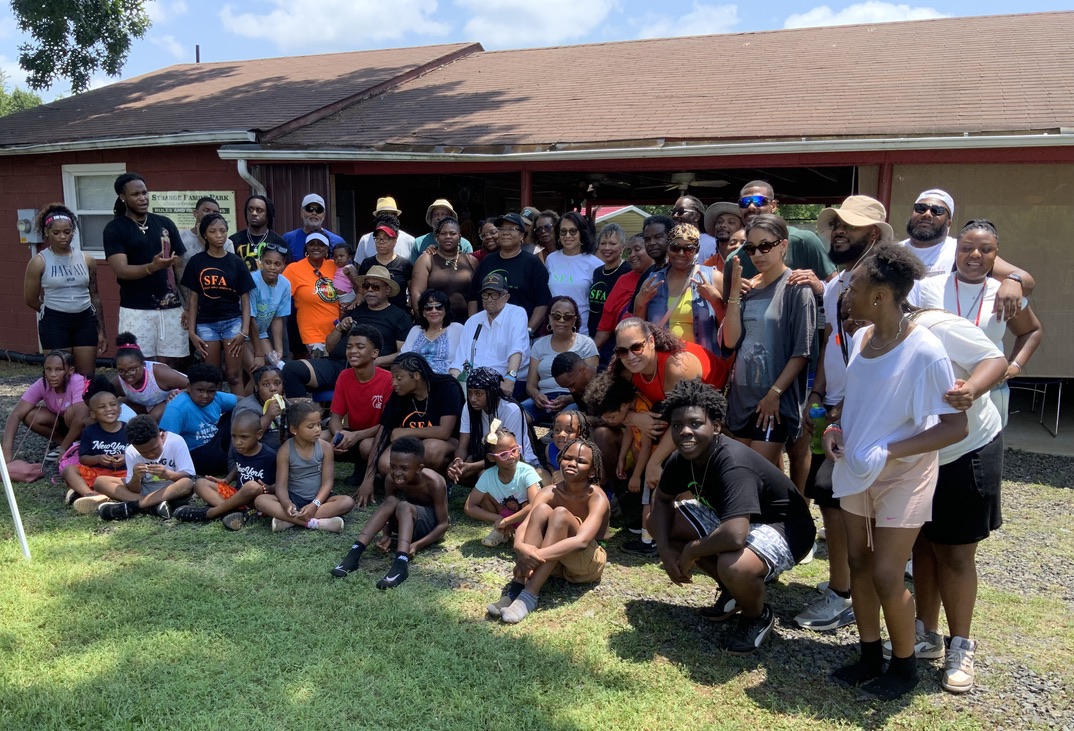
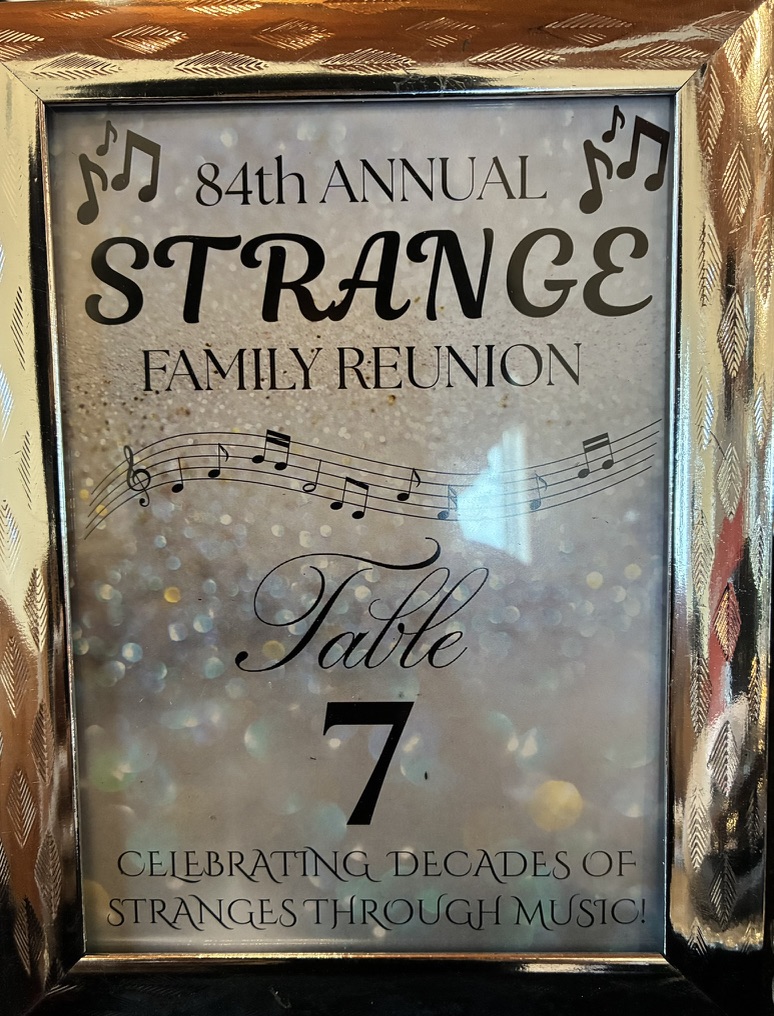
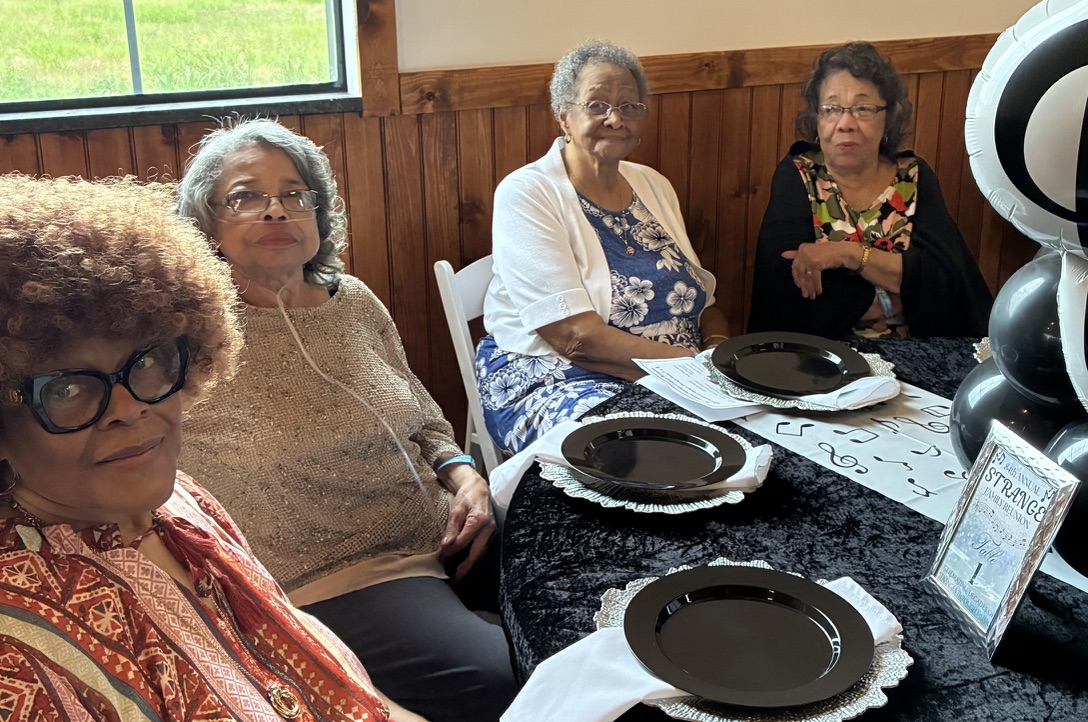
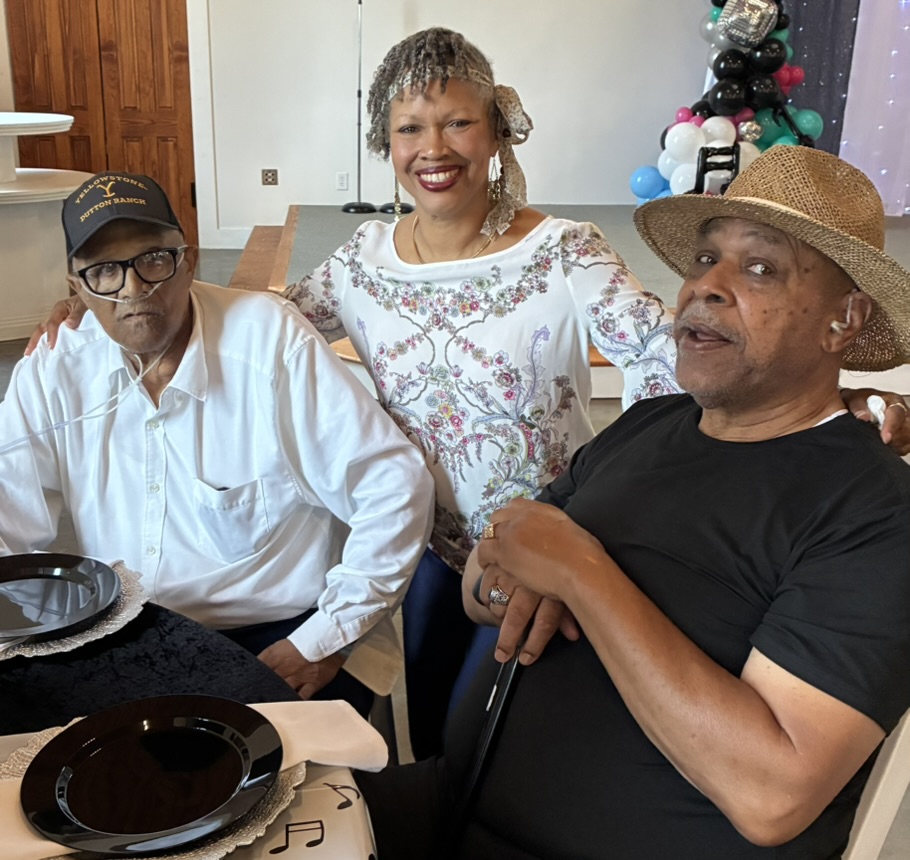
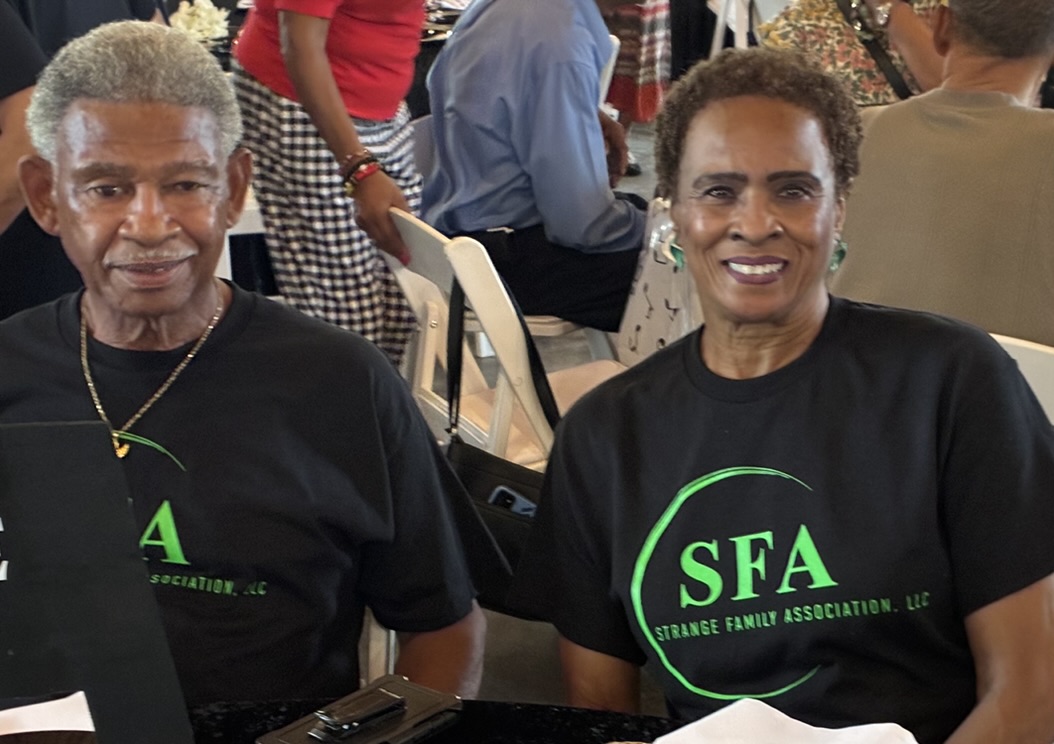
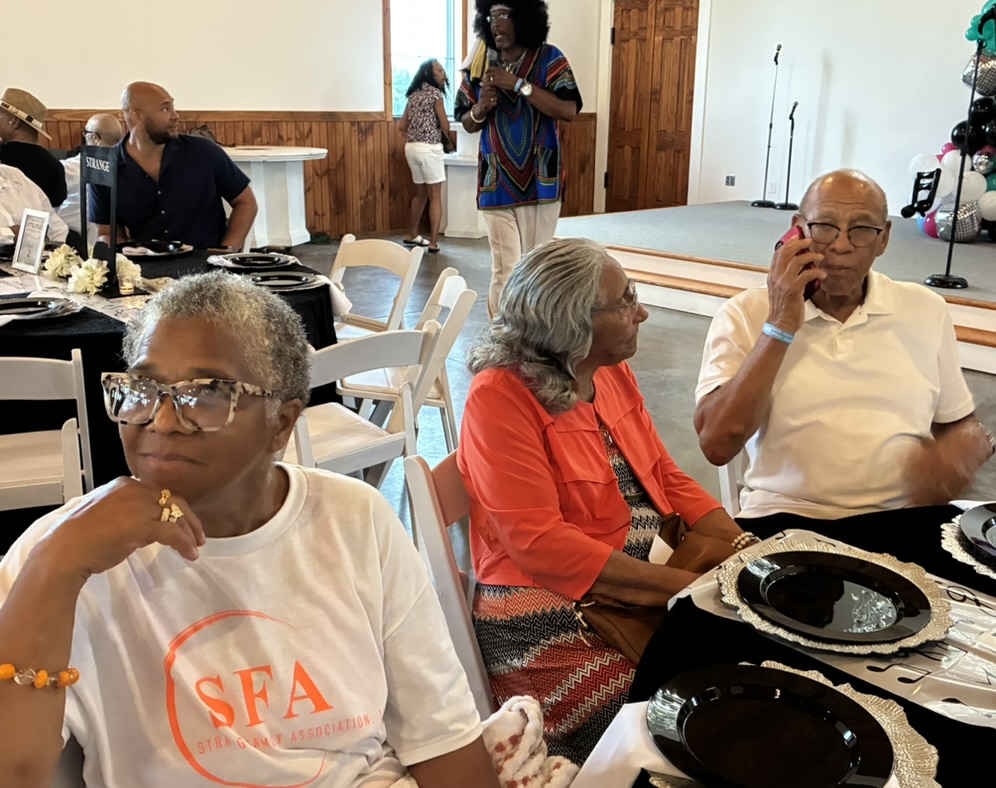
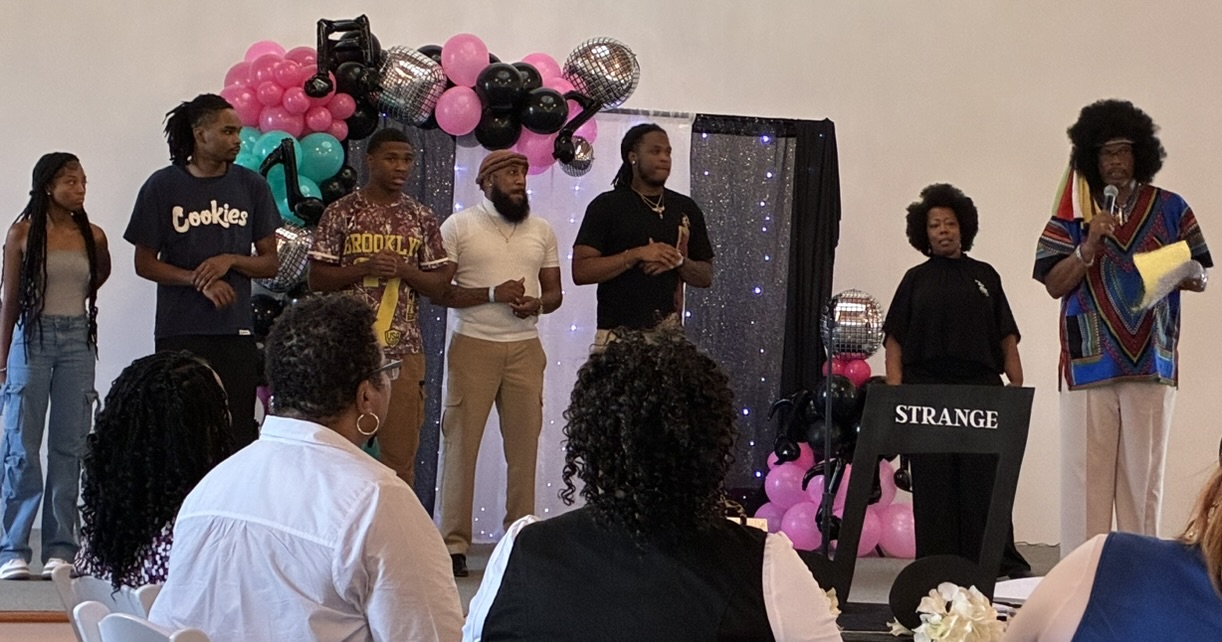
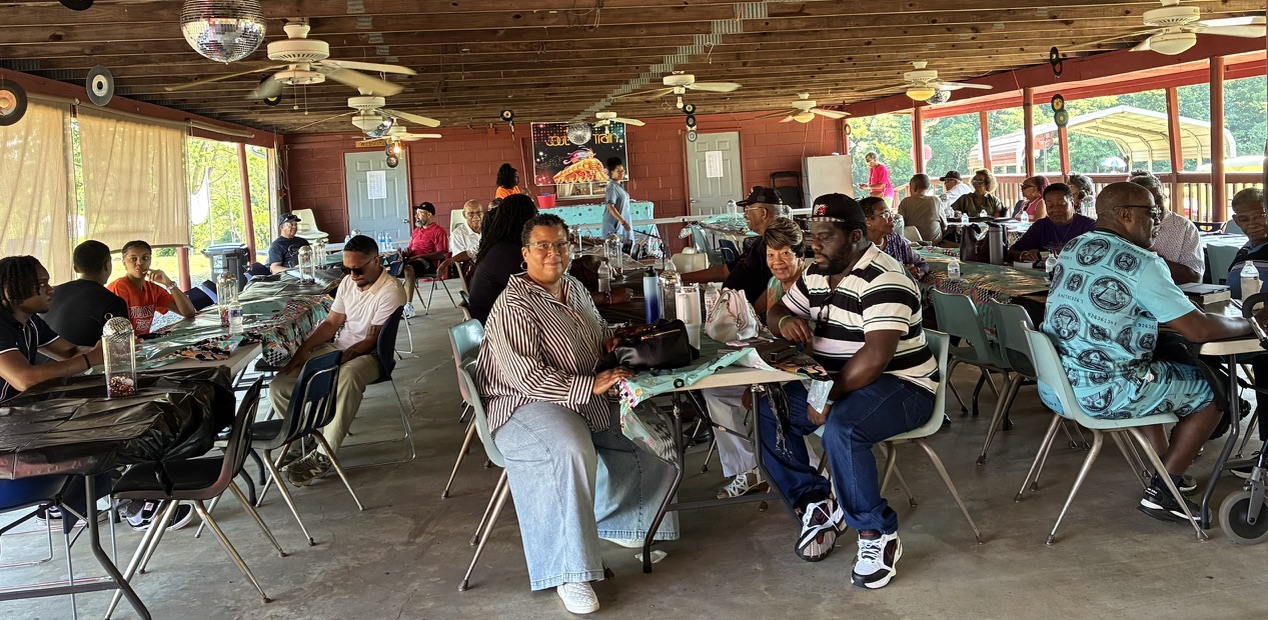
For our 84th consecutive Strange Family Reunion, we had some brand-new activities along with improvements on classic activities, making this year’s gathering fresh for everyone.
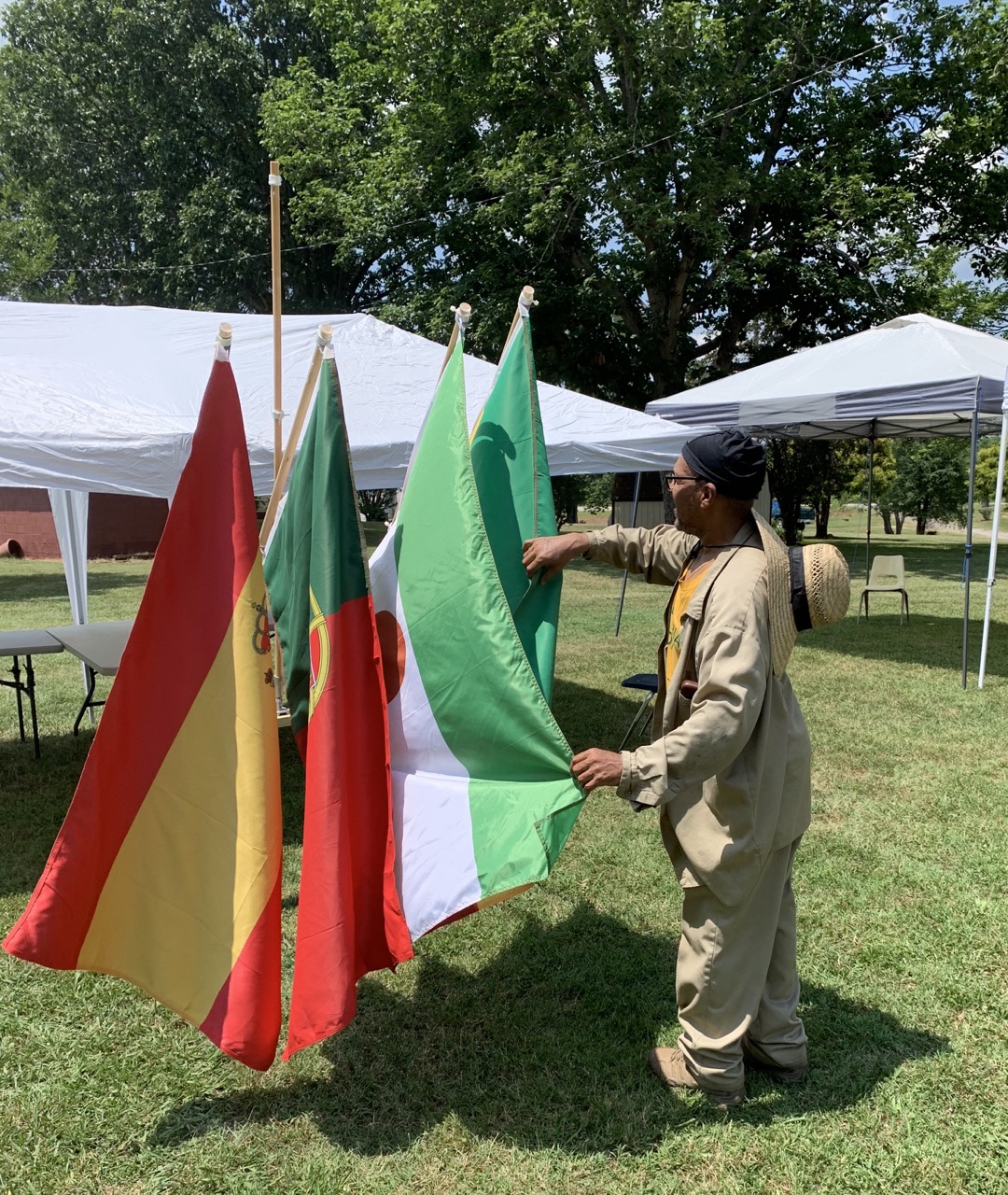
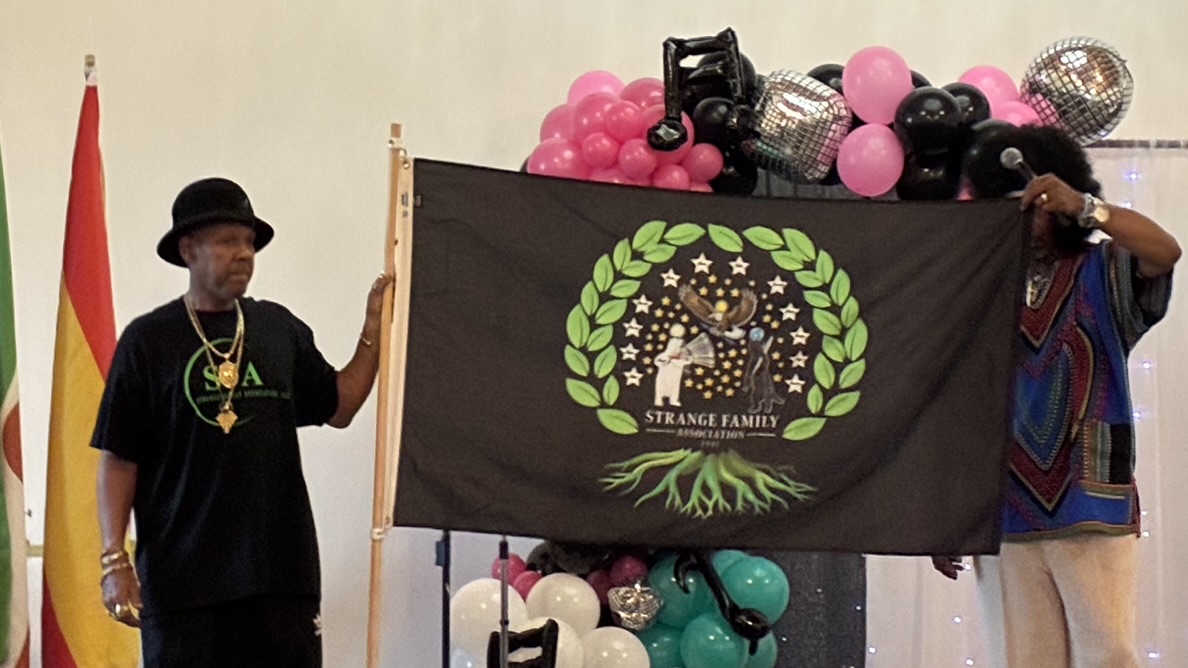
One of our continuing traditions was the flag display. The Ghanaian flag represented part of the story of where our family DNA came from. As a matter of fact, that was one of the reasons nine of us visited Ghana for two weeks.
In recent years, we have incorporated a reunion theme.
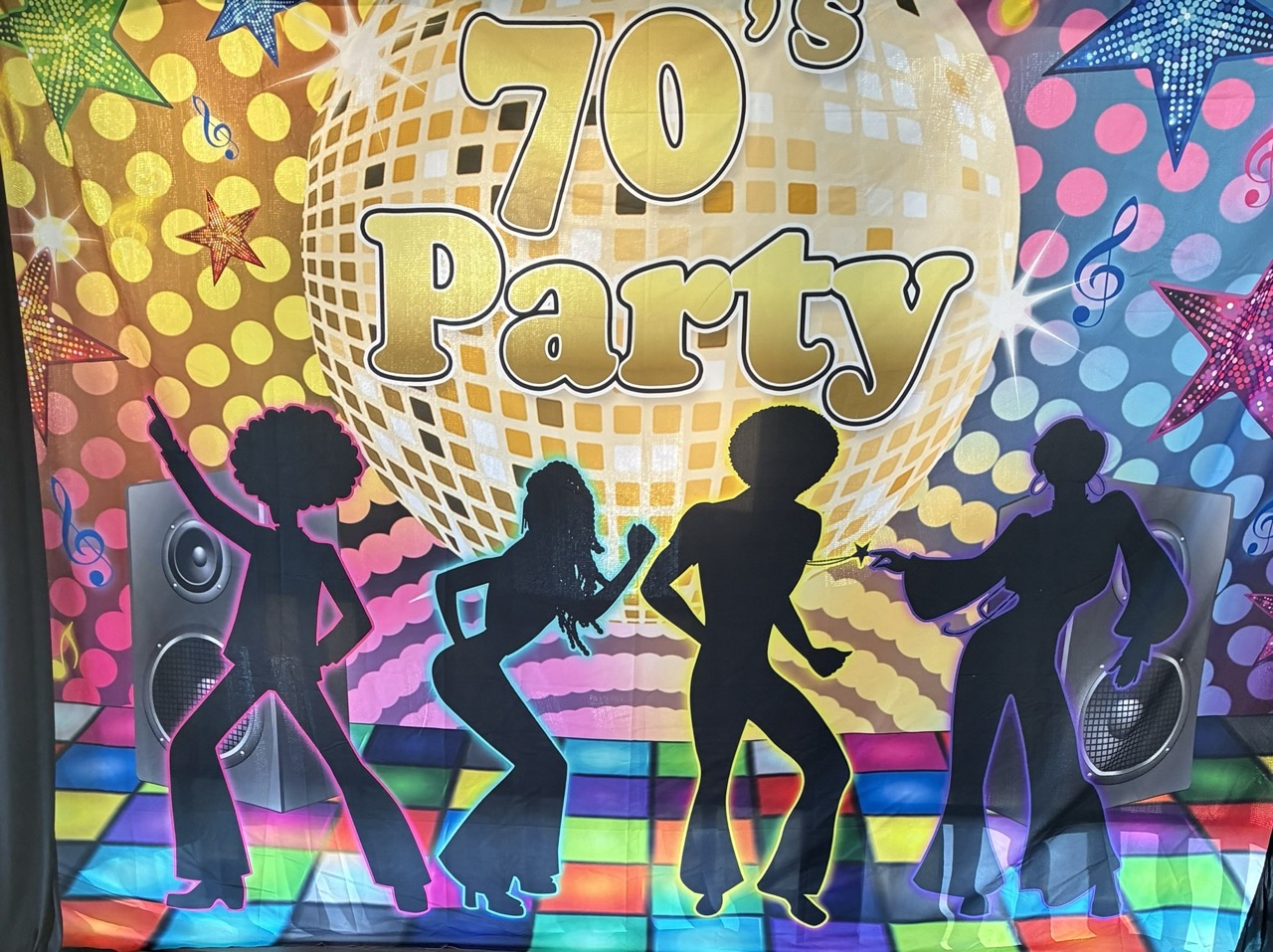
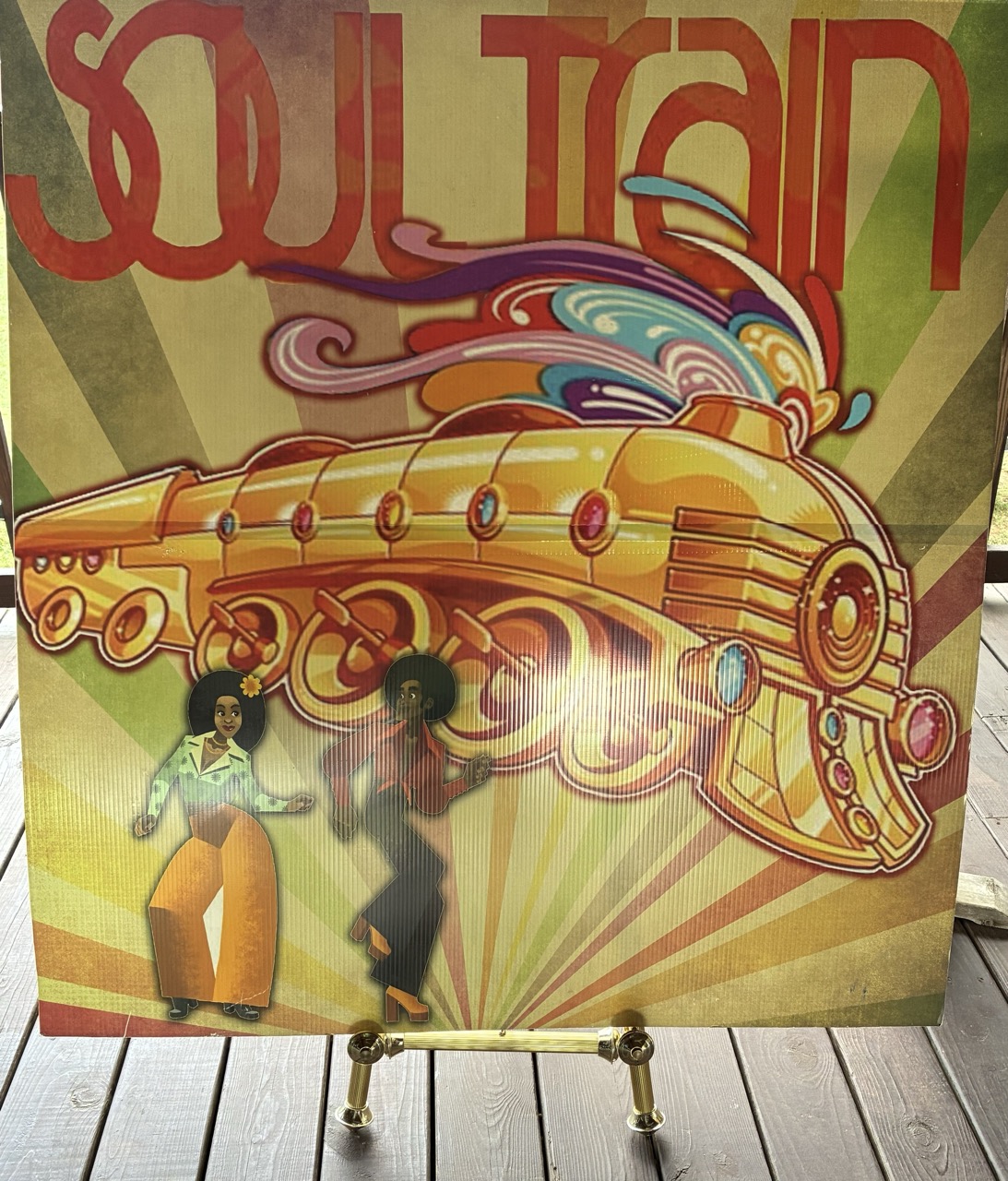
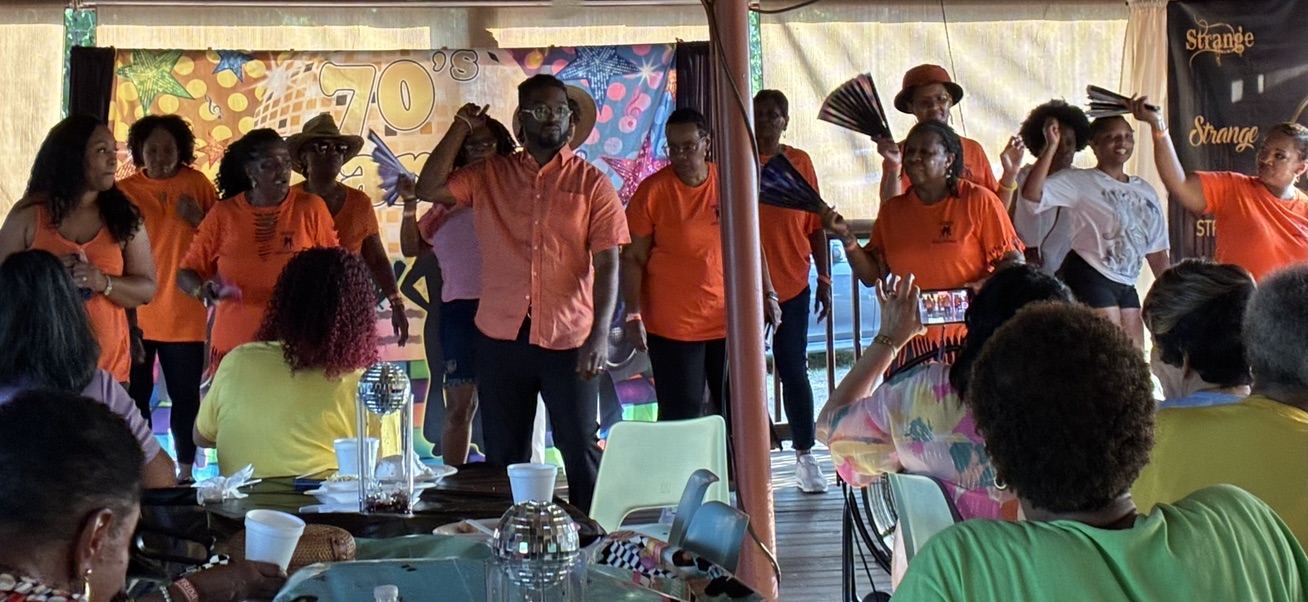
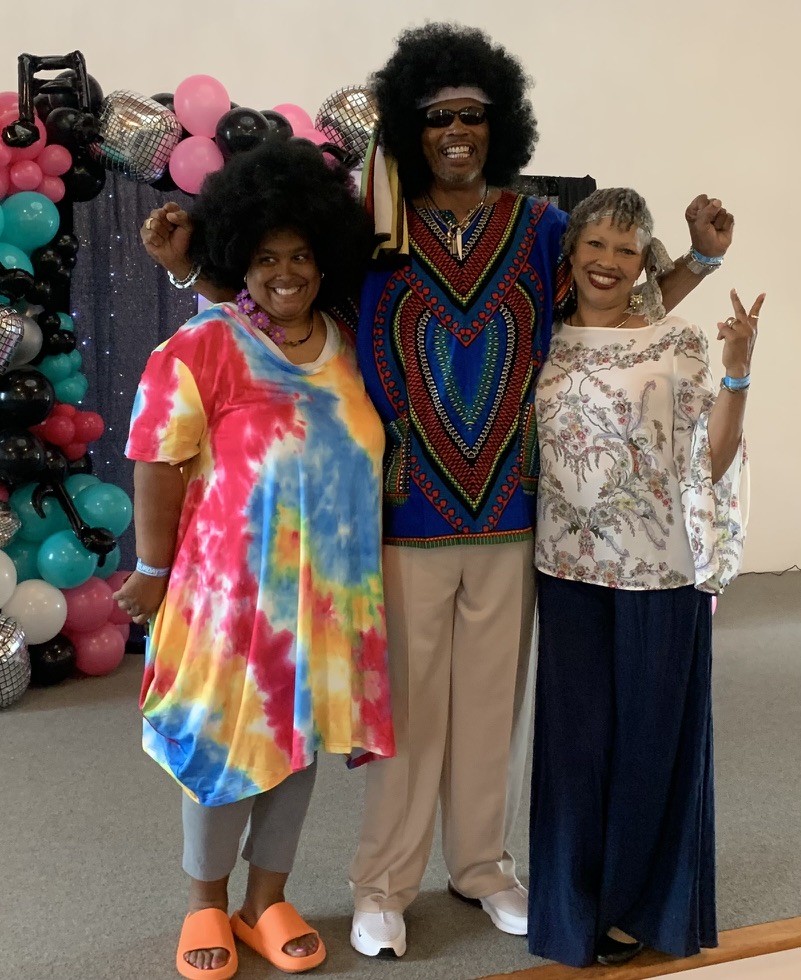
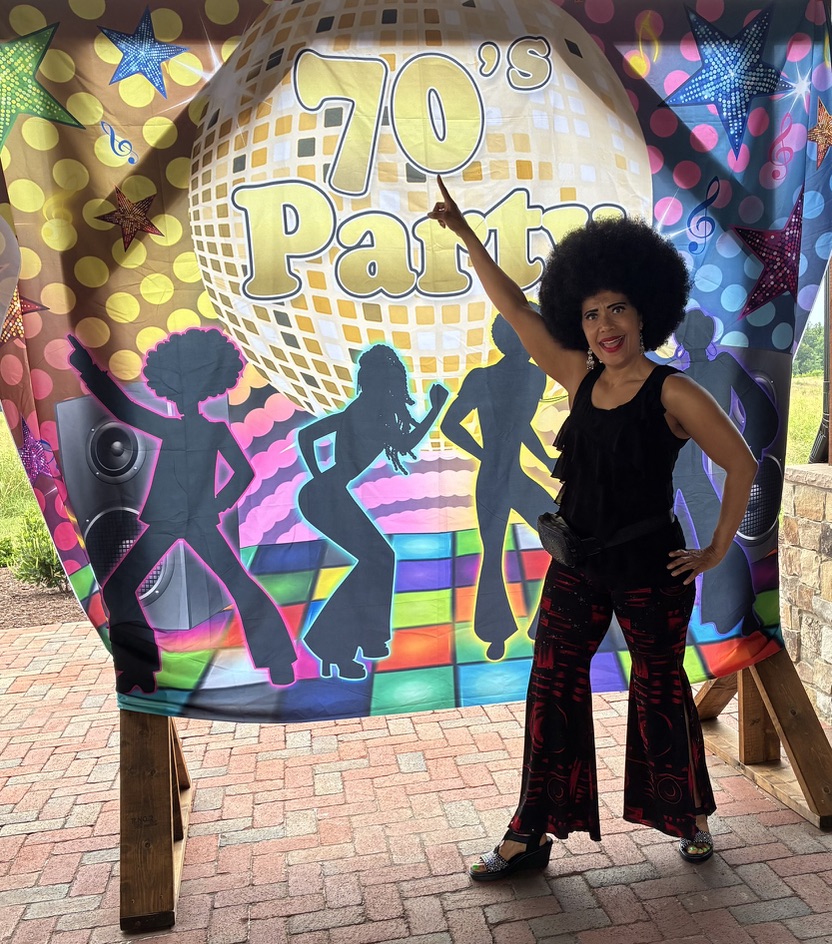
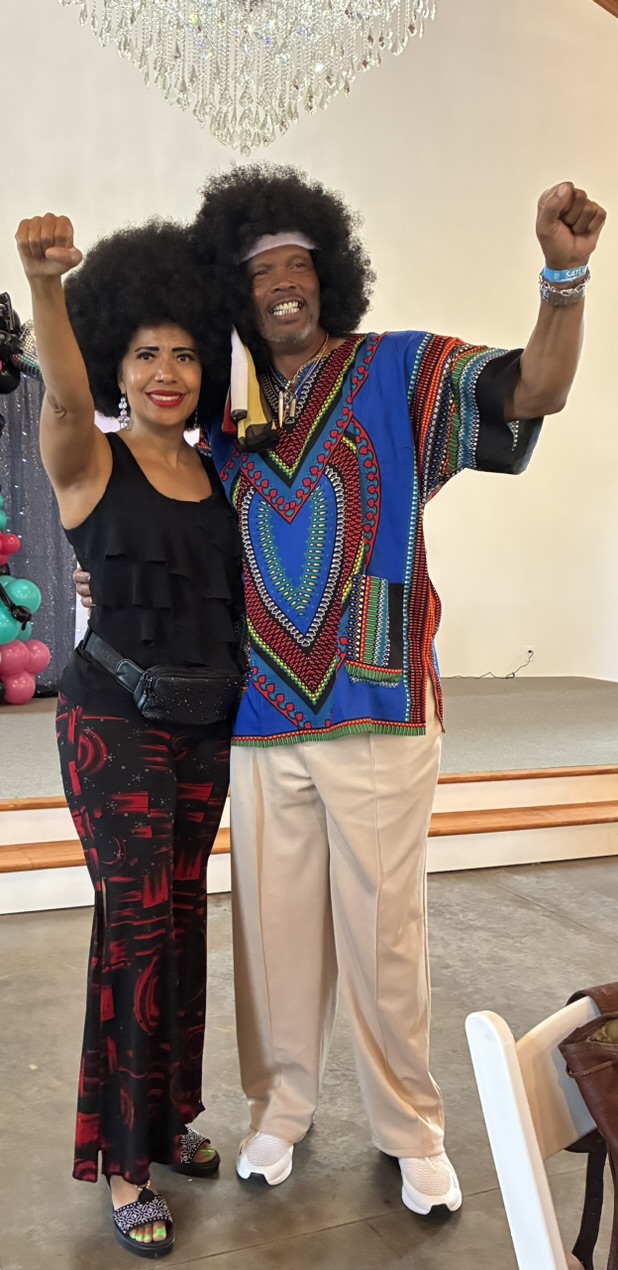
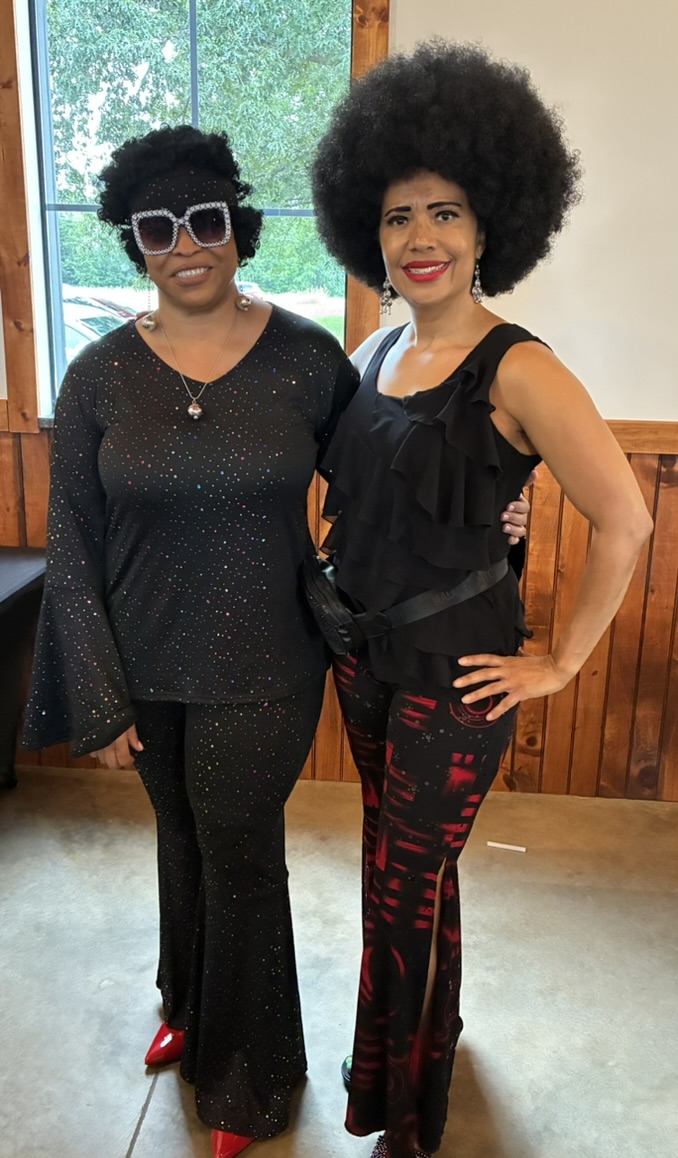
This year’s reunion theme was the 70s and Soul Train.
On Friday, along with our usual fish fry, one of my cousins had invited her line-dancing group to perform. Her purpose was twofold: entertainment and education. She shared that her line-dancing class was a wonderful way to stay in shape and socialize. Another dancer was a member of the medical field and told us some facts about the link between exercise and good health.
One of the needles we thread at our reunions is hosting a variety of activities for different age groups, especially for younger relatives and the young at heart. There was a field day (balloon toss, basketball, volleyball, cornhole, dodgeball) for the kids on Saturday morning while I interviewed 21 Jesse Strange descendants for my podcast, Strange Family Folklore.
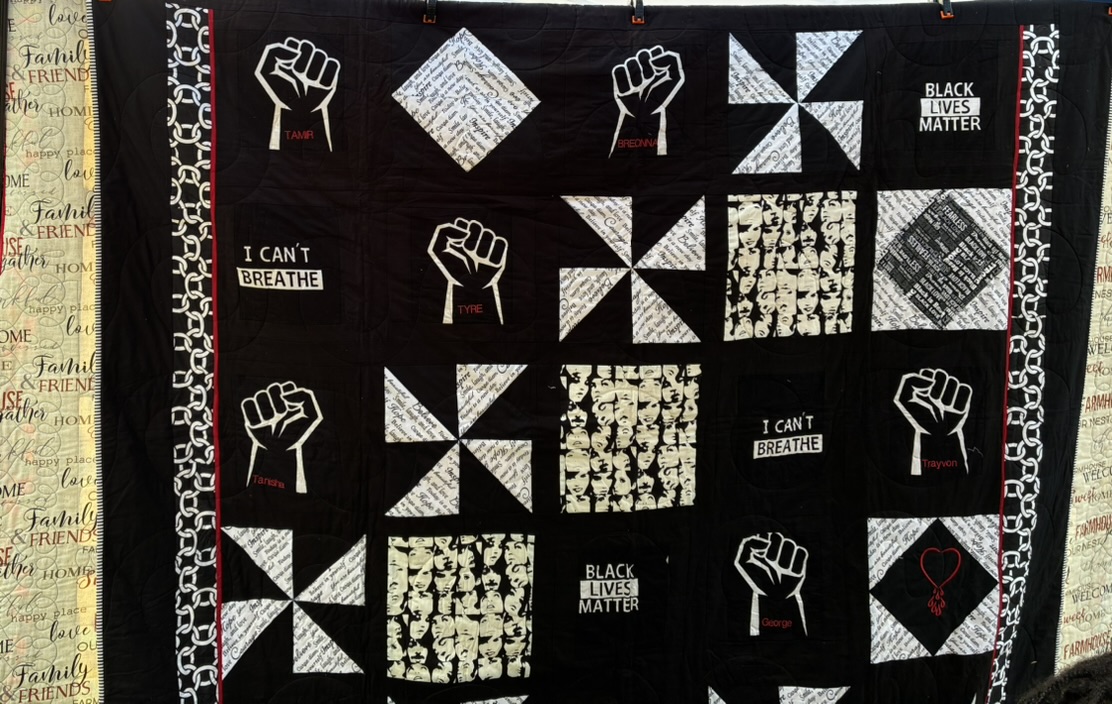
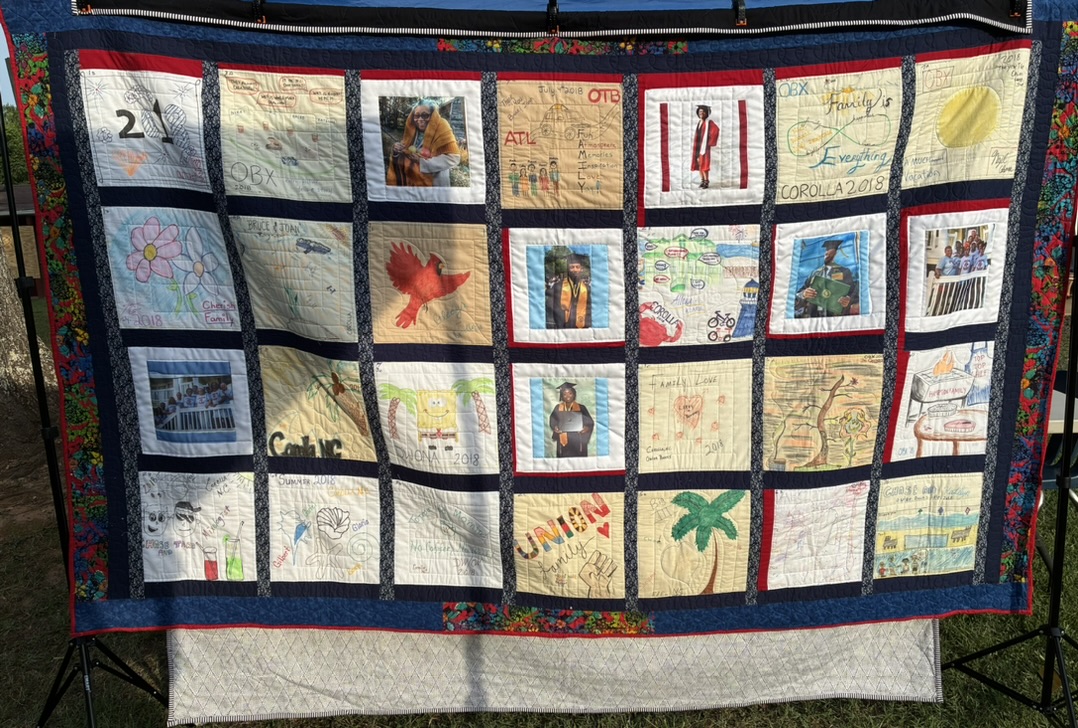
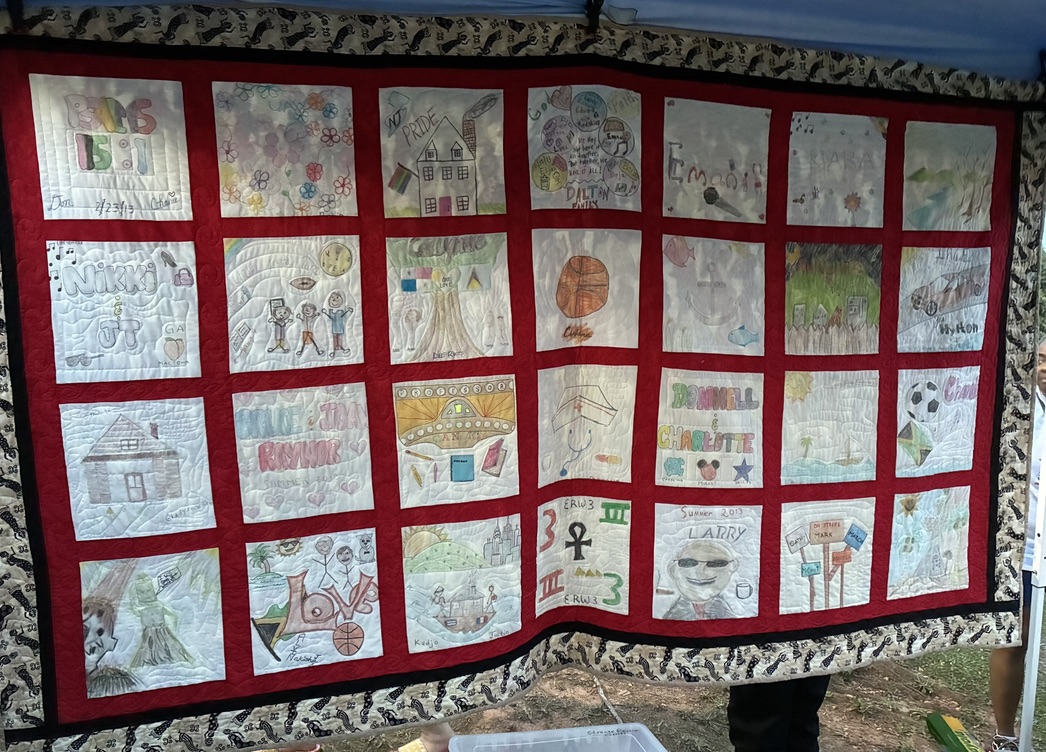
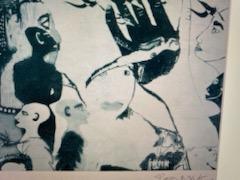
Additionally, another cousin, an accomplished quilter whose works have been a part of several exhibitions, arranged a one-day popup exhibition.
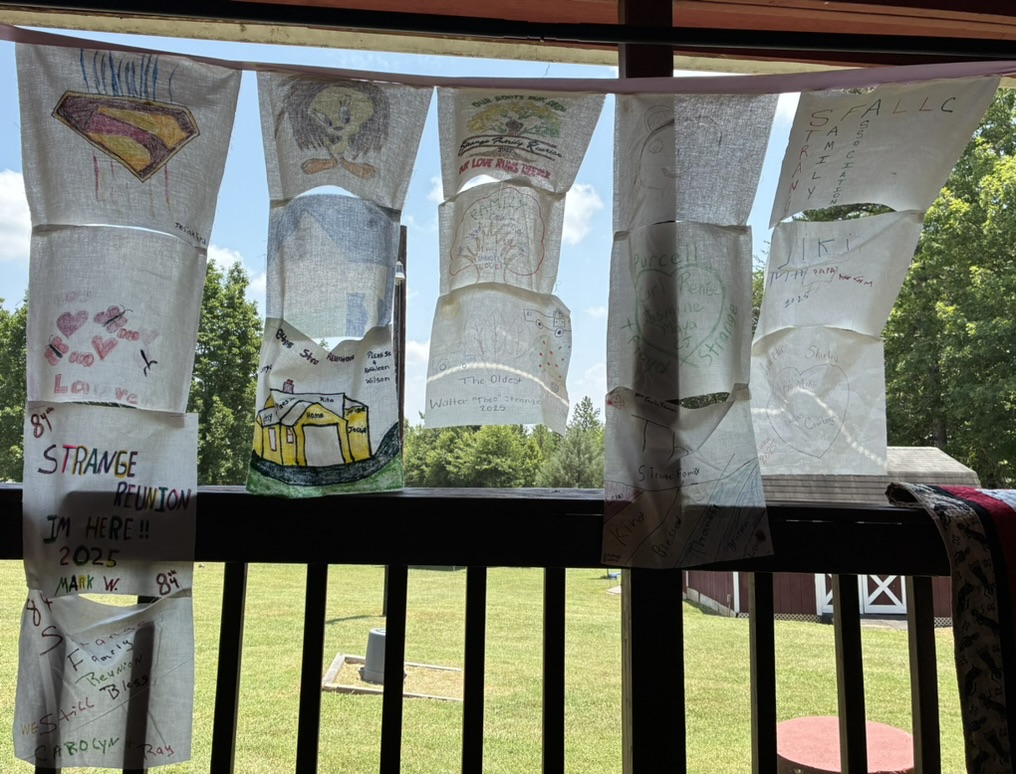
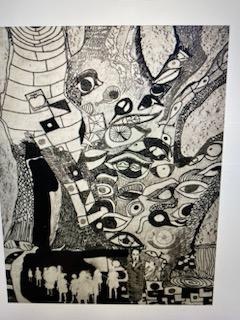
Her quilts depict African American subject matter along with more personalized family quilts. Below are two examples where her siblings and their children decorated a square to represent themselves.
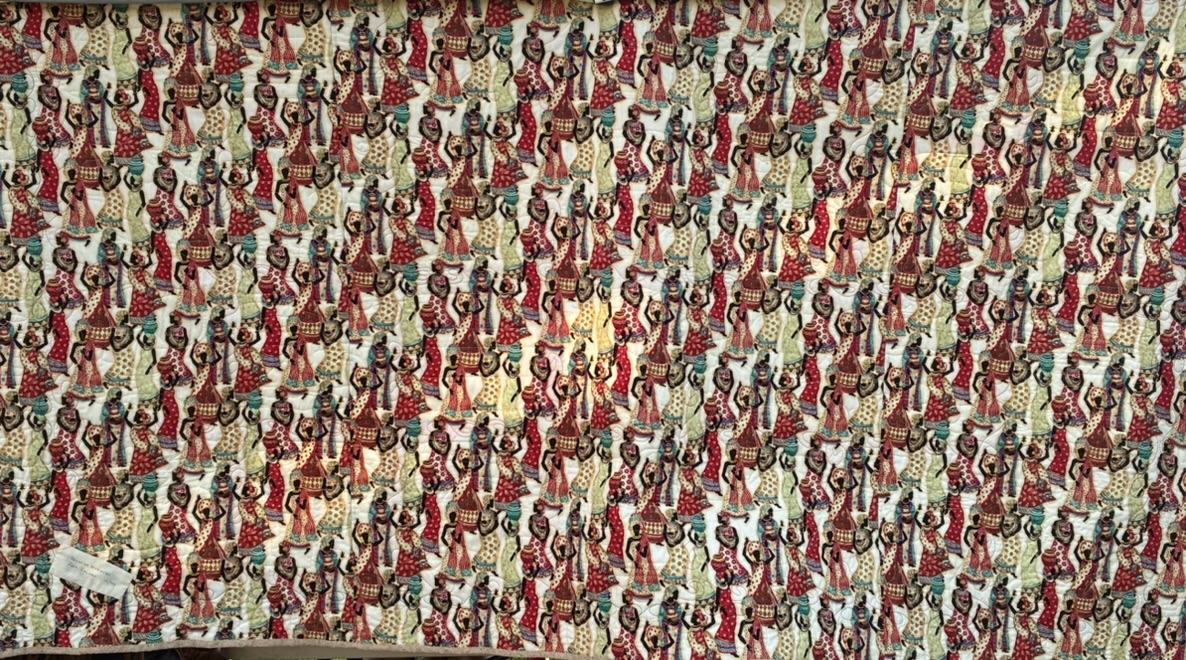
Even the fabric that served as the base for the quilting squares, reminds the African diaspora of our roots.
My cousin provided the family an opportunity to create our own representative squares, which will eventually be made into a quilt. My square depicts my childhood nickname, “Tweety Bird,” and my dreads.
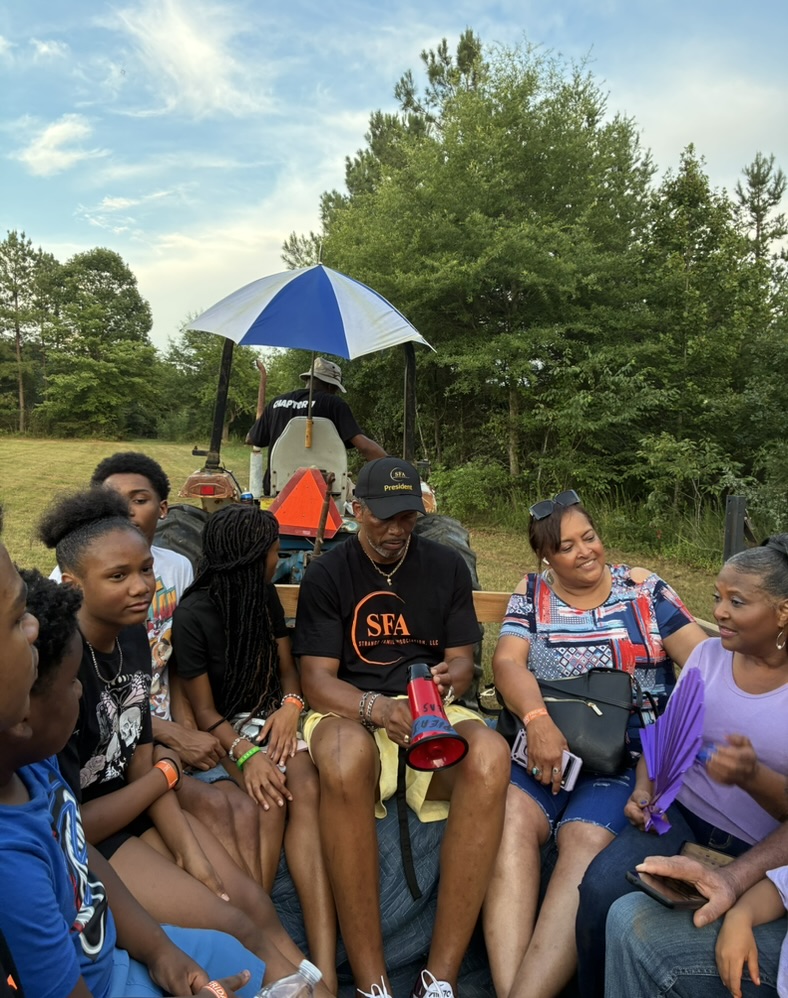
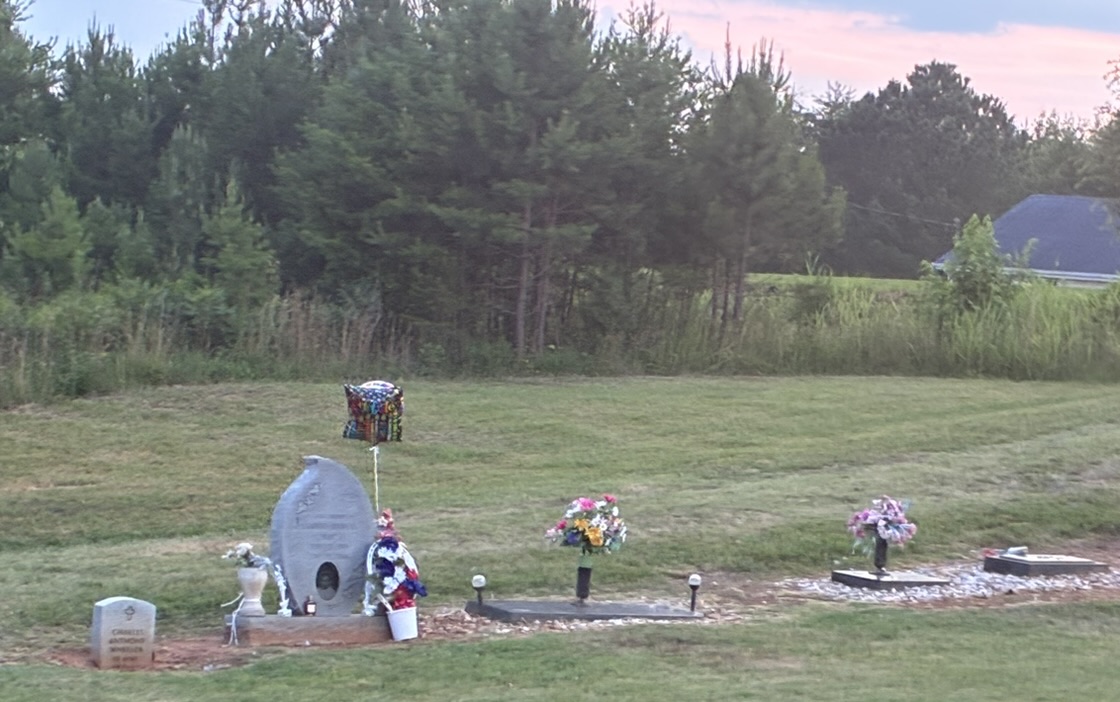
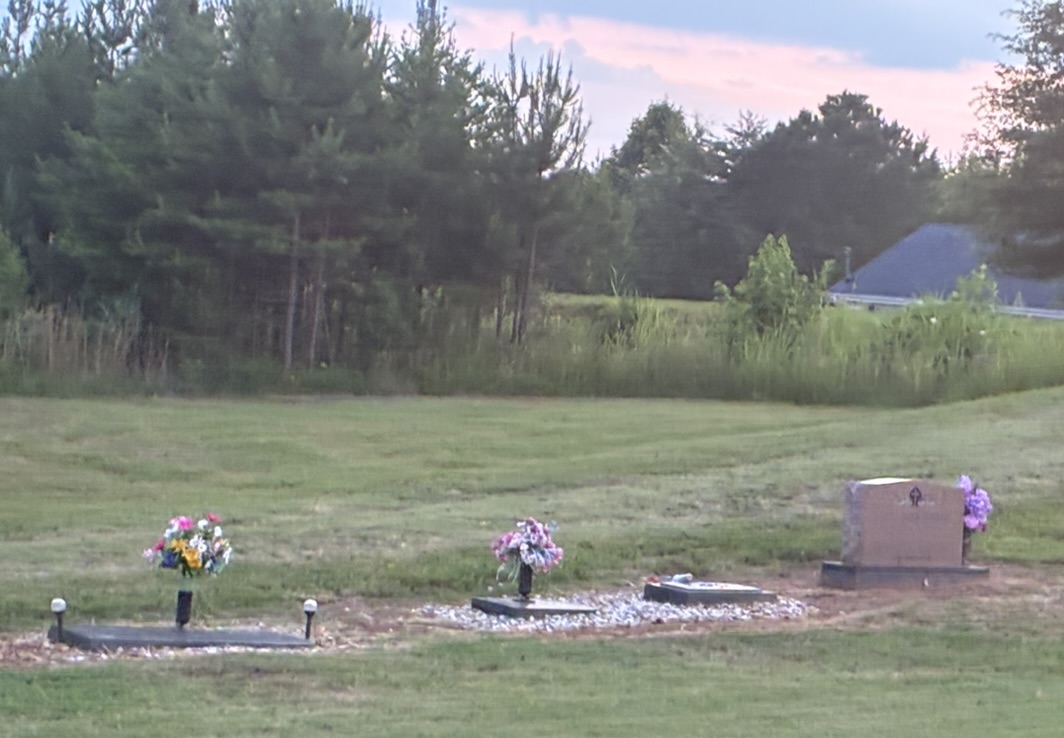
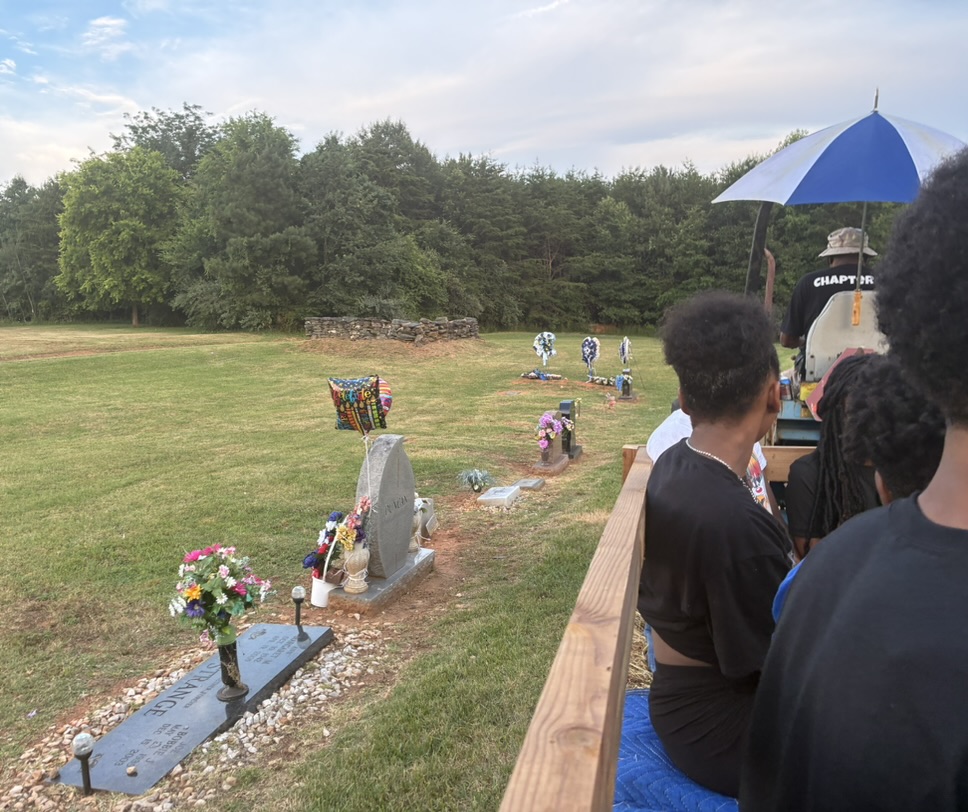
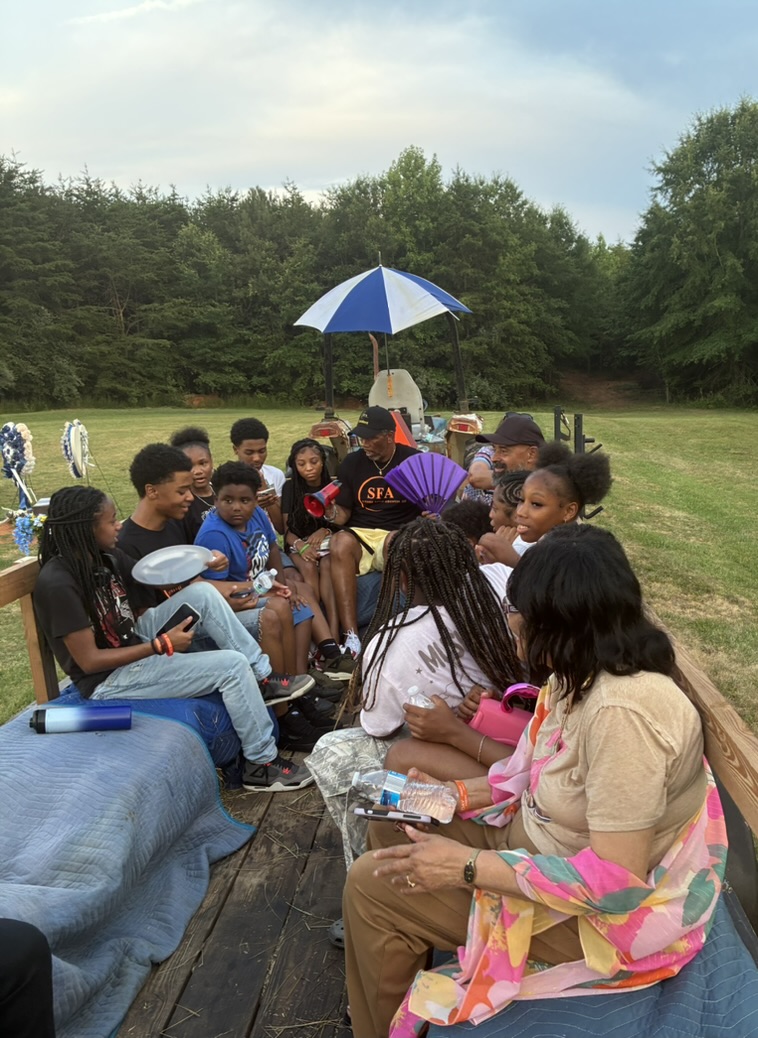
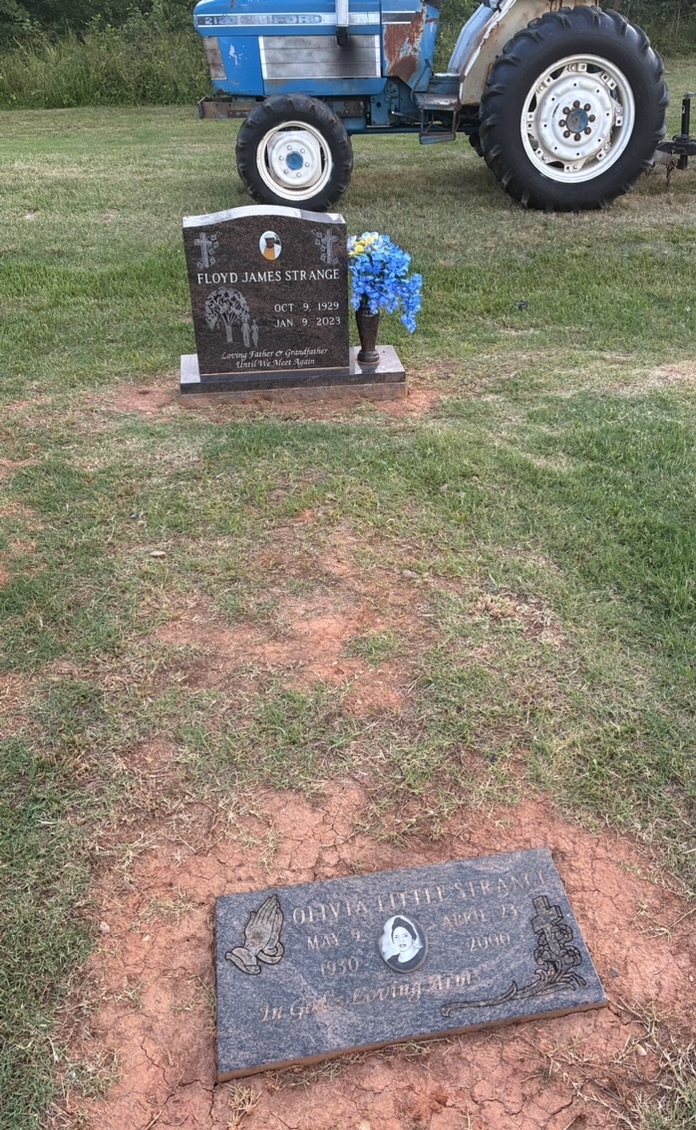
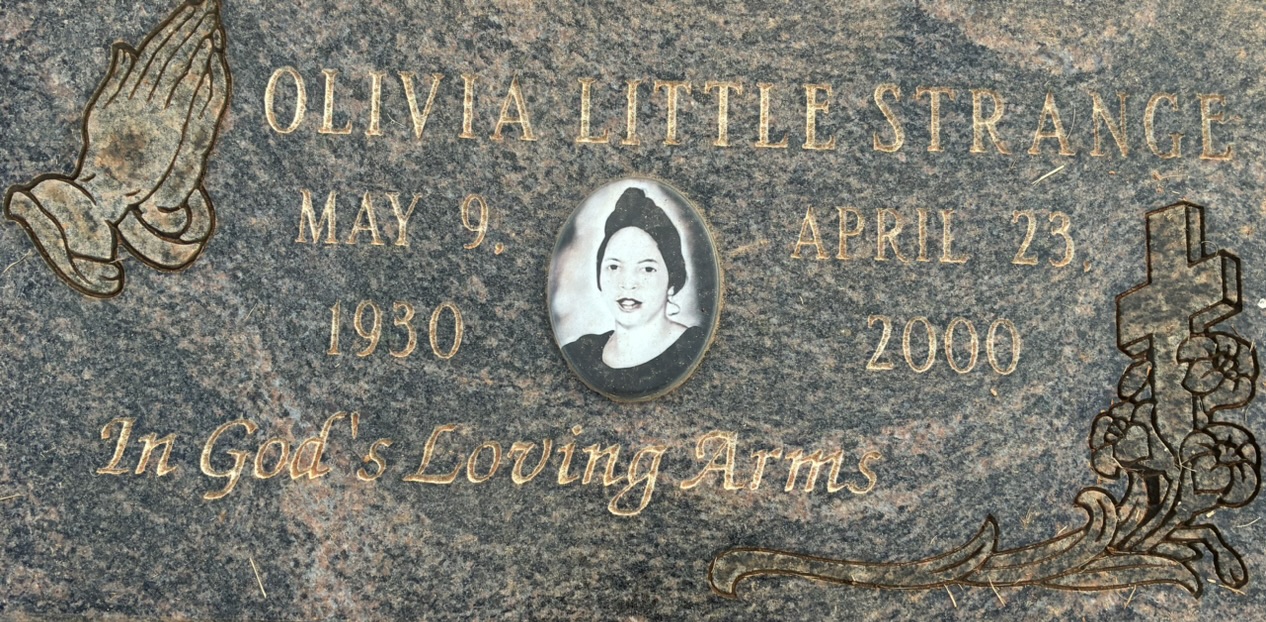
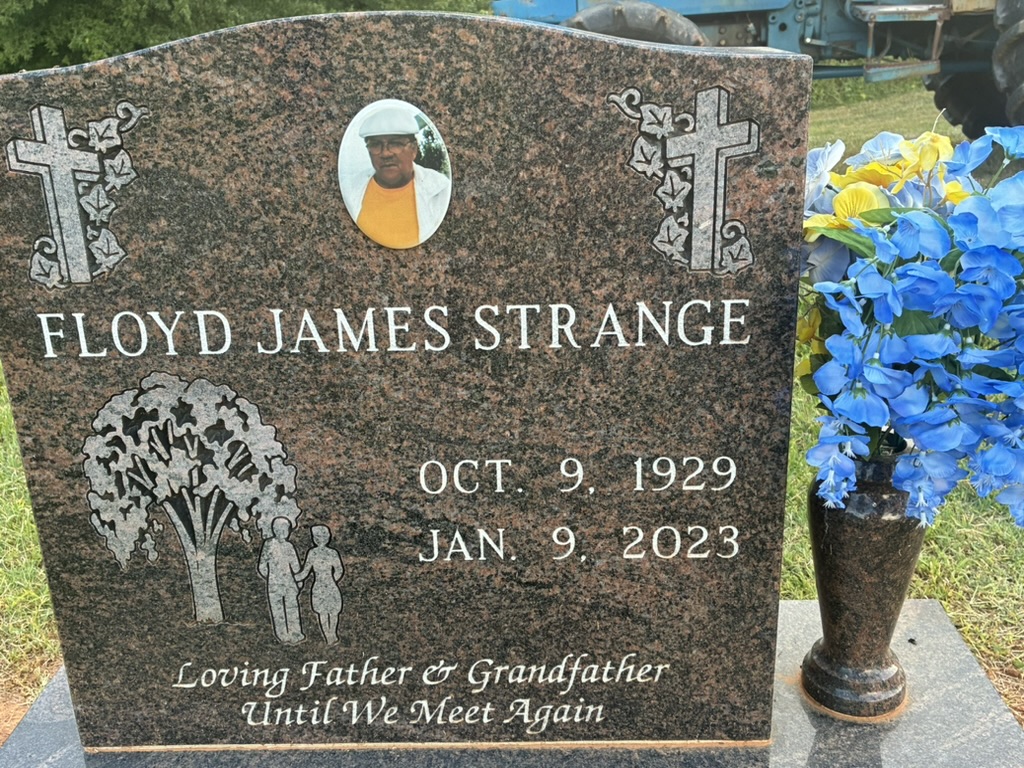
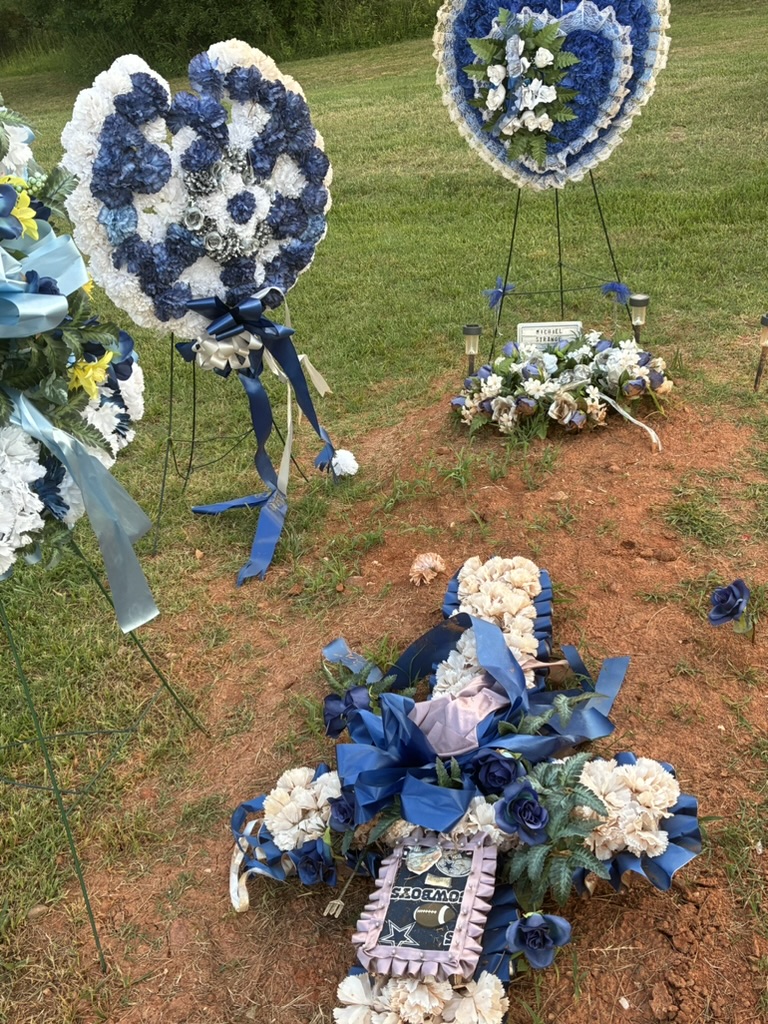
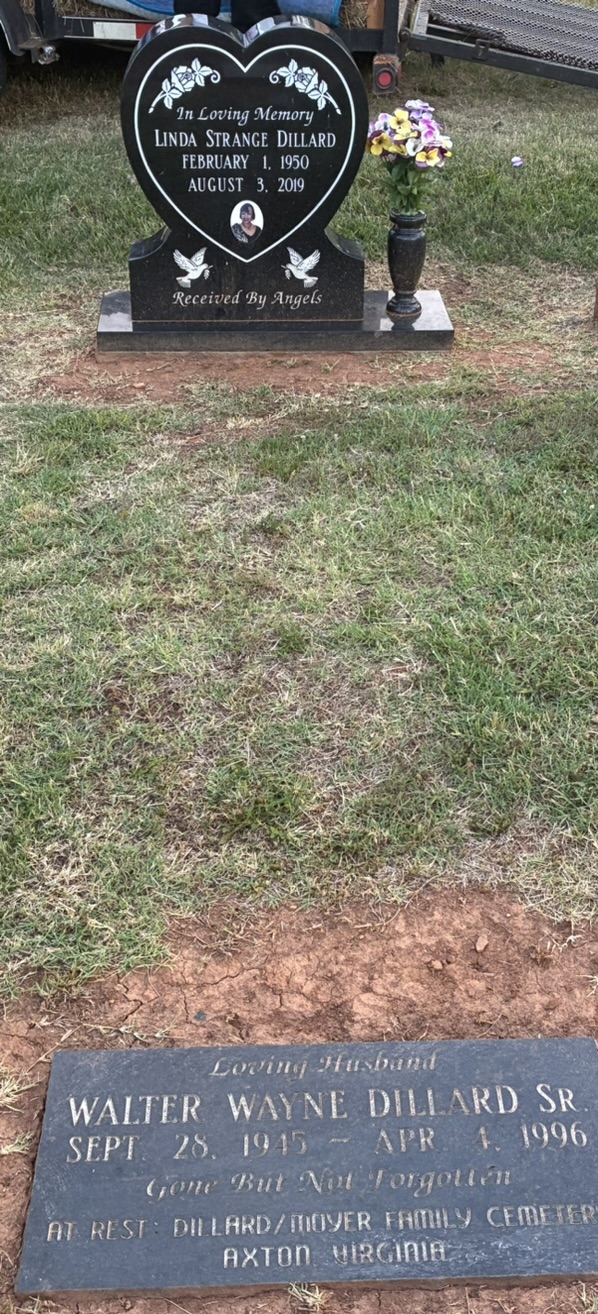
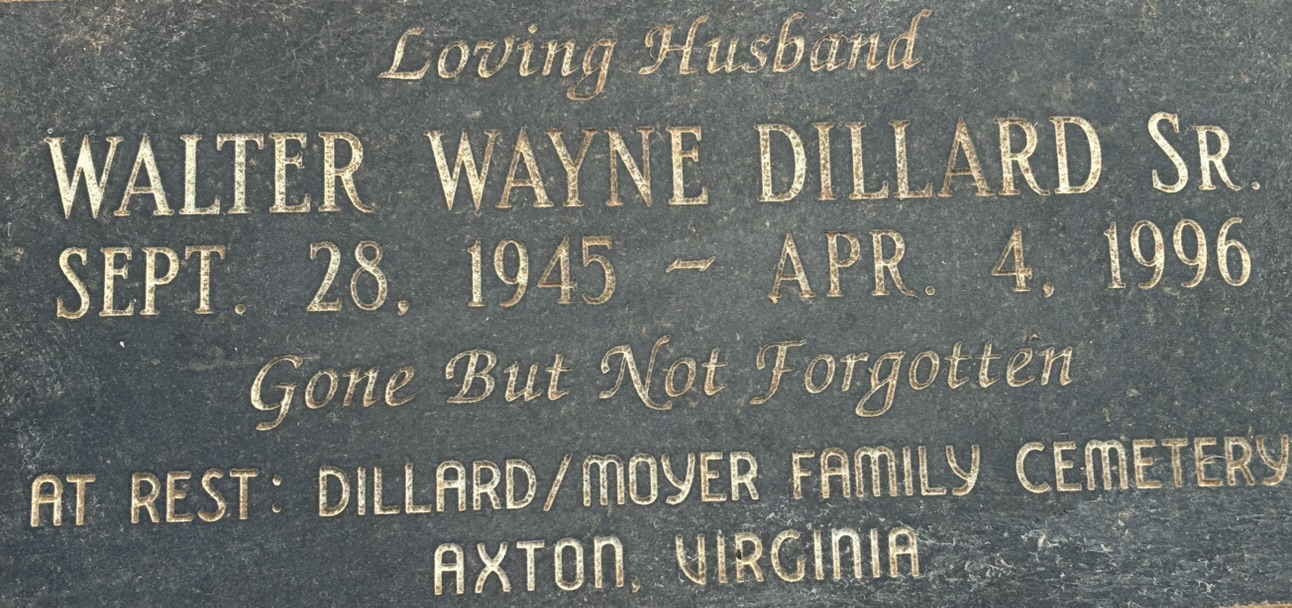
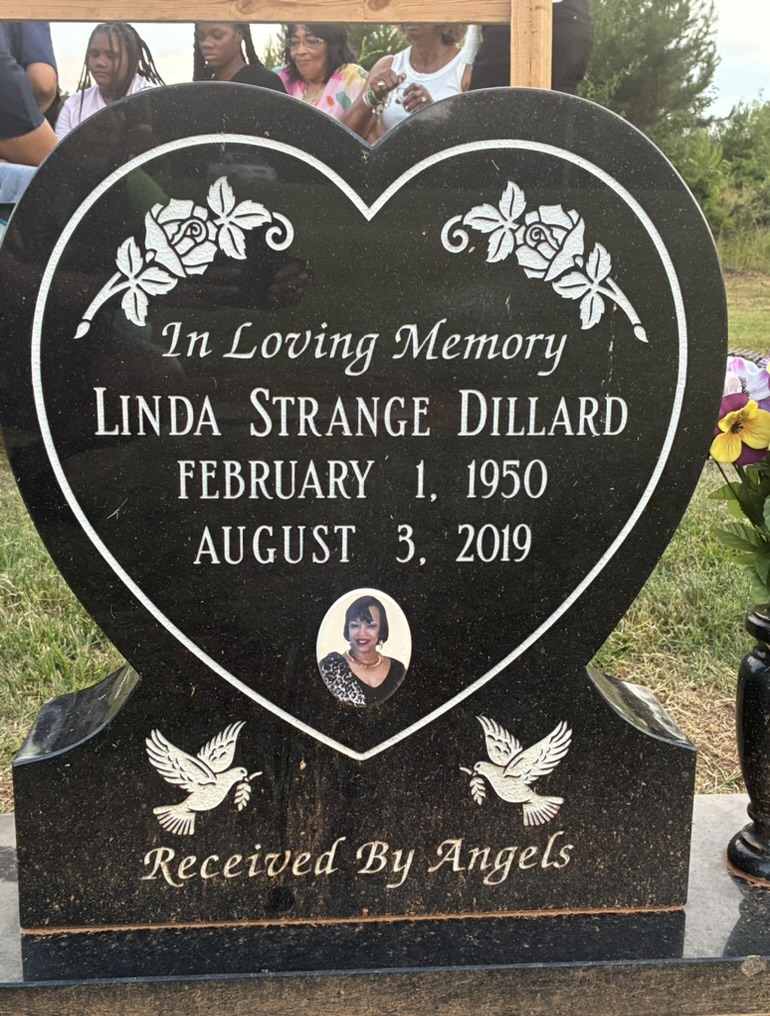
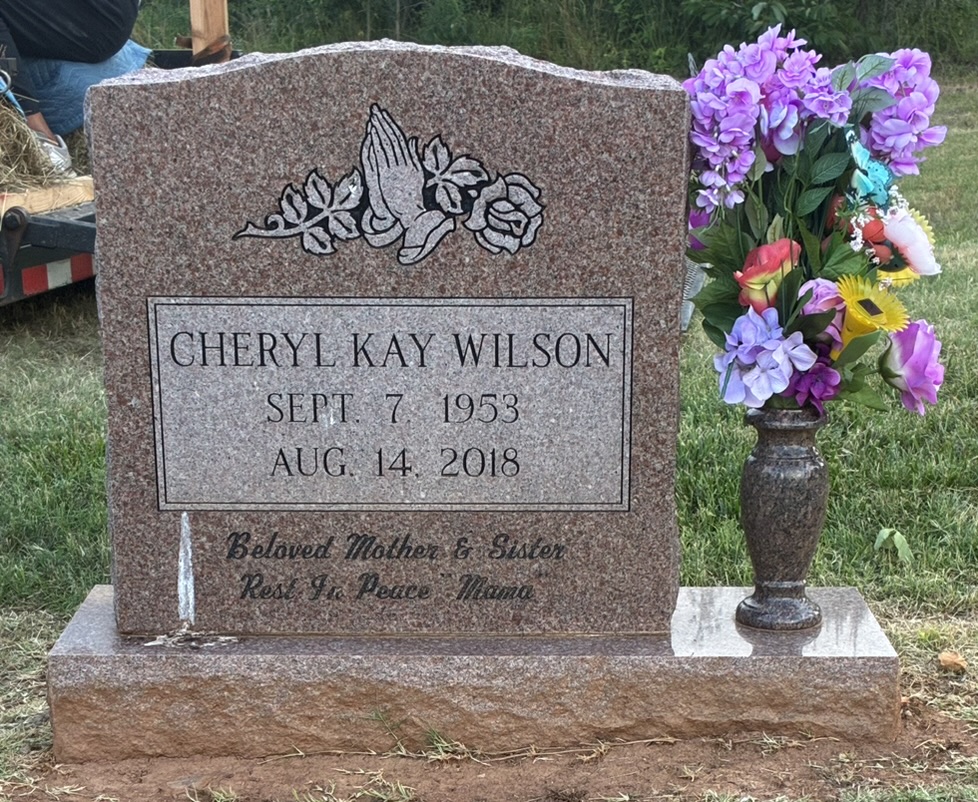
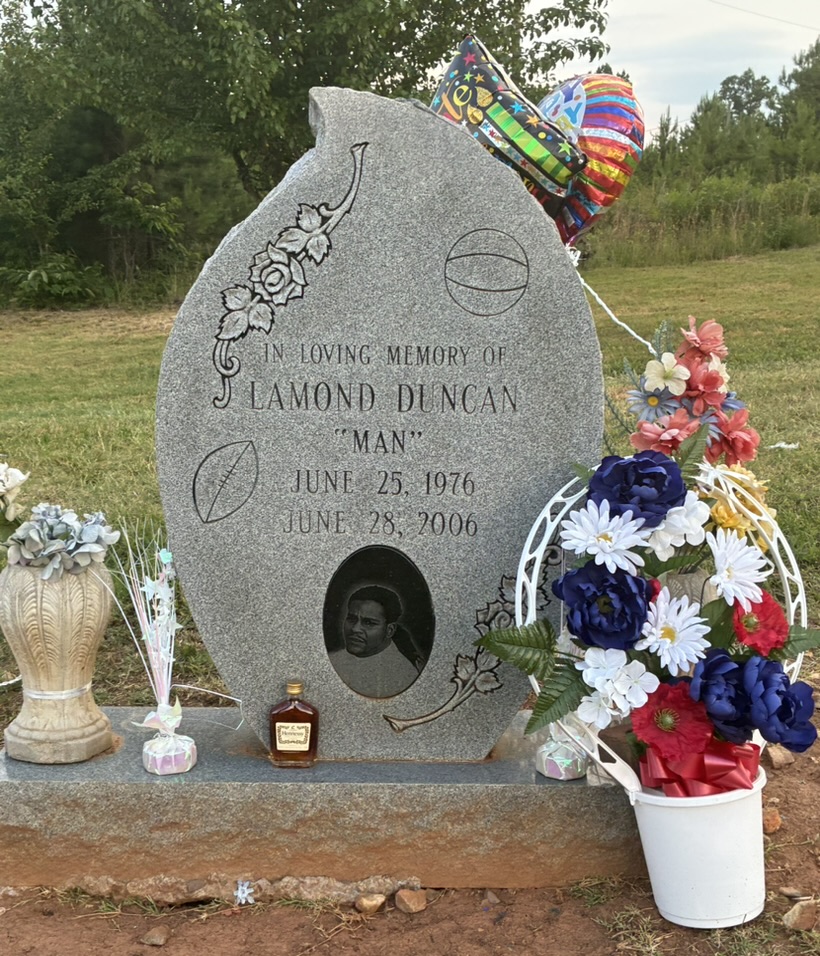
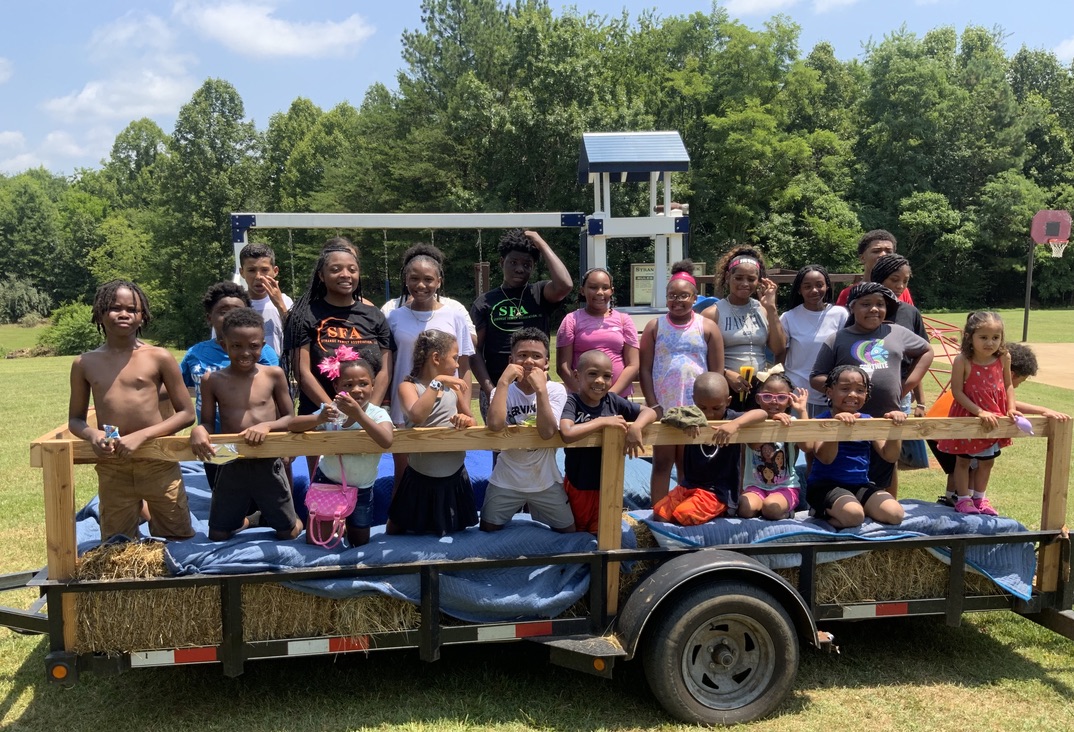
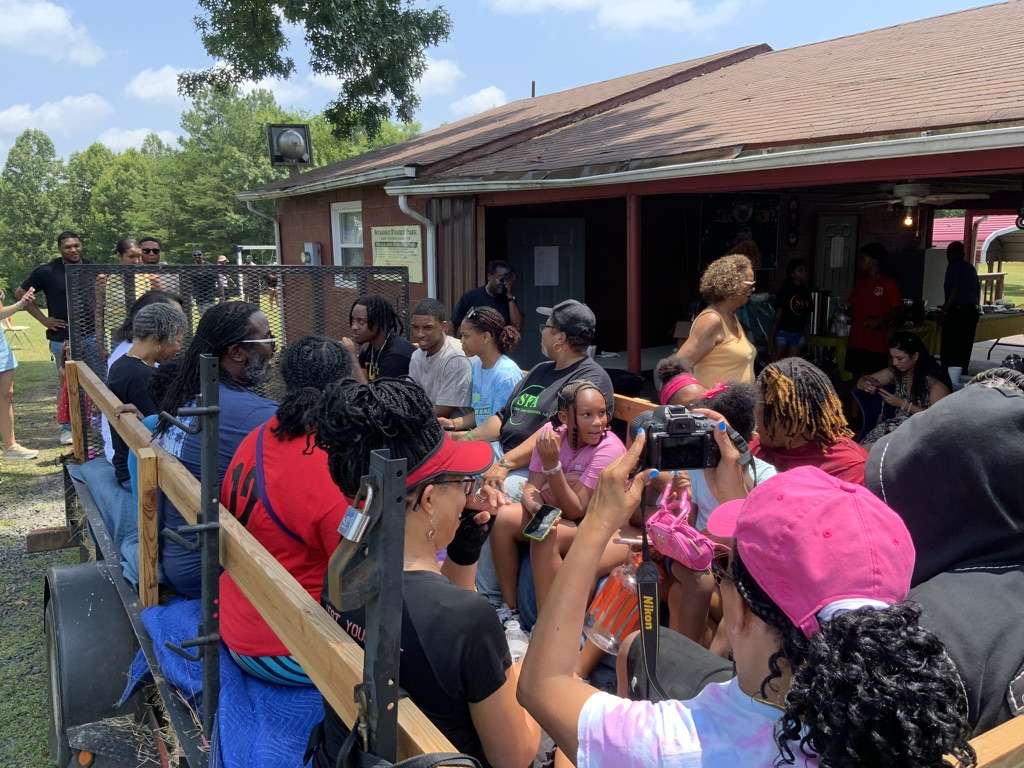
Another continuing tradition was the hayride, which occurred multiple times on Friday and Saturday. This year’s route had been expanded to include the Strange cemetery.
I had not visited since that rainy day when we buried my Uncle Floyd in 2023. (Please click on individual pictures to see the full view, then click on the browser back arrow to return to blog view.)
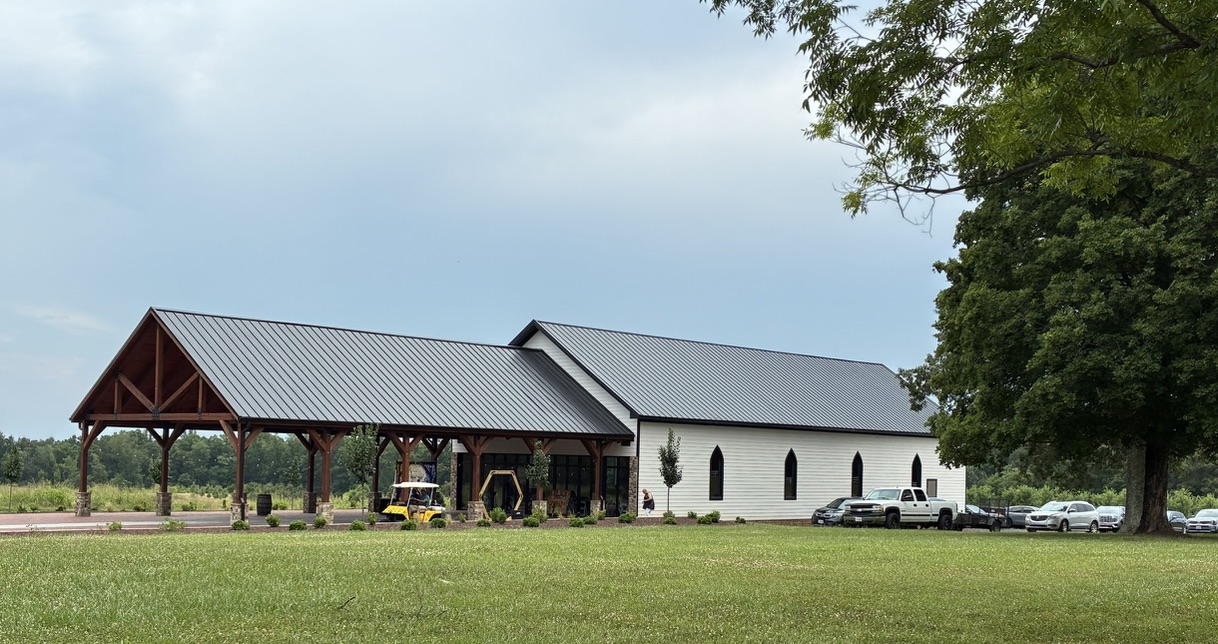
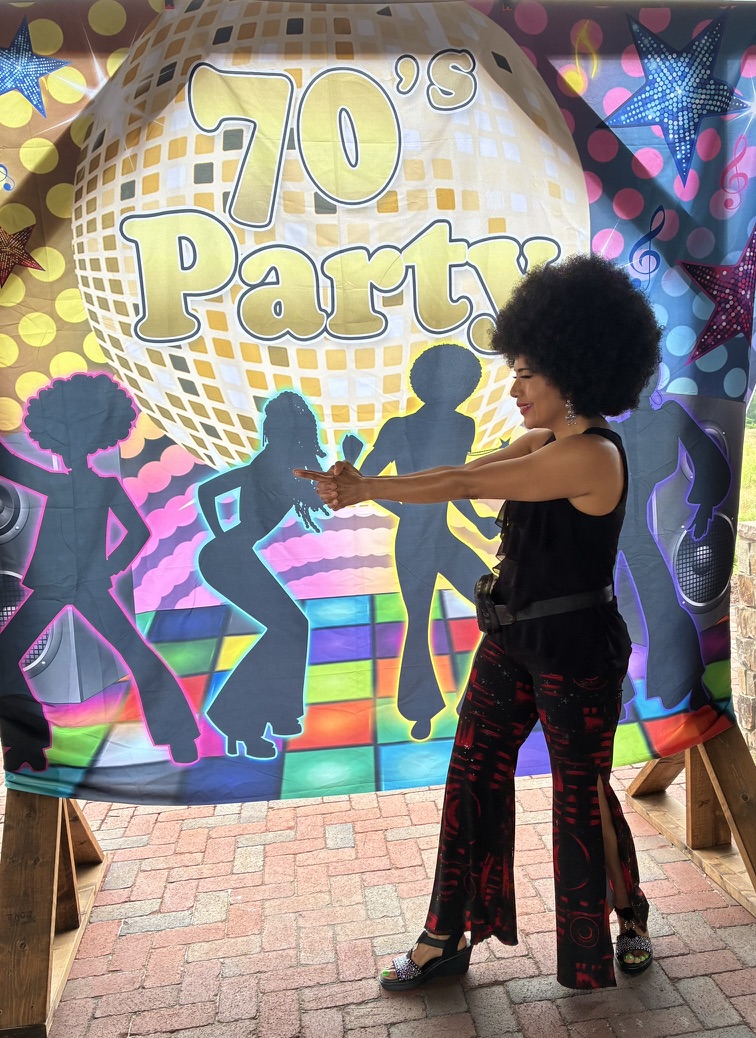
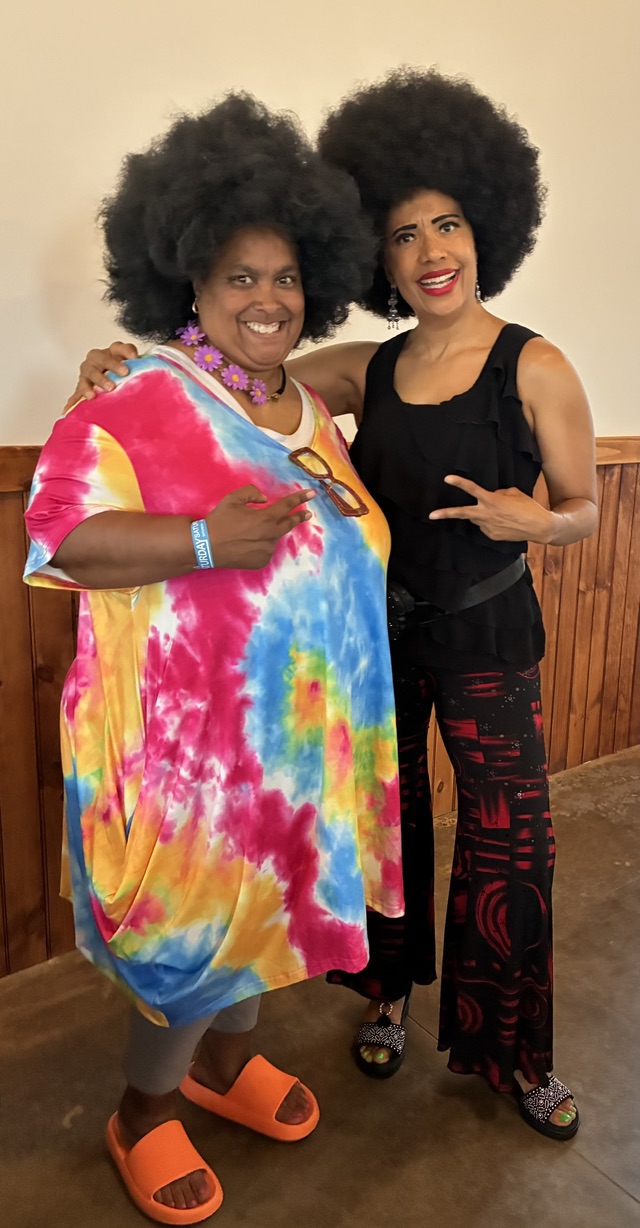
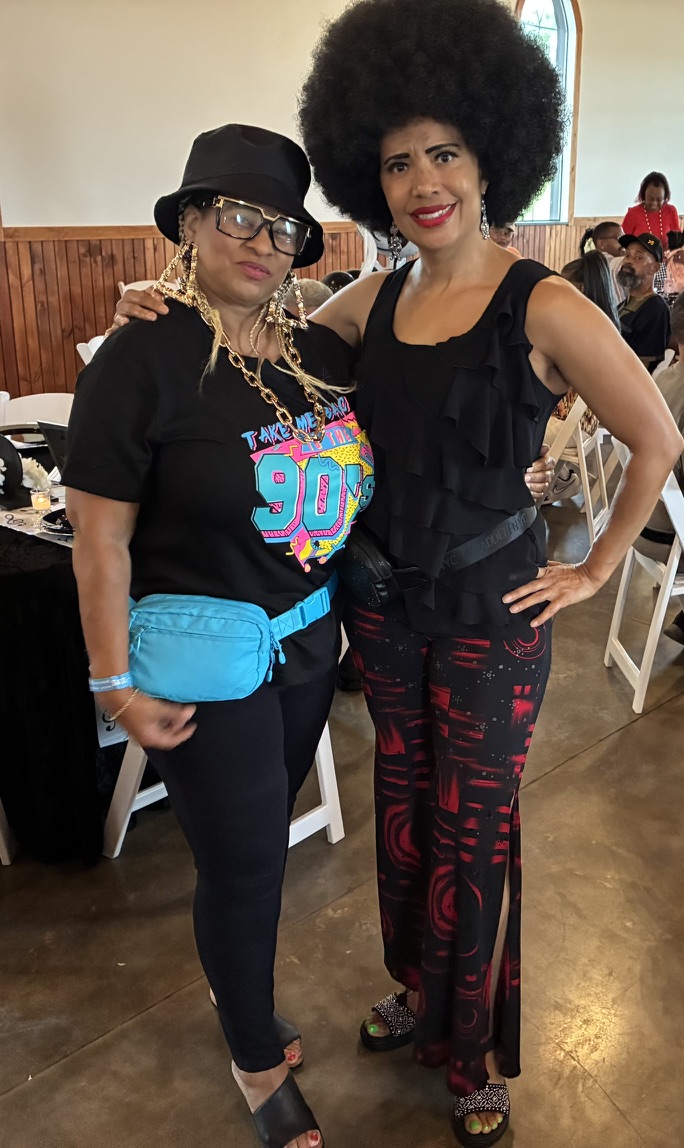
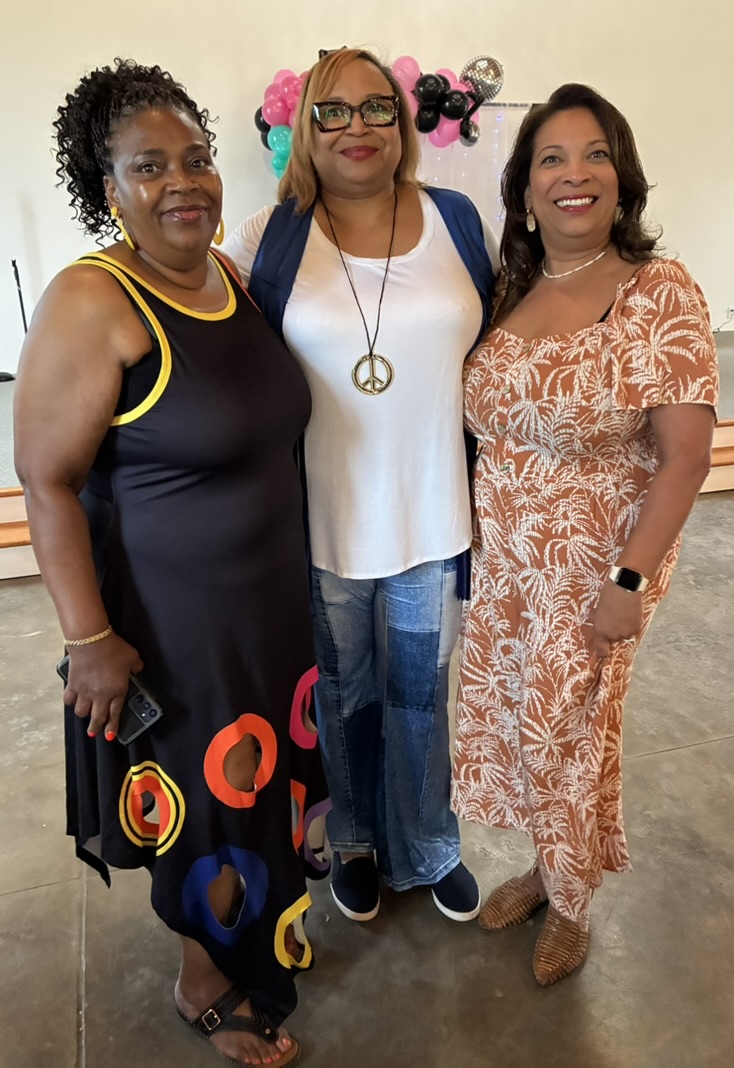
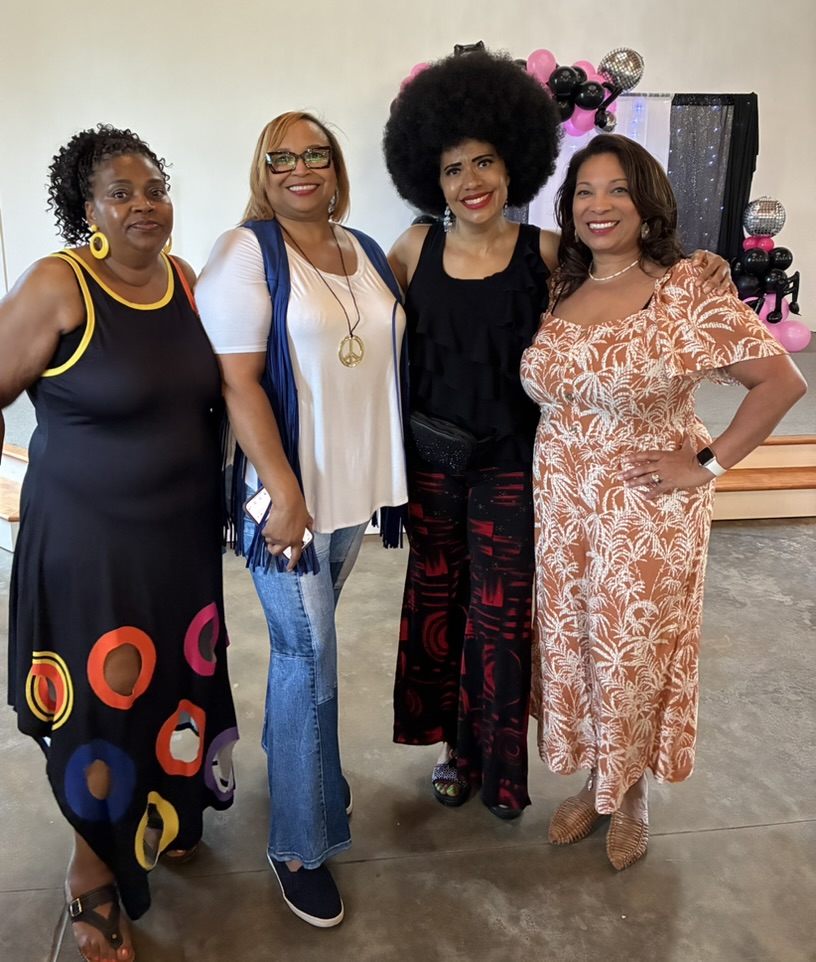
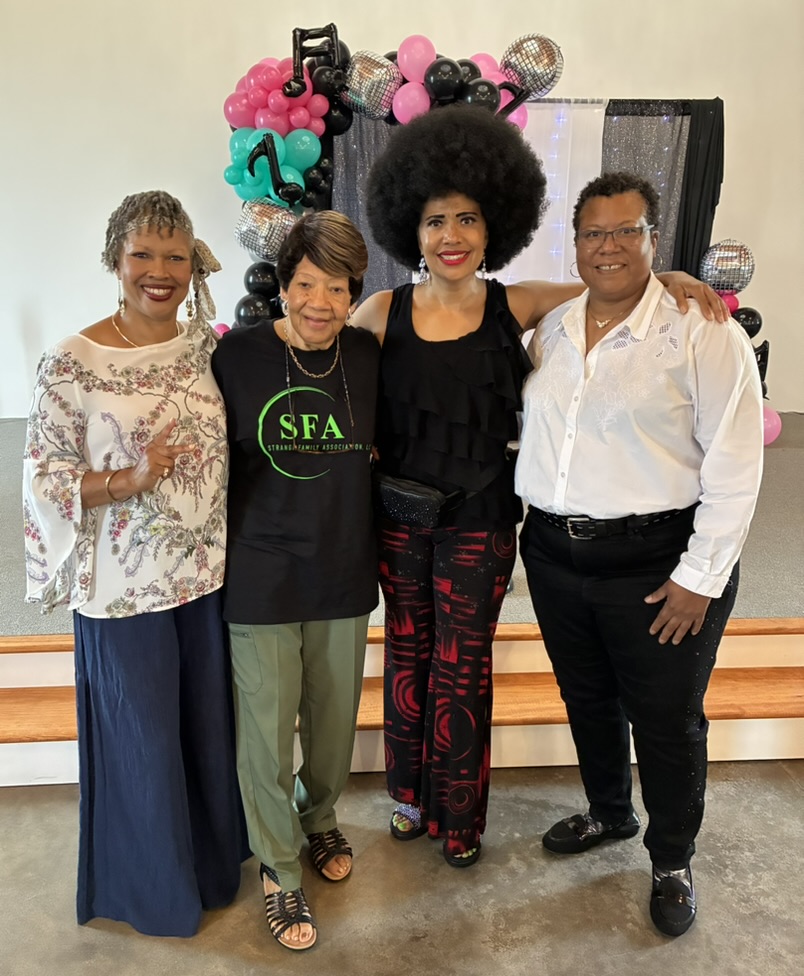
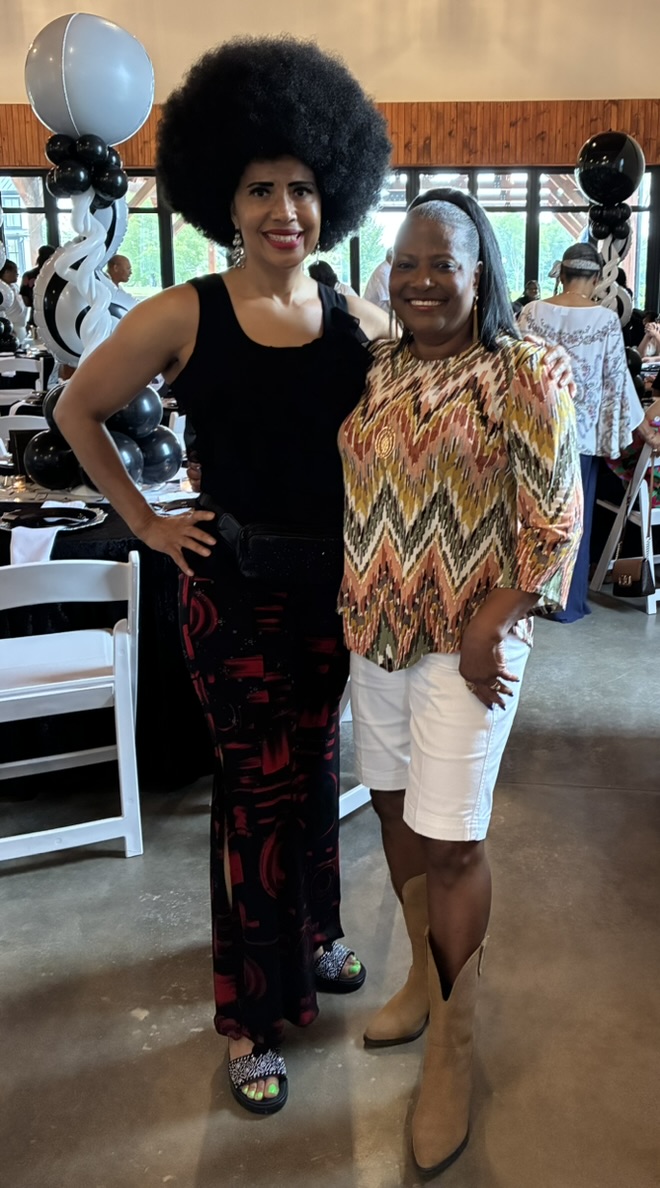
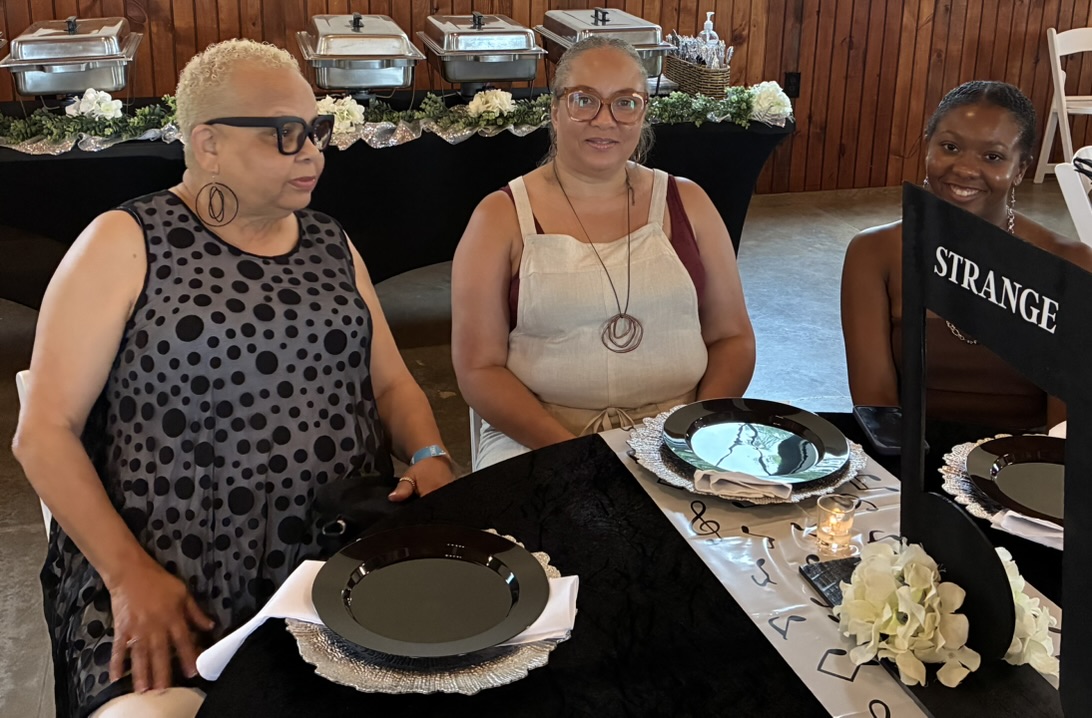
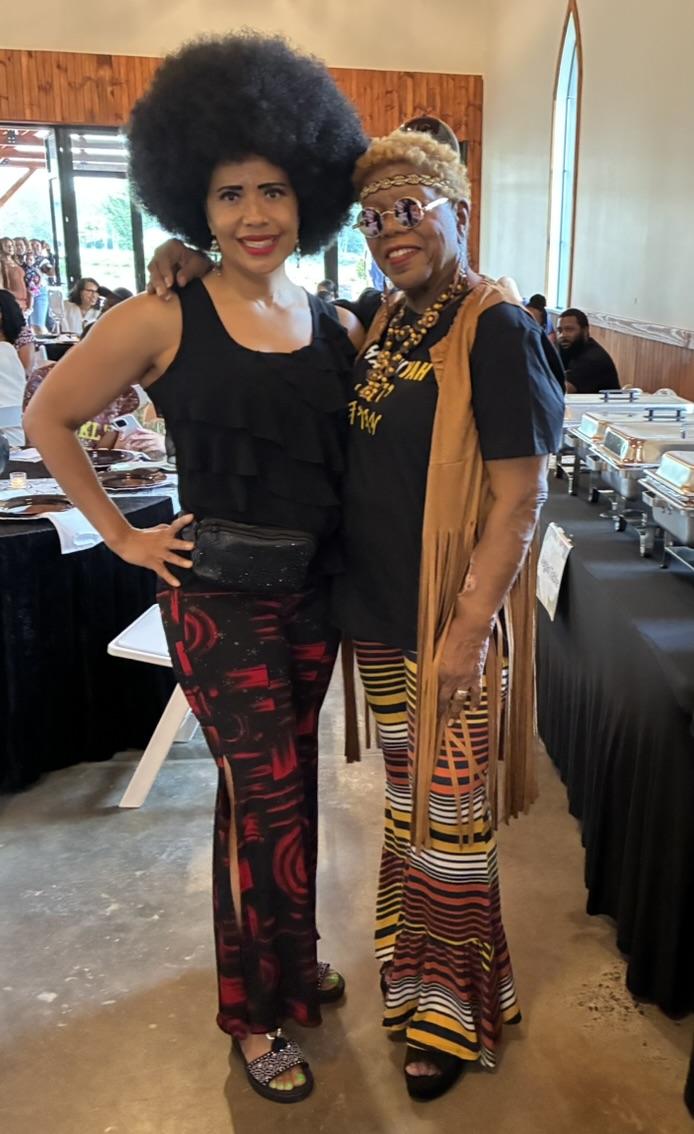
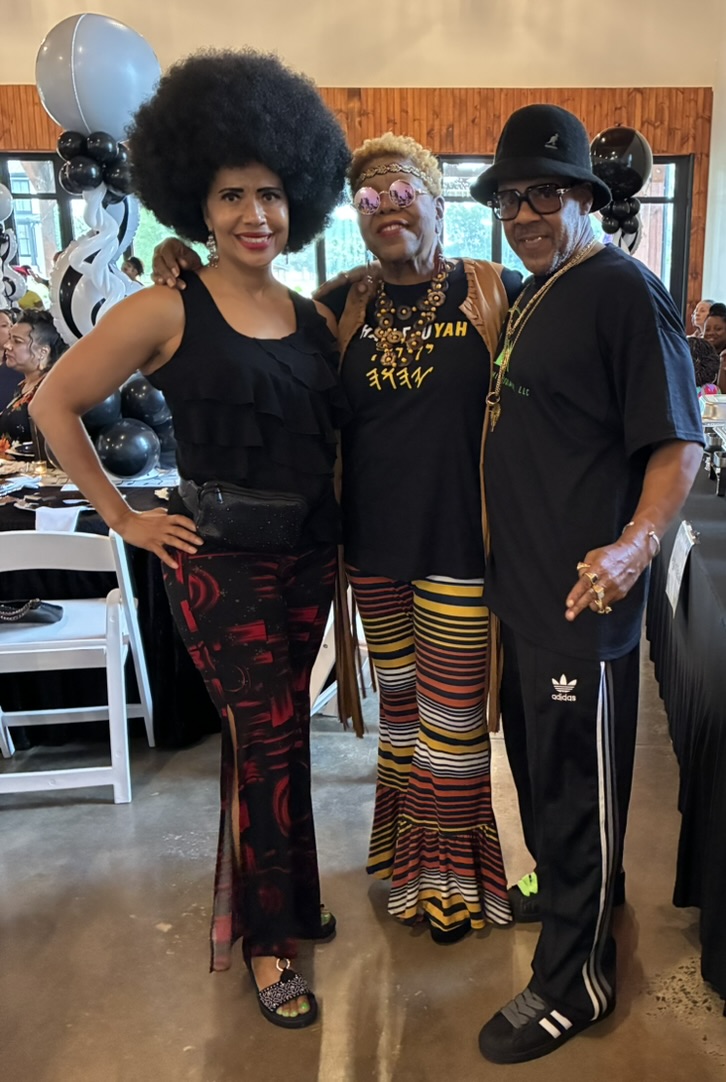
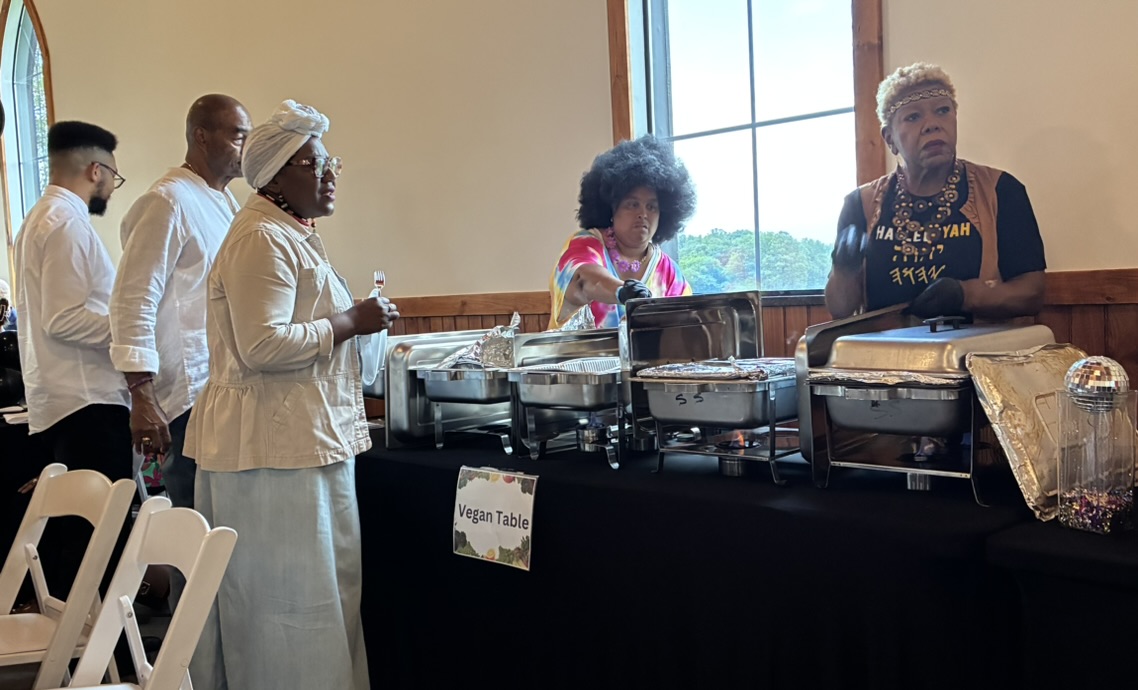
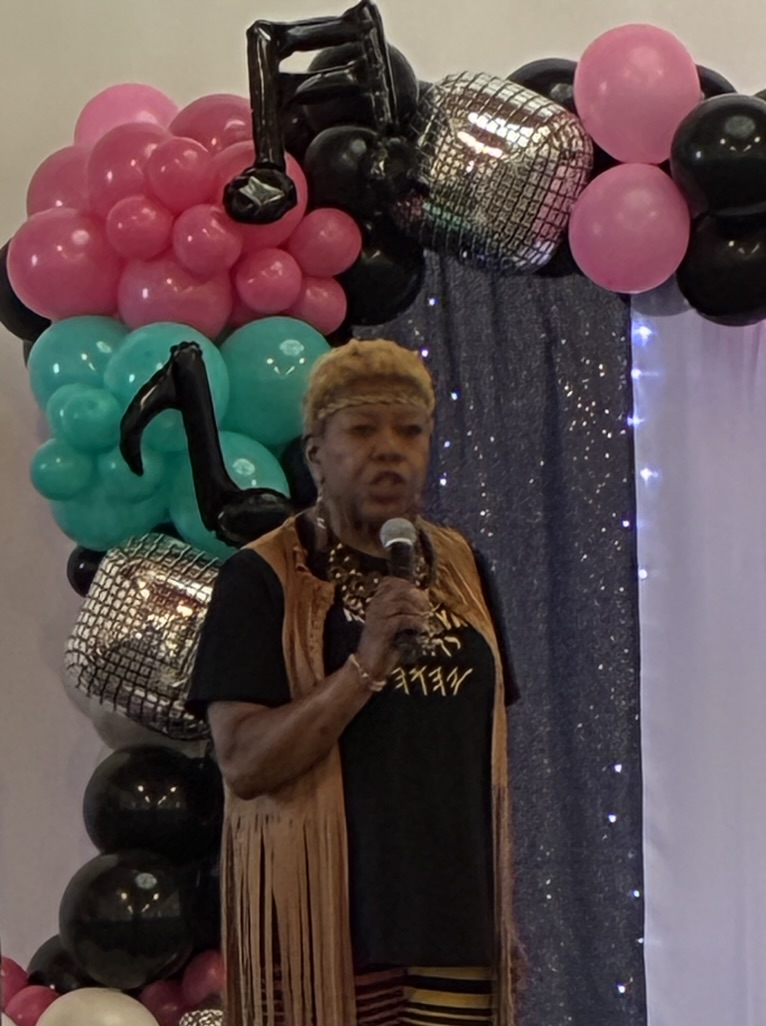
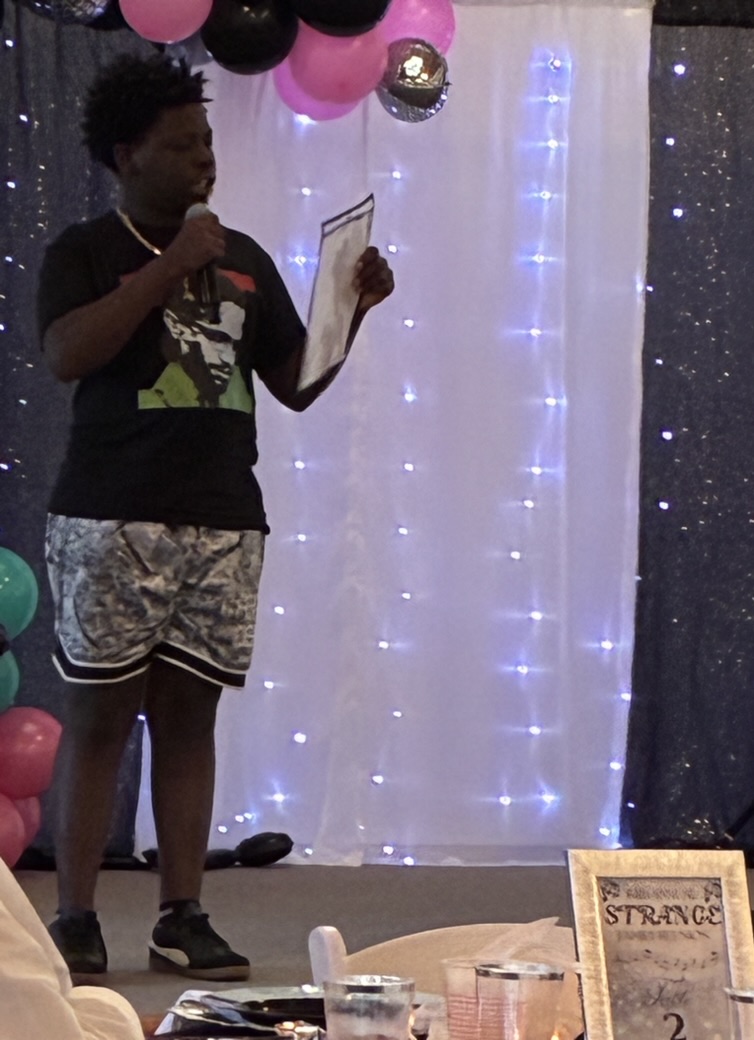
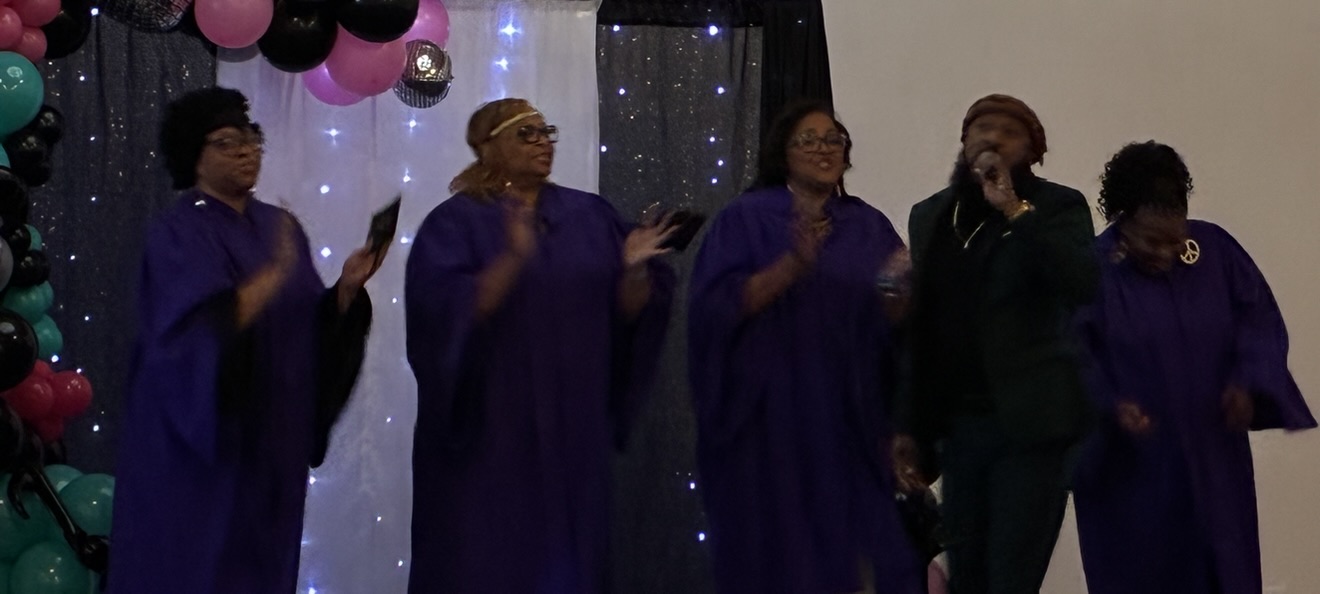
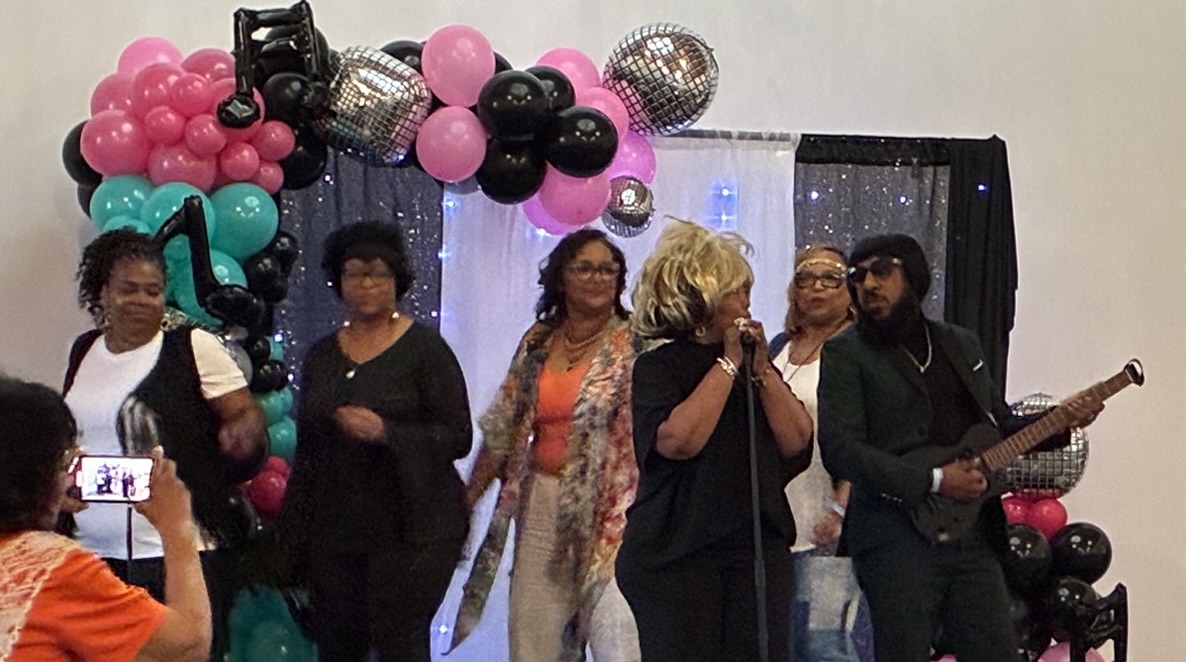
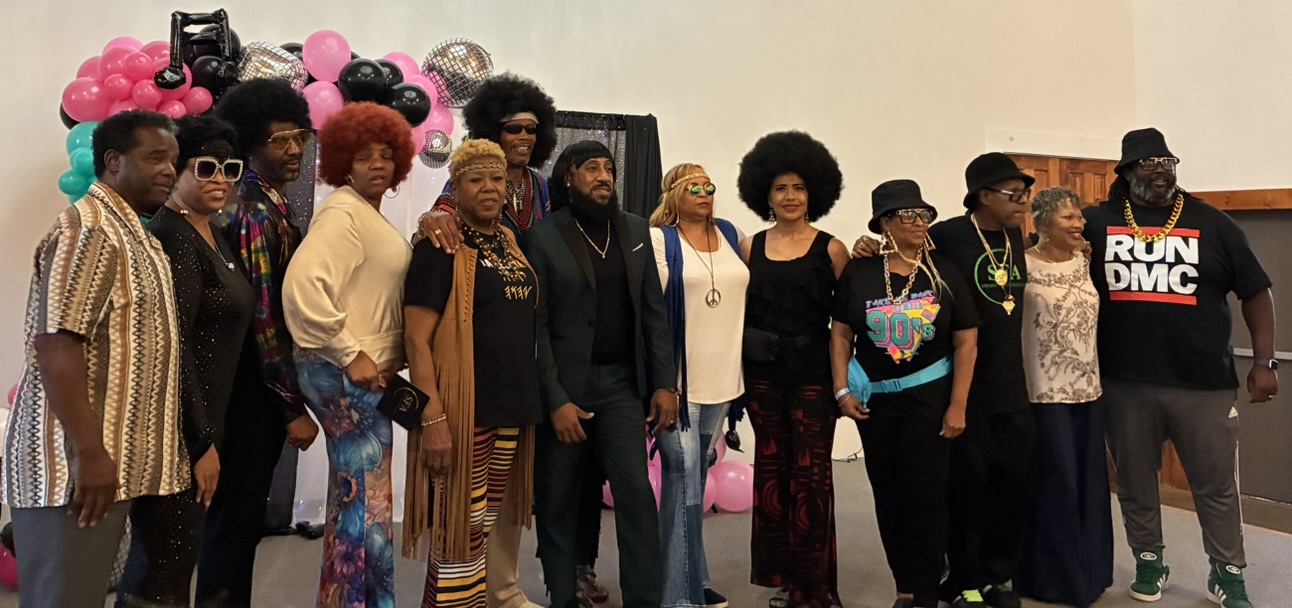
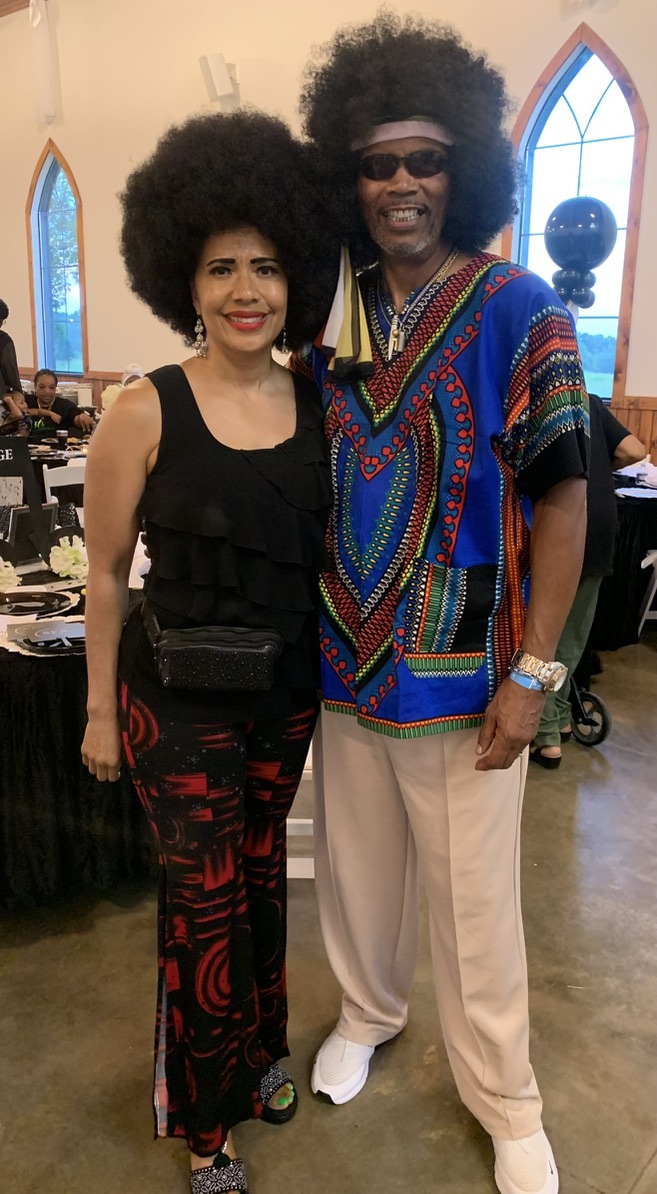
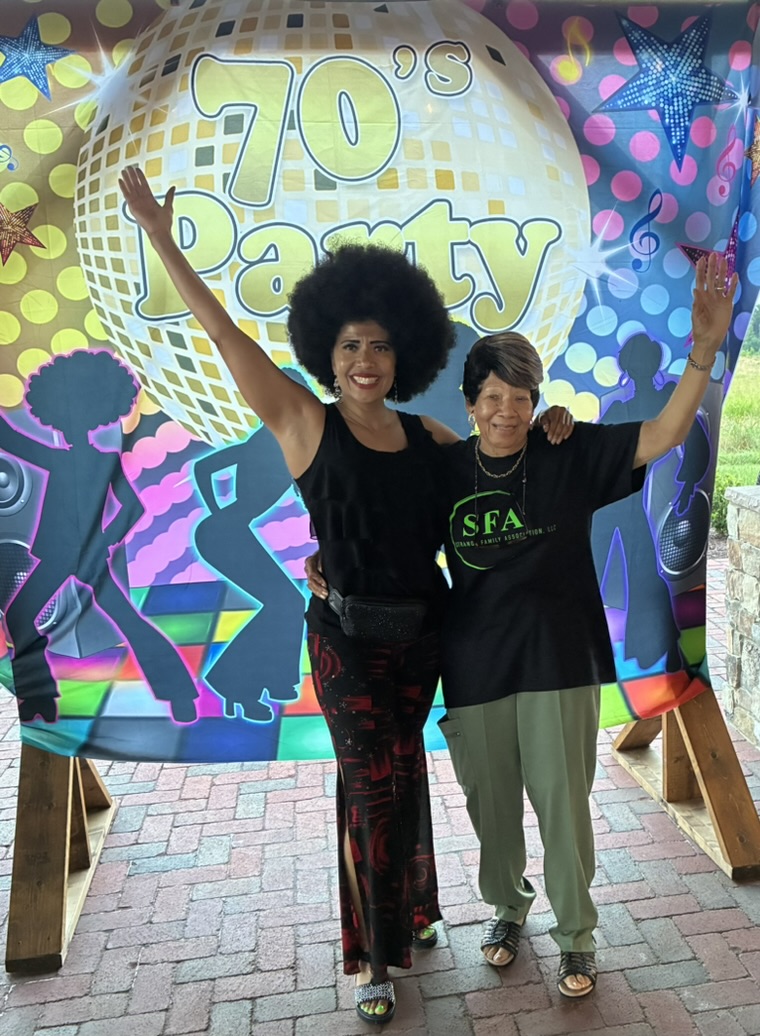
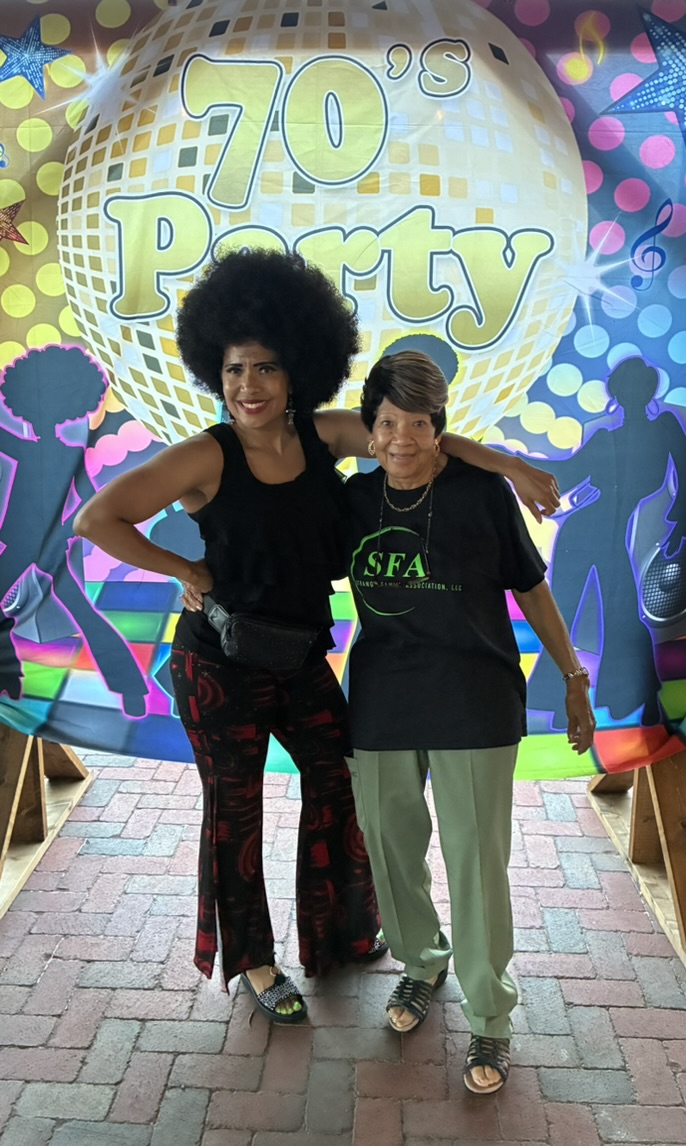
For the first time ever, the Strange family reunion rented a nearby venue to host our Saturday evening catered dinner and entertainment. The organizers encouraged everyone to dress up as their favorite decade.
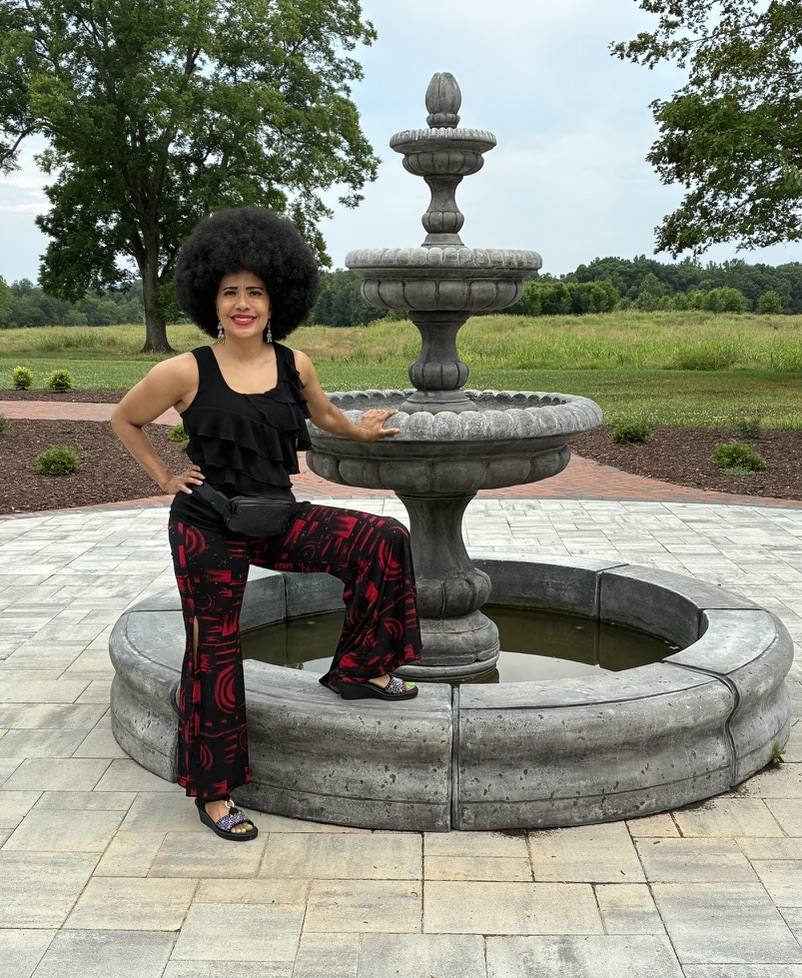
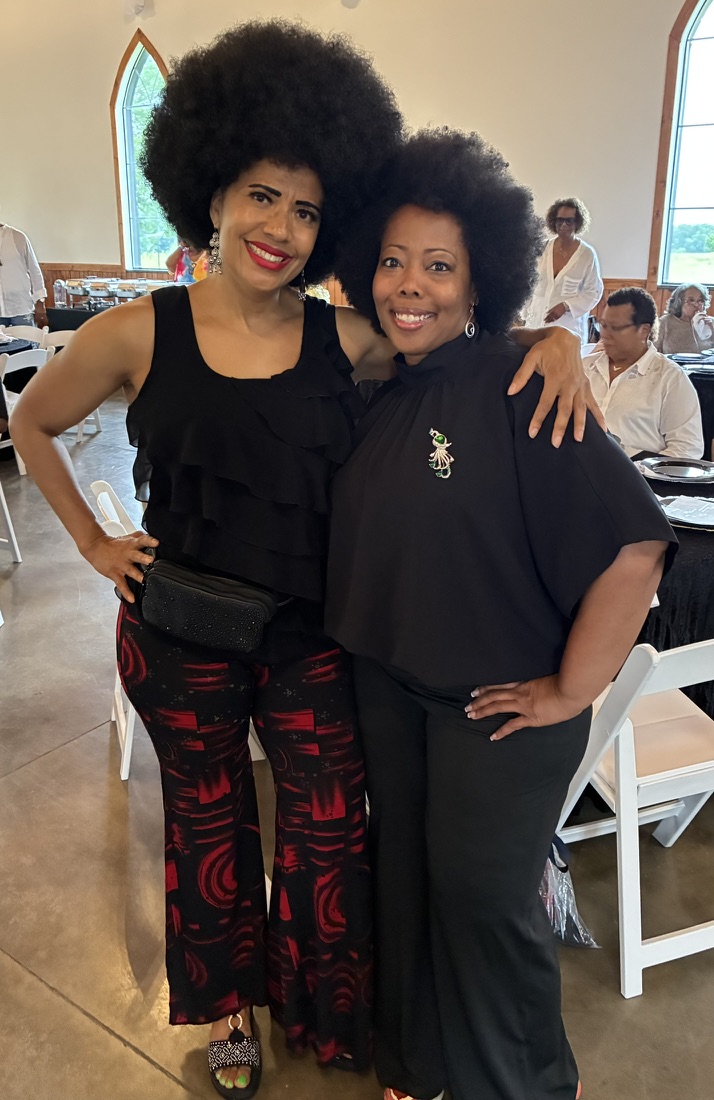
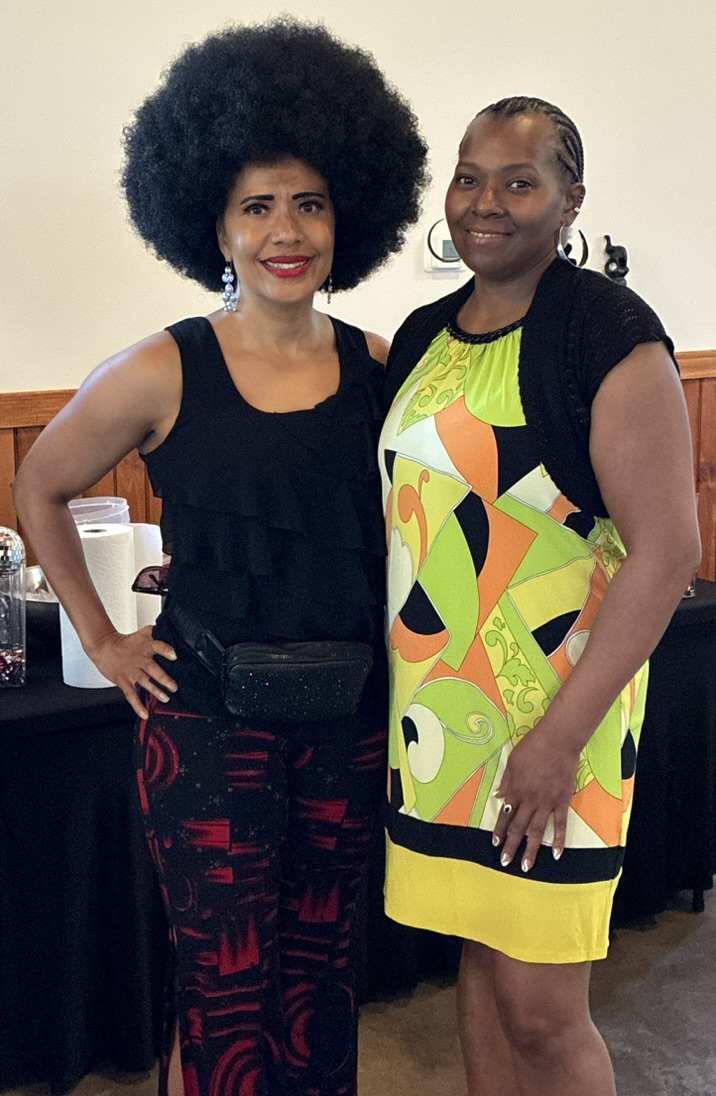
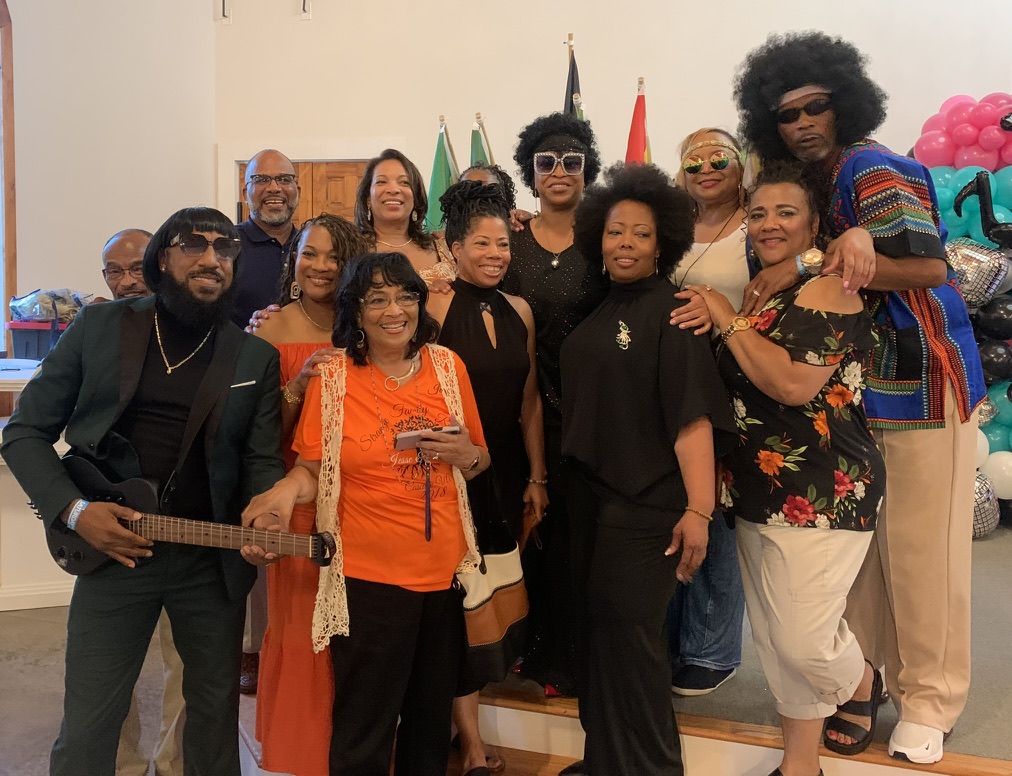
Never one to pass up on a chance to dress in costume, all I needed to complete my look was a larger-than-life Afro wig. I already owned the bellydancing pants and top. Majority of my relatives who’d known me all their lives, didn’t recognize me initially.
On Sunday, our very own ordained members of the cloth presided over church under the Strange shelter.
For me, the most intriguing thing my cousin said during her sermon was: “There’s no piece of dirt that is any better than another piece of dirt. We’ve all come from the dirt and to the dirt we will return.”
That resonated with me. The only thing that has ever stopped me from achieving something was the lack of time devoted to the endeavor. Not the lack of money or talent.
The real challenge: how will we spend our limited time from dirt creation to dirt reunification? If that seems too big a question, then scale it back to this: what can be done between now and the next family reunion? Stay tuned.
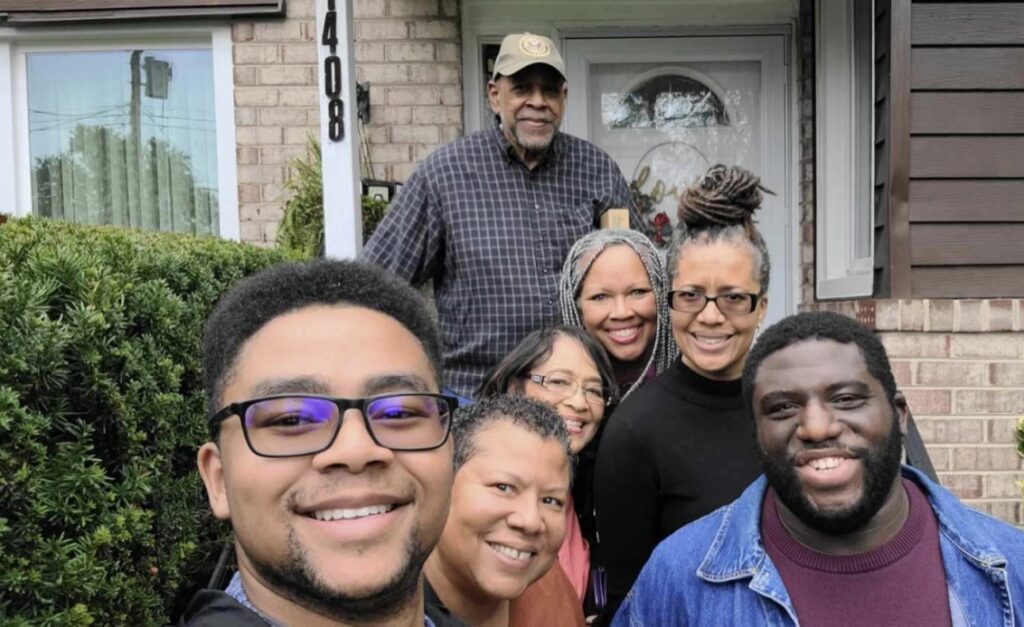
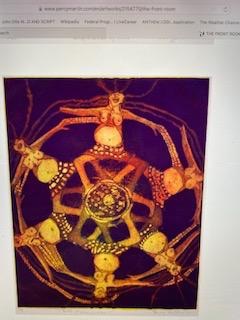
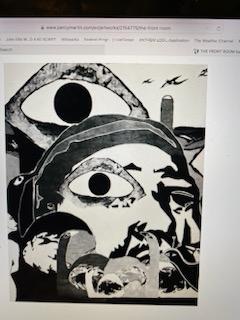
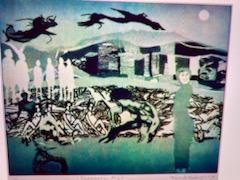
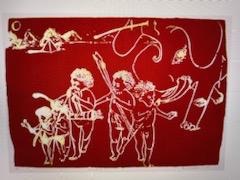
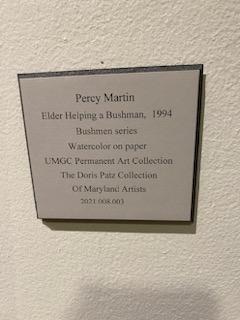
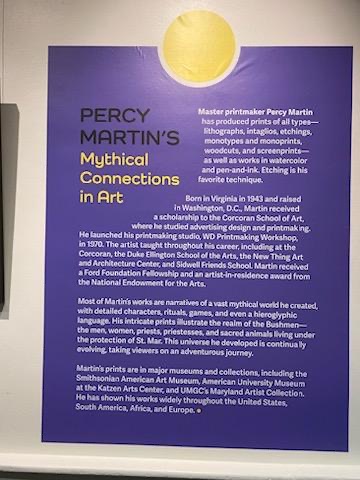
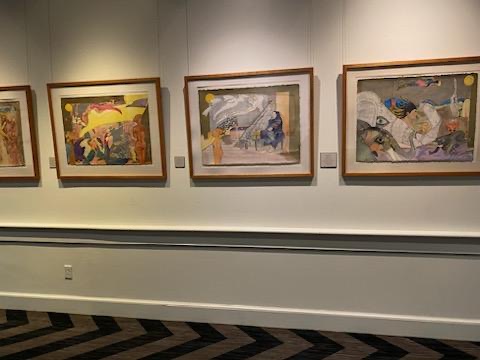
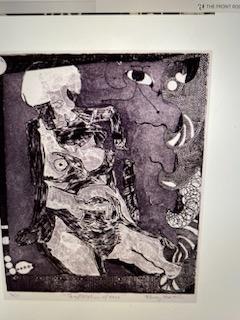
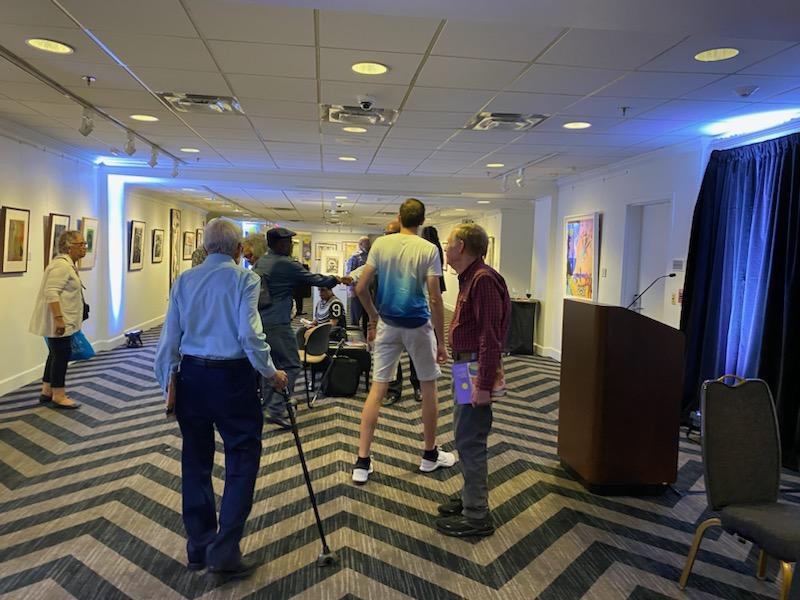
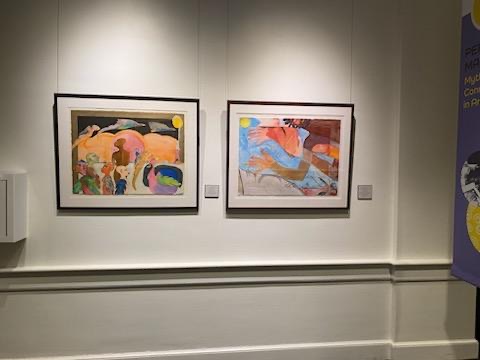
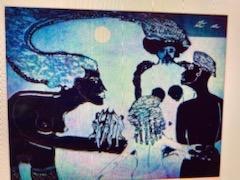
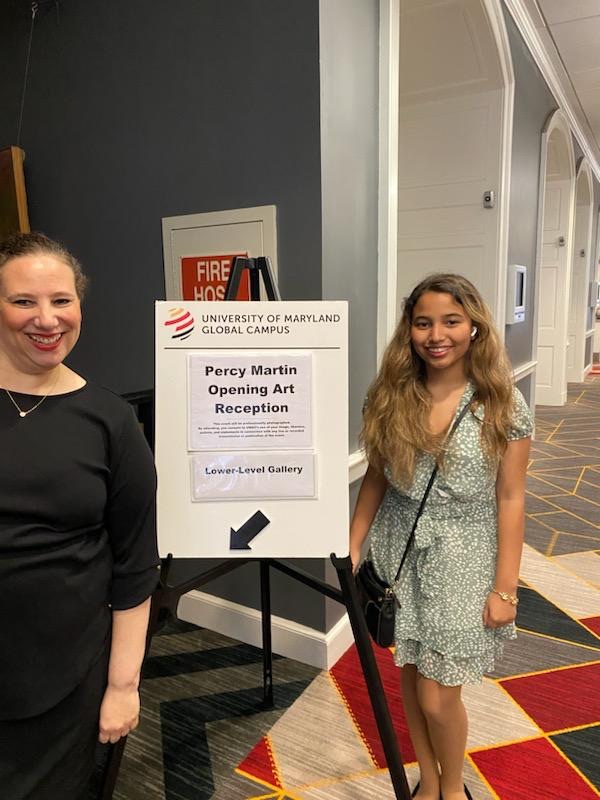
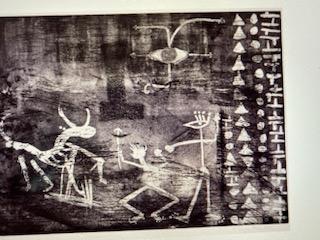
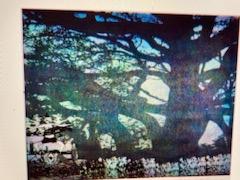
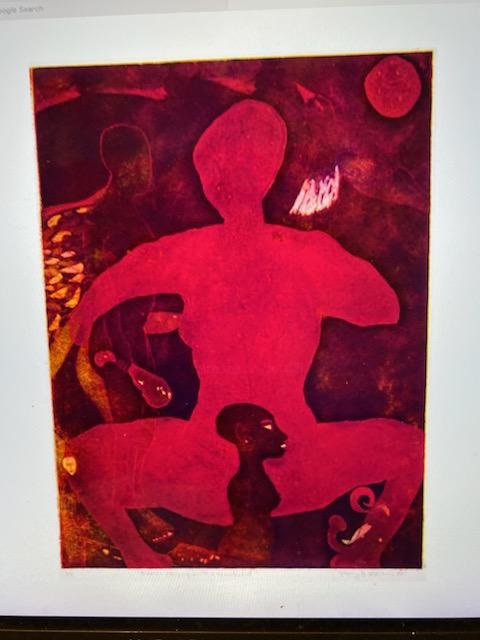
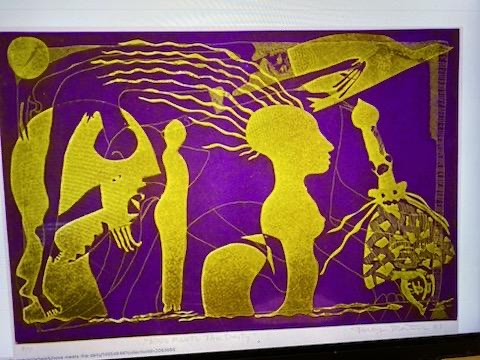
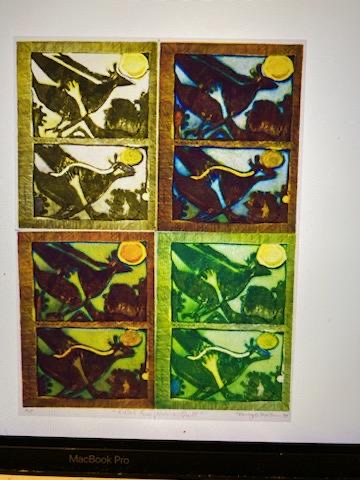
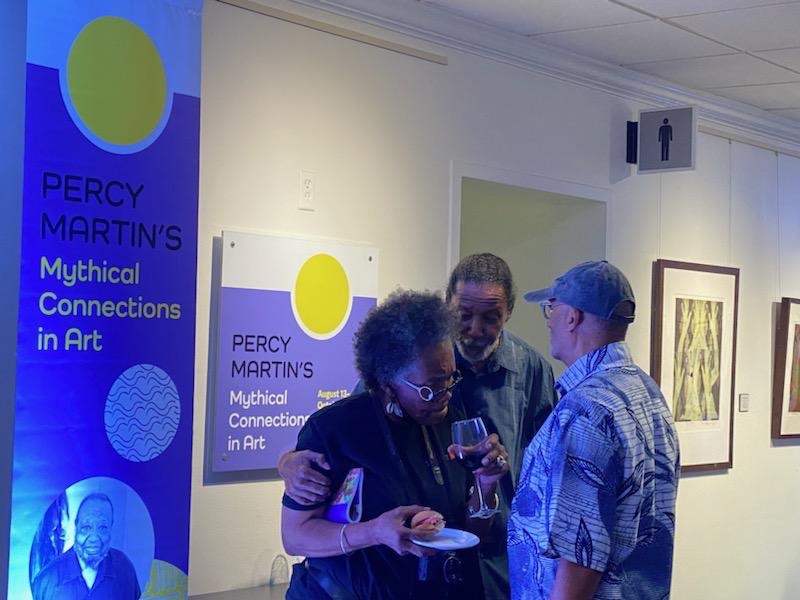
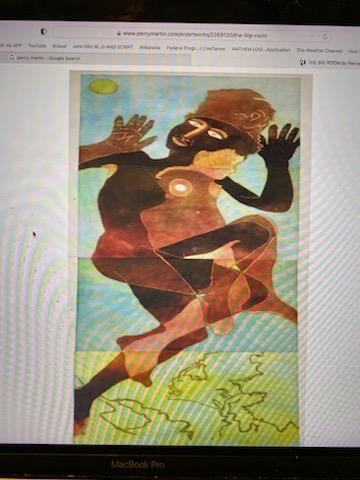
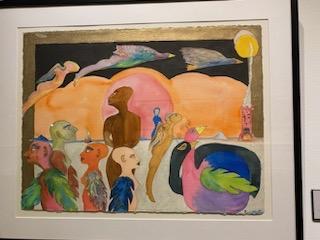
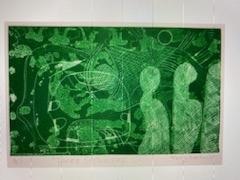
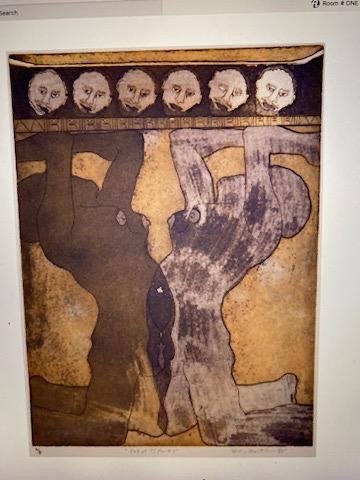
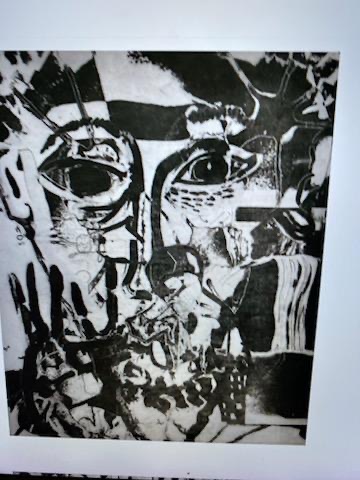
Proving both sayings that “the best-laid plans go awry” and “when life give you lemons, make lemonade,” my family and I went to a museum in Maryland on a Sunday to see our cousin Percy Martin’s exhibit only to discover that the building was closed. One of my sisters persuaded a maintenance man to unlock the art building’s side door, yet the gallery itself was also closed. Prominently displayed on the gallery window were the hours: Mon-Fri from 11 AM-4PM.
Unexpected Historical Facet
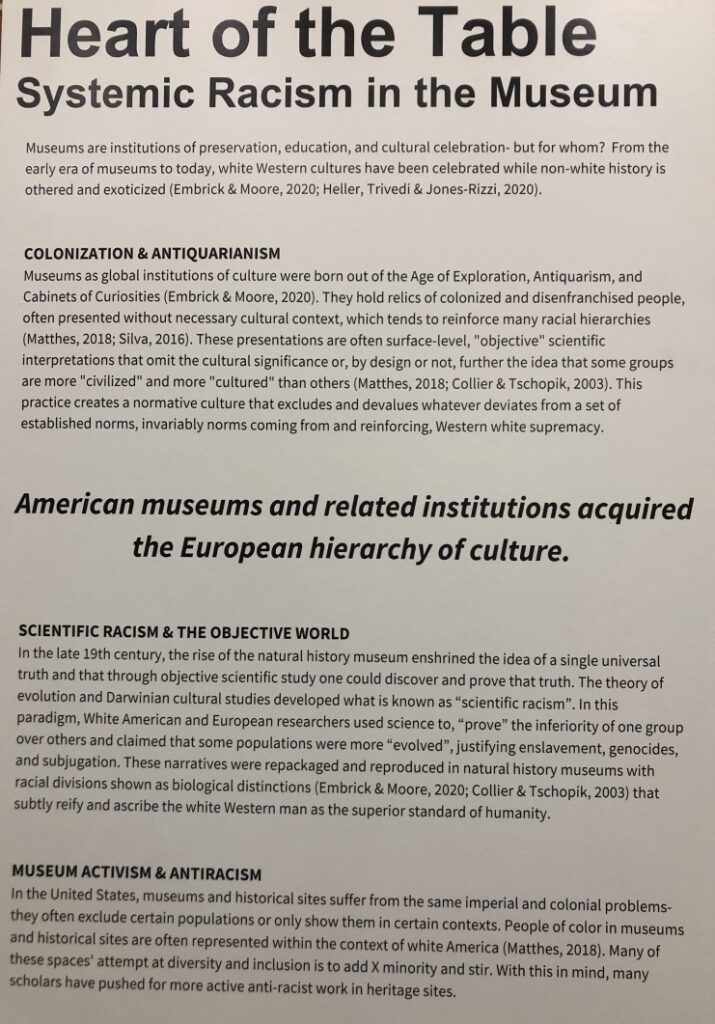
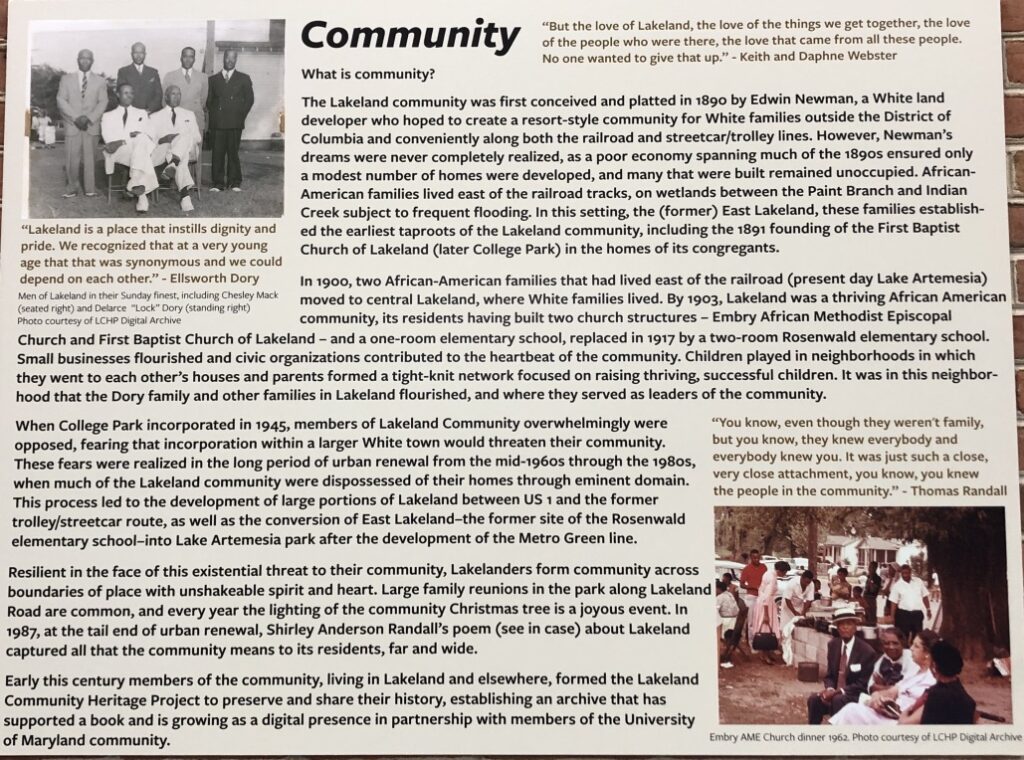
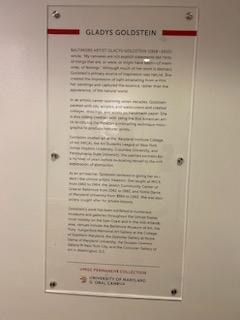
We saw other paintings and a set of cardboard pieces arranged in 3D shapes, which were obviously class projects. The exhibit that resonated with me was the brief history lesson about systemic racism in the surrounding area. After seeing on the news how Floridian institutions have been under attack for such content, it was refreshing to witness.
A Deeper Dive
We couldn’t find anyone else in the building to open the gallery. One of my sisters questioned two different people in the parking lot as we were about to leave. Both said they couldn’t open the gallery, so she texted Percy’s daughter to see if we could visit the artist himself. In the meantime, she called another cousin who had attended the artist talk the month before.
Lunch Break
While sitting in the car, talking to our cousin in attempt to come up with Plan B, my sister spotted a third person in the parking lot. She handed off her phone to our sister to approach that person. Next thing we knew, they started walking out of the parking lot in the opposite direction of the museum. By the time I realized that none of us had any means to communicate with her, she and the dude she’d approached were out of sight. All I could think of was, “What a perfect ‘Taken’ situation and none of us have a special set of skills.” I just prayed that that unsuspecting dude was a nice guy with no general woman-abduction scenarios in his back pocket.
Before We Go
After an uncomfortable amount of time, she returned, telling us that the guy had escorted her to the student union in hopes that someone there would have keys to the museum or the student union gallery. They’d struck out on both pursuits. I told her next time to use someone else’s phone to call her phone and check in with us. She hadn’t thought of that, but at least she was fine.
Humble Beginnings of an Artist
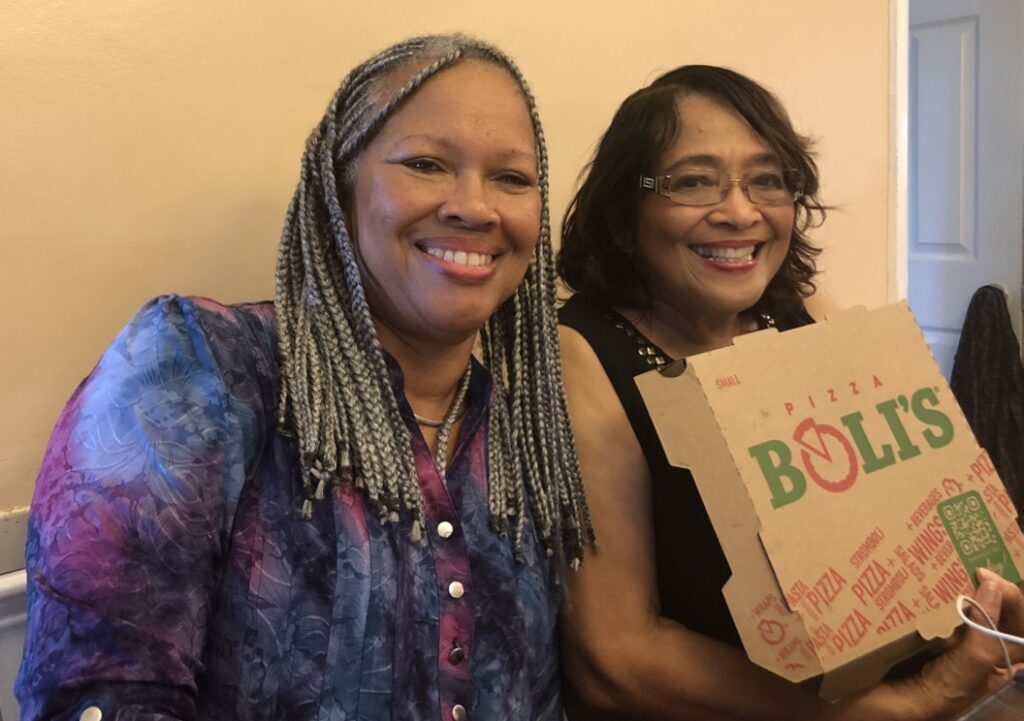
Our Plan B: go over to another cousin’s house who lived near Percy. We’d finally heard back from Percy’s daughter who invited us to come over for a visit after two. That was a few hours away, so we had an enjoyable time at our cousin’s house, including eating pizza since we were out later than anticipated. Originally, we wanted to hit the road back to NC by then, but we figured talking to the artist himself would make the whole trip worth while.
Prolific Artist
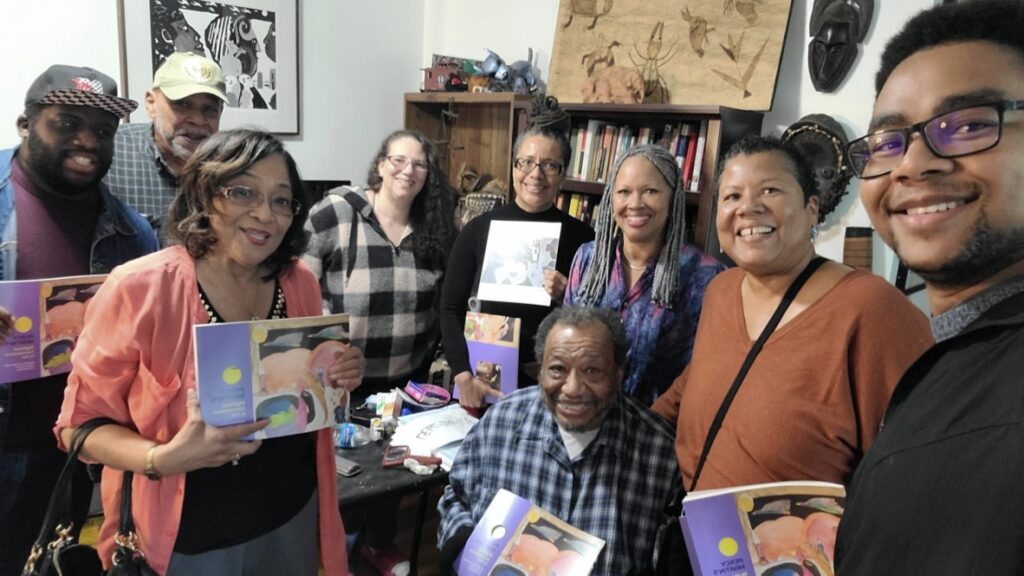
We truly got more than we bargained for. My cousin and her husband drove separately to Percy’s house since they showed us how to get there and would drive back home. Instead they stayed the entire time, which turned out to be over an hour, thanks to me.
Passing on the Knowlege
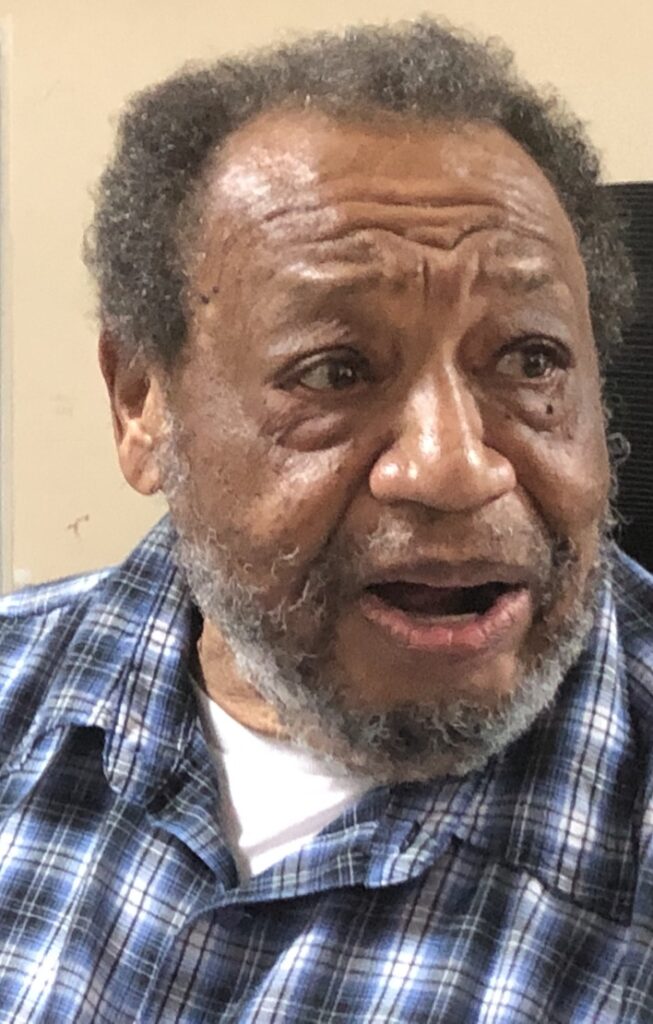
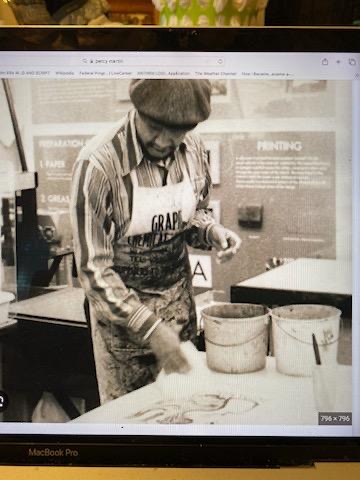
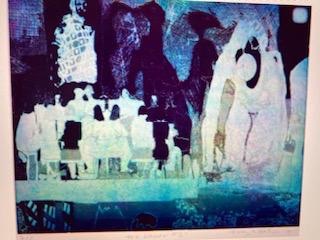
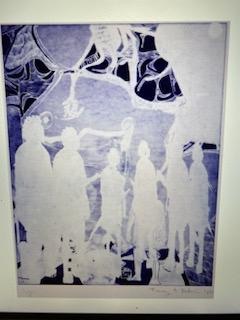
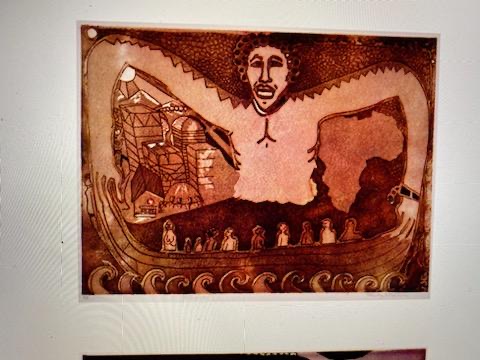
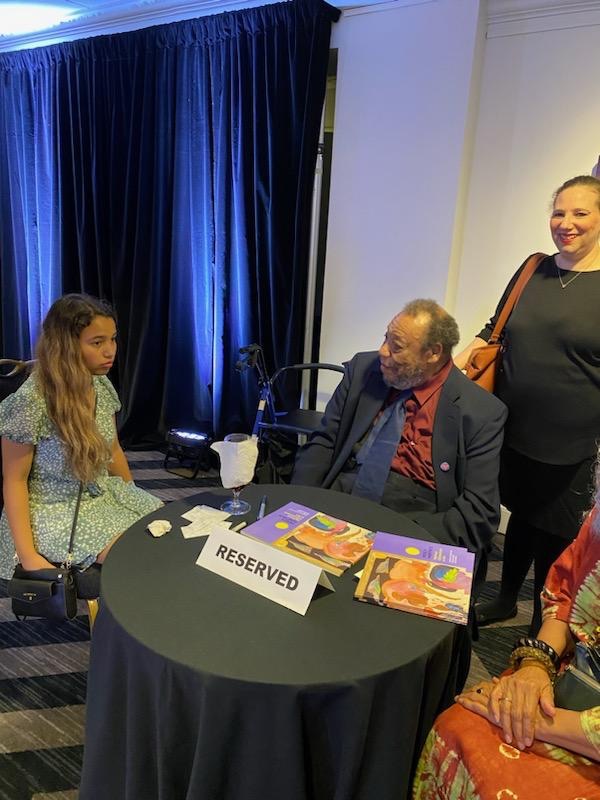
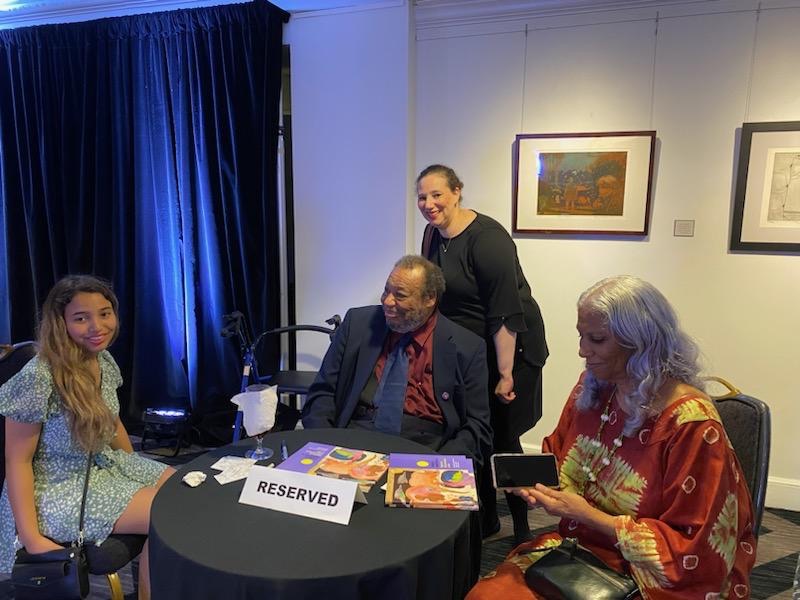
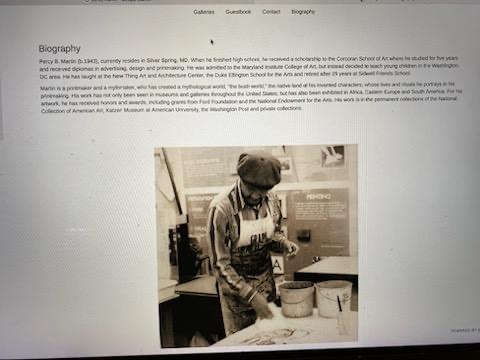
As soon as we arrived at Percy’s house, I introduced myself to him and asked if I could interview him for my podcast. He was ready to go. As a matter of fact, he invited me into his studio where we had a quieter environment to conduct the recording. He started, unprompted, telling me his story.
Here was an artist who had been interviewed so many times, he already knew several places to begin, leaving me to catch up. When he took a breath, I informed him that I was recording, which I don’t know if he cared or not, but it still seemed like the ethical thing to do.
From there, I was amazed at the life he led during his childhood when he discovered at age 8 that he wanted to be an artist and the famous people who he crossed paths with by virtue of living in D.C. As enthralled as I was by his back to back stories that flowed from one to the next, I was mindful of the time.
My original plan was to keep the interview at a tight 30 minutes, but he was still going strong with his storytelling. Once we blew through the 30-minute mark, I watched him to see if I detected a look of fatigue cross his face as did when I’d interviewed one of my uncles who was in his 90s. No such look appeared since I believe he’d had a nap prior to our visit. Not only that, but he admitted once the interview concluded that no one had been by to see him in a while. Such a heartbreaking admission to hear from a vibrant storyteller.
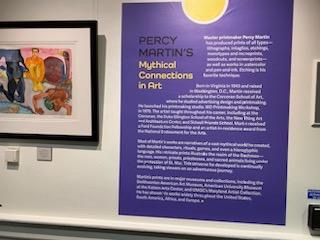
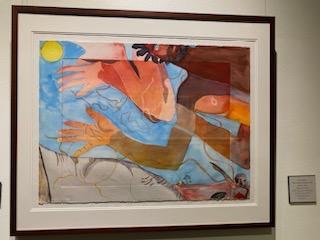
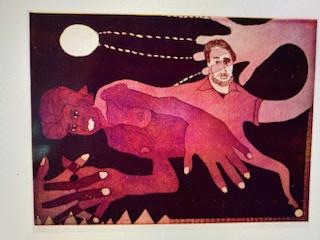
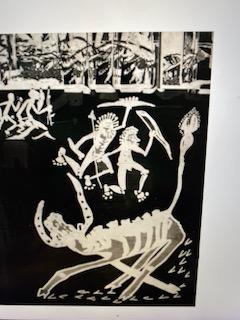
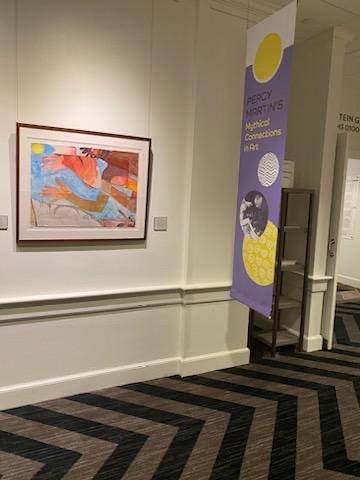
Another cousin, who had attended his artist talk a month earlier, shared her photographic documentation of the event:
While interviewing one of my cousins for the latest episode of “Strange Family Folklore: Where the Paper Trail Meets the Genetic Trail,” she kept referring to “Anne Swanson.” Nearly a week prior to our interview, I’d discovered a report that detailed Anne Swanson’s extended family, who were my maternal grandfather’s mother’s side of the family.
We came across the report when my sister and I organized the pantry part of our parents’ front closet. As I looked at the family trees contained in the report, I found several different Annes. Not only that, but Anne Swanson had a daughter whose middle name was also “Anne,” which she chose to go by rather than her first name.
Throughout the report, last names were dropped from family trees and people were referred to by their nicknames in some places and their Christian names in others. That alone motivated me to update the report.
As I studied the family trees, I came across a branch I knew the most about: my maternal grandfather and his children, including Mom. To my horror, my aunt who’d died in childhood, was not listed as one of the children. I knew that once I finished the post production of the latest SFF episode, I’d start updating the report.
My usual approach to any project, is to work a little at a time. Before diving into the update, I researched how to create a family tree with the Word doc tools. Next, I researched how to select some pages to appear landscape style while others are portrait.
I read how to do those things for two reasons. First, to know that the program had the capability, and secondly, I wanted to jump into recreating those family trees.
Apparently the Anne who’d put the report together also placed a high priority on the family trees. She’d used graphing paper to neatly organize each family tree and had oriented the paper landscape style to provide more room.
There have been many innovations since 1978 when the report was completed. Once I have retyped and updated what already exists in the report, then I will begin filling out who people were beyond the one-sentence descriptions as found in several places.
This isn’t a criticism of Anne’s work. I appreciate her laying the foundation. According to her own description, she was a very accomplished person who may not have had the time or help to flesh out every family member’s entry.
I’m going to do my best to advance what she put in motion.
I never met my Great Uncle Daniel AKA “Uncle Down,” who was the third child of my Great Grandfather Jesse and his second wife, Great Grandmother Lucy.
Yet, from the colorful stories I’ve heard about Uncle Down, I recognized the vibrant spirit that runs throughout my family.
Fortunately, I interviewed two of my older relatives for the Strange Family Folklore podcast. One of whom, my mother, Velma Mae Roberson nee Strange, reminisced fondly about how Uncle Down’s horse tricks and broom dancing in “Uncle Down, the Horse Trickster” episode.
On the other hand, one of my second cousins, Ted Strange, Jr., who is a year younger than Mom, painted a vivid picture of Uncle Down’s tobacco farming and moonshining in “The Daring Uncle Down” episode.
Two things that both Mom and Cousin Ted drove home was how Uncle Down and his wife, Aunt Carrie, absolutely loved children even though they had none of their own. Secondly, on their fertile property grew a veritable garden of Eden’s worth of fruit. Given Mom’s and Cousin Ted’s descriptions, I can almost taste all that homegrown produce.
The consolation prize of not having videos of Uncle Down’s horse tricking and broom dancing are the firsthand eyewitness accounts recorded for future generations to enjoy.
I couldn’t believe that more than two months had passed since I’d interviewed my sister. Although I didn’t have to start at the very beginning of my learning curve when it came to setting up the USB mics, recording, transcribing the audio file, editing the file and exporting it to be embedded into this blog post, I almost forgot the details of how to do it. Almost.
This time around the whole process went much smoother than the first time. I spent far less time beating my head against the wall, which meant I didn’t dwell in trial and error land. I actually fine tuned my editing skills. I still have room for improvement, but this clip is much cleaner than the one I edited when I interviewed my sister.
The best part: since my roommate, Stephanie, always talks about narcissists, AKA “narcs,” I’ve got plenty of opportunity to interview her for a multi-part series.
As an added bonus, here’s the edited transcript:
Teresa Roberson 0:00 Hello, Stephanie.
Stephanie 0:02 Hello, Teresa.
Teresa Roberson 0:04 How you doing today?
Stephanie 0:06 Well, you know, I do narc research and race research. So, as well as can be expected.
Teresa Roberson 0:14 You know, you say "as well as to be expected," but I'm thinking "Oh, is that why you're mad? Is that why you're mad every day?"
Stephanie 0:22 No, dude. And being able to see so much the connectivity between racism and narcissism. What I'm learning through my research is that a lot of people's trauma behavior, make sense. Like a lot of people who do things that that might irritate a lot of people. There is usually a very simple reason why they're doing it. Well, I say "simple," but basically, there is a reason why they do it. And you can actually try sift through their behavior.
Teresa Roberson 1:02 When did you start doing your research on narcissism?
Stephanie 1:06 A friend of mine sent me a video with Dr. Ramani Durvasula last year and said, "Hey, you should watch this video." And it was about narcissism and Dr. Ramani Durvasula is the most well-known scholar on narcissism and I watched it and I was like, "Oh, dear goodness." And I listened to that video, while simultaneously reading How to Hide an Empire by Daniel Immerwahr. And I noticed the patterns, the ups and downs, the boredom, the thrill seeking. Everything about this is almost every single page I've been reading from this American history book and the more I read about history, and the more I see what the plans for the future are, the more I see the patterns, especially in our current paradigm in the United States.
Teresa Roberson 2:14 So, what are the narcissistic patterns that you've noticed?
Stephanie 2:19 So, the biggest ones that I've seen are control without responsibility because narcissism at its core is an impulse problem. And so, what was the originating impulse problem? Some European sailors came to the continents, saw something they liked, and wanted it. Well, indigenous people were like, yeah, we live here. Yet have some food, get rested and peace out. And the European sailor was like, “You know what? No, I don't feel like doing that.” And so, the different indigenous groups were like “Yeah, ya know, but we didn't, no this is, this is where we live, and it's fine that you want to come visit, but you don't understand how this works. And there's even research that's just been shown that says because of the quote unquote exploration that occurred, that's actually what set off climate change, ie you basically had a whole bunch of people come and take over an area, not knowing how it works, not knowing the ecosystem patterns and how to sustain them and broke it. Basically, the indigenous people kept trying to say “no.” And the European settlers just said, "No, you don't get to say ‘no.’" They changed laws. They change circumstances. The most obvious permutation is ironically, our neighborhood with Domain Riverside, ie, people live here. People have lives here. And because somebody sent a nice PDF to the city council and the planning commission, well, that's the end of our neighborhood. We're just gonna go ahead and add Domain Riverside. So, control without responsibility is the biggest element of narcissism that I've seen throughout my research.
Teresa Roberson 4:47 So how is it that some foreigner can come to an indigenous land and say, "This is the law."
Stephanie 4:56 And that is what people have basically failed to see. For example, we are having a pipeline struggle both with Canada and in South Dakota. And the reservations are, of course, the last vestiges of these “foreign countries,” for lack of a better definition. And they've basically said, “No, you actually don't get to run this pipeline through here. We live here. This will destroy our water when we're done here.” Yes. And the way you do it is by force. And so, one of the reasons why the reservations got so much, why "reservation" is even a term that we're familiar with, is because a foreigner refused to hear a "no," knew that they were not entitled to it, but decided that because they wanted it, it was theirs. They used force and basically decimated hundreds of thousands of people in favor of their perception of reality because another part of narcissism is a false reality. It's you have one vision of how the world should be, whether or not the world is actually that, is not necessary and it's not relevant. But because of your vision, you're entitled to, to fulfill your vision, even if it comes at the expense of someone else.
Teresa Roberson 6:33 All right, so you talked about force. Is it just weapons?
Stephanie 6:37 It is not just weapons. And it's interesting that you said the law because what happened during the quote unquote, American Revolution. Well, basically, some foreigners came over, decided I see it, I want it, it's mine. And then they crafted this Constitution, which included eminent domain, which says that the government can seize land if it's for the good of the country. Well, that's basically saying, "I know you said 'no,' but my 'yes' is more powerful. And I just changed the law. And because I changed the paradigm, and refused to acknowledge your 'no,' it's actually 'yes' now." And if you're like, "Look, but Stephanie, that makes no sense." You're right, it does make no sense. And that is what is happening right now. We're kind of in an era of disillusionment, where everything about the propaganda about the founding fathers and fighting for freedom that had nothing to do with the creation of this nation. This was all about, I see it, I want it, it's mine. And they put all of the elements they created a heck of a marketing campaign that basically said, "Oh, yes, and because we created these laws, your laws are irrelevant. I'm sorry, we have guns and that backs up our laws. It's kind of like the College Board was created so that black people couldn't go to college. And people will often say, "Oh, but we need the SATs and the GREs because how would we know that everybody's worthy to go to college? And it's like, you realize that college was not mainstream. And that was not that was something that everybody could or could not choose to do. And when black people finally realized, "Hey, you know, we like to nerd out. Let's all go to school too. They then said, "Well, we don't want you here. So, we're going to create this barrier that basically says, "Oh, you can't get prep, you can't learn how to do this, then you won't be here." So, when the dominant narrative basically adds a barrier, or shifts the paradigm, that's basically telling people that, you know, with enough propaganda, people get used to the idea that that's the way it always was. And that just makes sense. And what is so frustrating to so many people actually in the dominant narrative now is everybody's like, but we literally had no right to do all of those things. People just did them. They just did them and then they created a fake piece of paper and created a fake system that said, "No, the answer is ‘yes’ now." That was backed by force. So that is the narcissus’s greatest tool, their reality and their demand that everybody adhere to it.
Teresa Roberson 10:00 Thank you so much, Stephanie, for at least explaining the beginnings of your narcissism research.
Stephanie 10:06 Oh yeah. Don't worry, there'll be more.