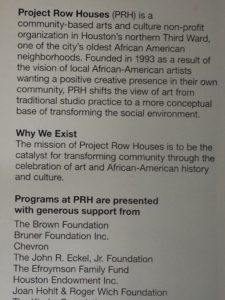
One of my friends sent me a call for submissions link, inviting Black female artists to do a voice recording of a famous Black writer. The recordings would then be played in one of Houston’s historic project row houses. On Sunday, May 21st, we made a 3-hour road trip to visit the installation.
By the time we found the place, we had about 45 minutes to view the houses. We first checked in at the main office both to use the bathroom and to speak to the artist who was on duty at the time. Just so happen that she had been planning to move to Austin sometime in the hazy future and wanted to create a similar project there. My friend exchanged social media information with her and I gave her my card and invited her to attend The Austin Writers Roulette.
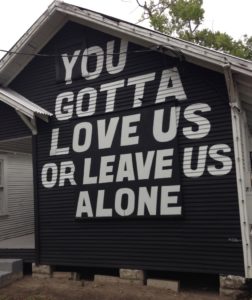
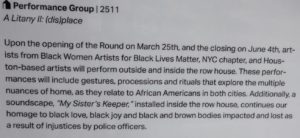
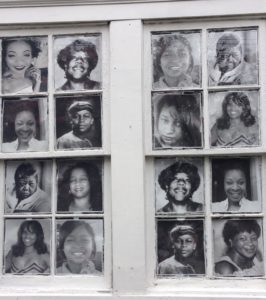
The first row house installation we visited was dedicated to the Black women who were affected by police injustice. The sound recording played a Black female choir, singing about being their sister’s keeper.
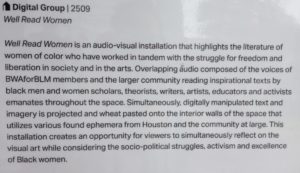
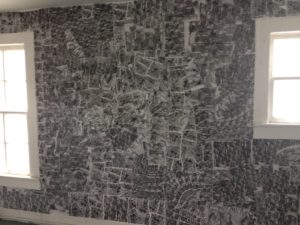
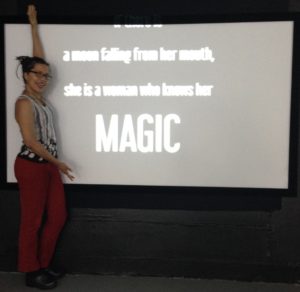
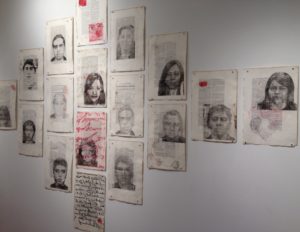
The adjacent row house had been wallpapered with block print designs except for the wall, which had been painted black. A screen had been installed. A video that scrolled the words to the recorded recitations, which played on a loop. We sat on a lone bench, listening and reading the words to ourselves as the recorded voice recited the passage. When my recording came, I ran up to the screen to pose with my passage. I love that the only word that photographed clearly was “MAGIC.”
After experiencing the installation, I used my phone to find a nearby upscale cafe. Initially, I wasn’t in the mood for “salad and sandwiches,” but I figured since we had a 3-hour trip back to Austin and they had a wine menu, this would be a quick meal to get us back on the road.
For the most part, that happened. I ordered their signature salad with smoked salmon and a glass of Malbec. My friend ordered her entree and a glass of wine. Everything came out in a reasonable amount of time although I had to ask the other server for water since that’s the one thing our server forgot to bring.
And then it happened. During our conversation and dining, time ticked on and we became invisible. I noticed our invisibility sooner than my friend since she was animatedly talking while her back was to most of the restaurant. She couldn’t see how the two servers buzzed around, interacting with all the other tables except ours. Our server briefly noticed us when he had to rearrange the small tables where we were seated to accommodate a larger party. He removed my friend’s empty entree plate before moving our table over along with the other smaller tables that shifted to the right to accomodate another large party at the far end.
That was the last time we had his attention. He flitted among the other tables in our row, especially the original large party to my immediate right and the newly gathered large party at the other end to my left. He even checked on the table to my immediate left, which was just a couple, but would turn on his heel away from our table, missing the few nonverbal attempts I made to get his attention by raising my hand and checking his eye.
I think it’s obnoxious to raise my voice to get a server’s attention. Or tap, grab or otherwise touch servers as they’re hustling around every other table. Besides, as I observed our server’s interactions with the other tables, none of those people had to do that to get his attention. They were successful at nonverbal and nontactile gestures.
That’s when I started to play my least favorite game: Intersectionality. There’re two versions of the game: Invisible and Singled Out. In one version, the player tries to figure out why she’s been suddenly rendered invisible within a seemingly normal situation. In the other version, the player tries to figure why she’s been suddenly singled out within a seemingly normal situation. And when I say “seemingly normal situation,” I’m referring to how everyone else that the player sees is NOT experiencing the same treatment.
Whichever version of the game the player unwittingly finds herself in, she analyzes how she got there. So, in my case, was it racism, sexism, classism, a combination or something else? I easily dismissed classism since we were dressed better than most although I’m sure we weren’t the most moneyed people there.
The next thing I ruled out was mere racism. The café was filled with a rainbow of hues, including interracial couples and mixed raced tables. Even the parties where there weren’t any white people still had servers approaching them.
That’s when I noticed we were the only table without a guy. Even the two black guys who sat together at the bar hadn’t turned invisible. Since our server was an Asian male, I wondered if he had a predisposition to focus on men. Ironic because he had a female boss.
At one point, during a break in my friend’s conversation, I blurted out, “Do you notice that we’ve become invisible?” She readily agreed and volunteered to talk to someone about it. I thanked her since I’m normally the one who has to have the confrontational talk in such situations. Her response: “Well, you drove.”
She calmly arose from the table and confidently strode to the bar where the other server was. In the distance, I saw the polite smile on her face as his expression transformed. Then, just as calmly as she’d left, she returned to the table, leaving him to scramble to get a water pitcher and dessert menus together.
Essentially, she’d informed him that we were from Austin and we had not come to Houston to have a Black Moment. However, our server had not refilled our water glasses when he refilled the other tables to either side of us nor had he told us about dessert. We’d just overheard the description of it when he told the large party beside us about it.
The other server refilled our water glasses and brought us menus before I witnessed him approach our server and tell him our concerns. With much remorse, our server arrived at our table and apologized. He told us that he’d been very distracted by the two larger tables.
At that point, I held my tongue since the table to my immediate left was just two people, who had received the server’s attention, which I’d concluded was because at least one of them was a guy. While I had that inner conversation, our server described to us the delicious locally made ice cream. We both ordered the Nutella with studded marshmallows, which he comped.
I ate my free ice cream with less enjoyment than dessert usually brings me. It was a nice gesture, but I’d much rather had paid for my ice cream with money versus his embarrassment of rendering us invisible.
I realize this was an “isolated incident” only in the sense that the conflict was de-escalated and resolved peacefully and had not become an on-going protracted argument between the server or the cafe and me. However, that isolated incident has become the latest star in my personal intersectionality constellation. There are quite a few stars in that constellation. They vary in size and intensity. All the isolated incidents forming a pattern that’s easily recognizable to others who have similar constellations of their own.
When I look inwardly and mediate on a reimagined freedom, I see my constellation where no more stars have been added.