Some view decluttering as embarrassing proof that your home, car, garage, or whatever space where you regularly dwell within is “junky.” I view it as an opportunity to transform the space into something more in alignment with how the space is used.
The latest work-in-progress is the den. Although everyone loves propping their feet up, there is only one reclining piece of furniture in the den. Some of the furniture is older than me (52.5) and needs to be put to pasture.
To get the ball rolling for reimagining the space, I researched reclining sectionals. Once I showed Mom the results during the week, she impressed me by going to a furniture place after Sunday dinner. By the time we left the furniture store, Mom had bought two reclining pieces, thanks in a large part to me handling her objections.
I told the salesperson that I deserved part of his commission because I was the one who’d closed the sale. He agreed, but apologized that he couldn’t pay me a commission. Sure, we’ll go with that story. I’m just happy that the new furniture will be delivered in a few weeks.
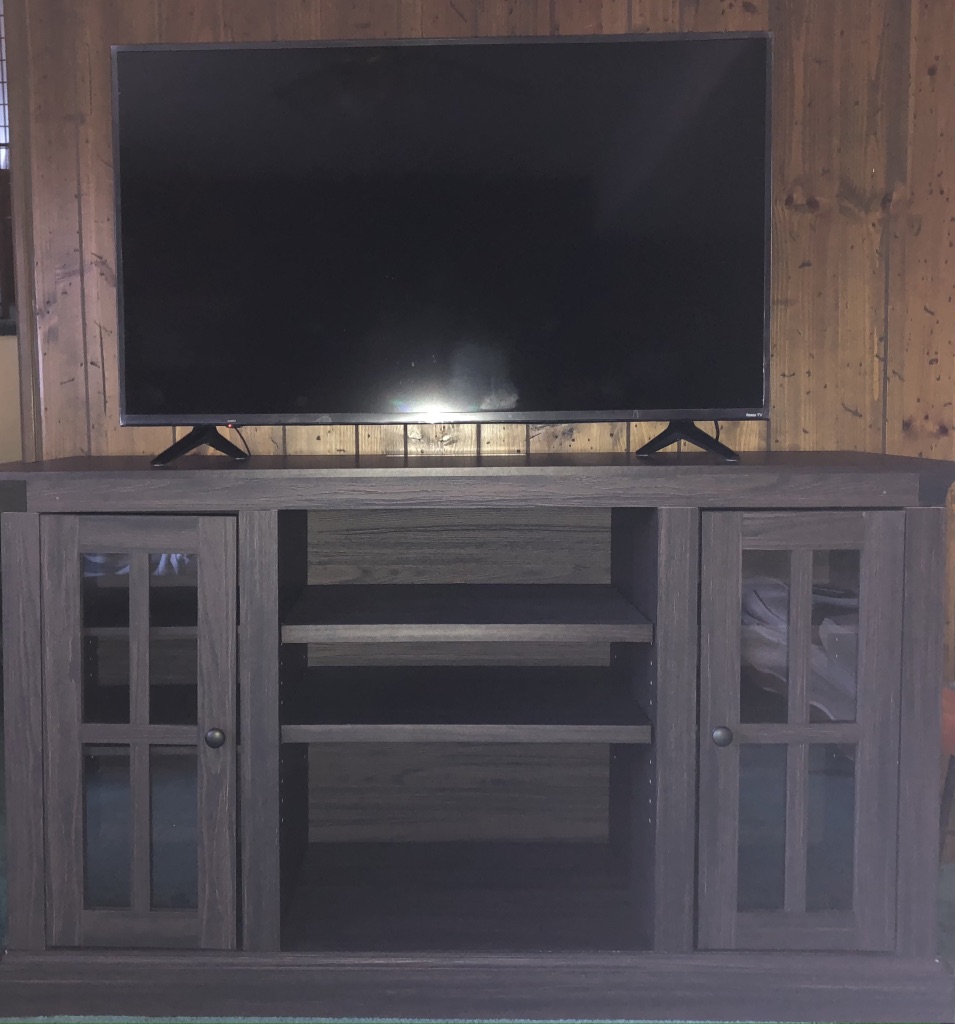
The following day after dance class, I bought a TV stand that was both decorative and had storage space. I knew that Mom preferred dark wood and that my sister was going through both the end table, which Mom wants to get rid of for some inexplicable reason, and the defunct “computer desk.” There’s no computer on the desk. Just two printers, only one of which is used and a lot of other things that can either find a new home, be thrown away or recycled. The main objective is to donate the desk and make space for the reclining sofa.
I underestimated how involved assembling that TV stand would be. Right out of the gates, I switched from following the printed instructions to the 3D instructions on the manufacturer’s app, which I downloaded on my phone. I enlarged the image and rotated it to see how the pieces fit together. I hit replay on a particular step as many times as I needed to before completing that task and advancing to the next.
By midnight, We were more than halfway through, which was good, considering we’d begun after 9:30 PM. Hey, I had to shower and eat a snack after my dance class. I certainly didn’t want to preempt my regularly scheduled activity to assemble furniture.
As much as I love building things, I’ve learned my lesson with that TV stand. First of all, I’m not going to assembly anything that’s in a box that I cannot lift/drag by myself. Secondly, if I ignore rule number one, once I see that the needed tools aren’t included in the box, I’m going to hire a Mr. /Ms. FixIt to put that shit together. I wouldn’t mind being their assistant, but I’m not running point on such an endeavor again.
After a third night of working on the TV stand, my sister finally said that I should have bought a stand at a furniture store, already assembled, and delivered. I agreed. I wasn’t about to argue that I’d saved money.
I’m creeping up on being “too old for this shit,” and thanked her for sharing in my latest life lesson. The following morning, she texted that she had borrowed a hand drill from a friend so we can finally secure the shelves.
POWER TOOLS…can I get an “amen”?
From here on out, no assembly job will be attempted with manual screwdrivers. At least in the past, my own set of tools had magnetized screwed drivers. In my haste to just “get her done,” I’d not given proper consideration to the tools being used.
Once my sister opened the hand drill case, I asked her if she knew how to use it. She demonstrated by unscrewing four of the door screws that I had painstakingly screwed in manually the night before. She straightened them out, correcting how the door swung open.
That was all I needed to see. I relieved her of the power tool and went about screwing in all the shelves and the backing in record time.
In less than a fortnight, the rest of the den transformation will be complete. I’ve arranged for the old furniture to be removed the day before the new furniture arrives. Not only will there be more space, but the space will be conducive to how we want to use it.
Months ago, I had an epiphany: I didn’t need to “good job” my way out of Texas. I stopped putting undue stress on myself with the weekly job hunt rat race. My current job was portable. All I had to do was make a plan to leave.
Once I returned home, I resisted most attempts by other people to pull me into extracurricular activities since I didn’t have the mental bandwidth for much. I’d packed up and relocated 14 years of my life and unloaded all of it in one bedroom in my parents’ house. That in and of itself was a great source of stress, time and expense.
Being back home was the financial restart that I needed. Plus, I, along with my sister and her son, were able to do the literal heavy lifting my parents needed to organize their things through storage, recycling or throwing it away.
A new financial picture started to form after a few weeks. Although I had the thin illusion of disposable income, I was highly aware that my life was subsidized by my parents for the first time in over 30 years. On the one hand, I was fortunate to still have this option. On the other hand, I needed a new mojo.
I’d joined a CBD company as an ambassador about 9 months prior to the pandemic. My heart had never really been into recruiting others nor selling although I loved the products. I’d dedicated my efforts on the other things I was juggling. Few of them were money-making ventures.
As a matter of fact, my attitude toward making money had ranged between, “if I do good work, the money will come,” and “if I’m organized enough, the money will come.” At this point, I know better. The facile belief that the quality of my work would govern how much money I earn is so far removed from most of my experience.
After reassessing my financial situation, I revisited the CBD company and researched investing in a different pathway to success. Something that’s more tailored to what I’m actually willing to do. After all, writing a business plan that one doesn’t put into action isn’t actually a business plan. It’s a fiction. So far, none of my fictions have motivated me to quit my day job.
With my newfound parental subsidy, I now can feasibly and comfortably invest in setting up myself in business with a virtual warehouse. The biggest appeal is that my customers will be able to place an order with me, then the company packages it up and ships the package to the customer.
I felt energized coming up with this plan. Not only is it a new endeavor, but if successful, the additional income will allow me to quit my day job and have control over my own schedule…AGAIN.
My sister invited me to participate in the Trunk or Treat activity at the church where we attend. I’d never heard of it before, but apparently it’s been going on for a while…to the extent that there are costumes to deck out one’s car that can be bought online. Of course. Halloween is my favorite holiday, but this past celebration was bittersweet because I’d donated all my costumes before relocating, so I couldn’t just throw something together for this event.
Plus, in my mind, I’m still in the process of getting settled. It’s more than simply unpacking my things. I’ve passed many a day stuck in rumination, so I hardly gave more than a passing thought about this activity. My sister and I even went shopping for some decorations a few weeks prior to the event, but nothing really clicked since I thought she was simply using my car to run her own Trunk or Treat activity.
As we got closer to the event, I’d brainstormed “Musical Pumpkins,” played like Musical Chairs except instead of walking around chairs as music played, kids would pass small pumpkins around in a circle until the music stopped.
In order to get a better idea of how we’d run our own Trunk or Treat, we visited another such activity at a school the week before.
Ever so popular Mario Brothers
The Haunted Cemetery
Or was it a portable haunted house?
More Mario Brothers
Skeletal Remains
Pumpkin Patch
Candyland
Spiderwebs & Pumpkins
The Nightmare Before Christmas
We didn’t participate in a single game and as far as getting candy. My highbrow self didn’t care for any of that cheap stuff. If I was going to challenge my prediabetic status, it might as well been with the good candy. In the end, I accepted a fun size pack of peanut M & Ms. Peanuts are nutritional. Besides, there were only five or six pieces. Nothing too bad to make my left eye throb…my internal monitor that there’s too much sugar in my blood.
Musical Pumpkin Patch
My sister bit off far too much. I knew that she was in charge of the event, but I hadn’t realized how much she’d signed off to do rather than delegating the work. In addition to decorating my trunk for Musical Pumpkins, she decorated two other trunks; had chopped onions in two different styles for the hamburgers and hot dogs; provided games for other people; had made a game out of styrofoam and a cardboard box; and circulated around the event, which was held in the church parking lot. In other words, I was left alone to run my activity.
Pumpkin Ghost Game
My sister had put a lot of effort into making the Pumpkin Ghost game, but turned out that no one needed it. I took it off her hands. The objective was simple: manipulate the box to place the three balls, which were painted to look like Jack ‘O Lanterns, into the three indentations, which were the ghost’s mouth and eyes. The dexterity needed to place all three balls into the indentations eluded most of the little kids, who wildly jerked the box around. The preteens to teenagers got it although I had to reset the balls in the middle of the styrofoam because they’d get stuck along the edges.
Dad playing Pumpkin Ghost
As hokey as Pumpkin Ghost was, I found that I became too invested while watching the kids manipulate the box. Without thinking, I’d be all up in the box myself before recovering and taking a few steps back. Even parents complimented me for such a simplistic, yet engaging game.
For some of the little kids, I encouraged them to try for at least one ball, so I could reward them with a piece of candy. The older kids walked away with at least two or three pieces of candy.
Nighttime View
I could have easily left long before the sun went down, but darkness brought out the beauty of the lights. I believe next time, Trunk or Treat will be held earlier in the day. If asked to participate, I will order a car decoration and have a matching costume!
Can’t believe I waited so long to do this. After all, I’ve written a variety of other things, but for some reason, I never thought about writing my own bible for storytelling purposes. It’s not a coincidence that all the details of a TV series, summed up in one convenient place, has been referred to as a “bible” versus an “encyclopedia” since The Bible is a collection of parables, which details the Christian faith. The same is true for TV bibles for the shows they represent.
For over a month, I’ve been reading through a variety of TV bibles for different genres of shows. By and large, my favorite ones combine the overall feel of the show in pitch fashion rather than a dry collection of facts. Since episode dialogue can be added to a bible as an example of an exchange or to show characterization, the overall gist of the story arcs can be discussed in broad sweeps without getting into the weeds.
TV bibles can take many forms as long as the form enhances the storytelling rather than distracts from it. Some of the detractors I’ve found so far are pictures that don’t reproduce well when photocopied; fonts that are too small and once enlarged, margins too wide to see the complete sentences without scrolling from side to side; and fonts that are smudgy to give it an old typewriter feel.
The best part is that I can quickly jot down several ideas about a show to get them on paper, figuring out plot twists ahead of time prior to writing episodes and committing to all the characters.
Another thing I’d not considered: selling the show. At best, I’m an emerging entrepreneur. At worst, I suck at it. I joke about monetizing certain skills that I have, which I do nothing about because the capitalistic way forward eludes me. Whenever I do make an effort, I’m amazed at how I STILL don’t make money.
Even though I want to have an episode ready in case someone is interested in the show, I’m not clear as what the industry. In other words, the example episode doesn’t necessarily have to be the pilot although that seems counterintuitive to me. I don’t know if the rest of the series would make any sense without the opening pilot. Then again, what do I know?
While interviewing one of my cousins for the latest episode of “Strange Family Folklore: Where the Paper Trail Meets the Genetic Trail,” she kept referring to “Anne Swanson.” Nearly a week prior to our interview, I’d discovered a report that detailed Anne Swanson’s extended family, who were my maternal grandfather’s mother’s side of the family.
We came across the report when my sister and I organized the pantry part of our parents’ front closet. As I looked at the family trees contained in the report, I found several different Annes. Not only that, but Anne Swanson had a daughter whose middle name was also “Anne,” which she chose to go by rather than her first name.
Throughout the report, last names were dropped from family trees and people were referred to by their nicknames in some places and their Christian names in others. That alone motivated me to update the report.
As I studied the family trees, I came across a branch I knew the most about: my maternal grandfather and his children, including Mom. To my horror, my aunt who’d died in childhood, was not listed as one of the children. I knew that once I finished the post production of the latest SFF episode, I’d start updating the report.
My usual approach to any project, is to work a little at a time. Before diving into the update, I researched how to create a family tree with the Word doc tools. Next, I researched how to select some pages to appear landscape style while others are portrait.
I read how to do those things for two reasons. First, to know that the program had the capability, and secondly, I wanted to jump into recreating those family trees.
Apparently the Anne who’d put the report together also placed a high priority on the family trees. She’d used graphing paper to neatly organize each family tree and had oriented the paper landscape style to provide more room.
There have been many innovations since 1978 when the report was completed. Once I have retyped and updated what already exists in the report, then I will begin filling out who people were beyond the one-sentence descriptions as found in several places.
This isn’t a criticism of Anne’s work. I appreciate her laying the foundation. According to her own description, she was a very accomplished person who may not have had the time or help to flesh out every family member’s entry.
I’m going to do my best to advance what she put in motion.
I researched dance classes after relocating to a new state. I’d been rehearsing with an African dance troupe for several months. I wanted to continue dancing even if I had to pay for classes rather than be a part of a performance group.
Just as I’d feared, not only were there no African dance classes, the vast majority of the offered dance classes were geared toward children and young adults. The first and perhaps only adult dance classes I found were pole fitness classes. I didn’t bother researching ballroom classes since COVID’s made a comeback. Now Monkeypox is making a run.
I’d always heard that pole dancing was good for both strength and flexibility. I started out with a style of dance class that could be best described as “backup dancer moves,” followed by level one pole dancing lessons. Next week, I’ll check out both “chair dancing” and “beginning aerial hammock.” The class names alone make me happy that I’ve found this studio.
I’m just fortunate I have something to get me out of the house that’s a form of exercise because my parents’ house is full of good, healthy food along with damn-near addicting unhealthy snacks. I’m eating too much of both for my full-time desk job. Even though I have a standing desk, it’s not a treadmill desk. That’ll be next.
Four months ago, most of us dancers auditioned for a nonprofit West African dance troupe. This rendition of the group’s debut occurred during Creative Action’s first Creative Sunday since the pandemic.
We’d rehearsed for several months.
This was our first dress rehearsal. The choreographer fussed over our costumes like a mom getting her daughters ready for prom. We wore several layers over our sports bras and dance pants/shorts: a gele (head wrap), shirt, lapa (wraparound skirt), belted “grass” skirt, cowrie shell belt and arm bands, cloth anklets, necklace and earrings.
So of course we had to test everything.
One unwritten rule: never dance in a performance wearing something you haven’t practiced in. I made a point of sharing that little pearl of wisdom with everyone. Then on the day of the performance, I did the very thing I’d warned everyone about. Instead of using one of the masks that I’d practiced with many times before,
I switched out the white mask for a black one.
That bad boy flew off dramatically into the wind the moment I started my interpretative dance for “Why Anansi Has Eight Skinny Legs.”
As soon as I wished out loud to be part of a real film set, versus the spur-of-the-moment set where I shot my first short film, the universe granted my wish. Originally, I applied for the “Sound Mixer” position not really knowing what all it entailed. The only other open position was DP (Director of Photography). I learned back in undergrad that I didn’t have the “eye” to be DP. Besides, I’d edited several podcast episodes. All I knew was that the filmmakers, who shared director/producer titles, stated they would rent the equipment if the Sound Mixer didn’t have their own equipment–something I learned while on set to not be the usual case.
Fortunately, my mentor guided me in the right direction by providing a few videos and a blog. Until she did that, I truly thought I’d stroll up on set, dressed in all black, wearing hiking boots and a camelback without having done any research. Thank God I killed the camelback idea and brought a water bottle like a normal person.
The first thing I learned and immediately internalized was: early = on time; on time = late; and late = fired. Since my official title for this set was “Sound Shadow,” which, if I hadn’t known any better, I would have assumed was the latest comic book superhero, essentially meant I was an unpaid intern.
At least I didn’t have to pay for a class to gain this experience. As an undergrad, I’d worked on three student film sets. In that blind-leading-the-blind situation, none of them were at any level of professionalism as this movie set was. Regardless of my volunteer status, I still respected our mutual time and made the most of the opportunity.
The second lesson was an explanation of what “collaboration” means on set. As collaborative as both codirectors/coproducers, who I’ll refer to as A and C, announced they’d be on set, I’m happy I didn’t go with my original plan. Instead, I quietly approached the codirectors to ask a question or suggest something. That way, none of the actors overheard, which might have been confusing.
Plus, if one talks when things aren’t rolling, then they should do so quietly. I witnessed first hand how side conversations get out of hand. I found myself pulling a Ms. Roberson and gesturing two people on set to talk quietly. Given the lag time between takes, there was no way we’d all remain silent, but talking normally was too loud.
On the first day, I parked on the edge of the lawn among the other cars with a minute to spare from my call time (ie, late) and texted one of the codirectors/coproducers, C, about my arrival. I entered the house through a side door, nearest the line of carefully coiled cables–another thing the videos had reminded me: the over-under method to wrap most cables that would minimize damage and entanglement. C met me at the door with a big smile on her face and gave me a hug. (At least her eyes communicated “big smile” since her face was actually covered with a mask. Everyone on set had to show a negative COVID test that had been administered within 48 hours).
As I walked in, I met the Boom Operator, T.
For weeks I’d sung the phrase “boom operator” to the tune of Sade’s “Smooth Operator.” Took me mere seconds after our introduction to sing it to T. It had been my ear worm for a while, but I didn’t quite plant it in T.
Moments later, the Sound Mixer, J, arrived with an impressive amount of equipment, 12 years of filmmaking experience and a remarkably positive attitude for someone who wasn’t a morning person. The most golden nuggets of information I learned from him was that sound mixers were expected to own their equipment, and that he sometimes makes more money renting his equipment verses his labor rate. Although I’ve been a lifelong an emerging entrepreneur, my ears perked up when he talked about “rental.” There’s a standard package of sound equipment that filmmakers pay for. On top of that standard package, any additional needed sound equipment will be rented at a daily rate.
One of our producers/directors, A, bravely chose to shoot in and around her home.
I could have made a documentary just from the furniture alone. The piece that spoke to me the most was the Singer sewing machine that had been repurposed into a table. My maternal grandmother had a Singer. When I visited her, I’d sit down in front of the Singer and peddle. Not sewing, mind you, just idly peddling. Bonus: the set dog is in the picture. He was super chill for that many strangers doing strange things around his house.
I notoriously have cold fingers and toes even in warm weather.
For once, masking due to a pandemic worked in my favor because it kept my face warm. We purposely had open doors to keep fresh air flowing–fresh COLD air. Except for when I was eating or using the bathroom, I had gloves on whether I was inside or outside. The combination of post lunch, a comfortable beanbag and comfy coat and KA-BOOM! immediately transported T into a power nap. The headphones were such a nice touch for someone who confidently stated that she wouldn’t fall asleep.
At one point on the first day, T and I talked about me handling the boom when we were outside.
Yet, I didn’t want to be part of the reason why the shooting schedule got further behind. So, even though I never worked the boom for a scene, I miked the actors. Plus J told both T and I that whenever we were operating a boom, we should either fully extend our arms or have them bent and close to our ribcage in order to use our bones rather than our muscles. He summarized in this sound adage: “Muscles wear out; bones don’t.”
On Halloween 2021, I’d requested to read A’s script after she announced that she wanted to make a movie. Just get the dang thing done. Although I didn’t know her, I loved her confidence. Since it was a short film, I offered to read it and made three suggestions.
Fast forward to mid-February 2022, I was part of the crew. The first scene we shot implemented my first suggestion. To my joy, as the two-day shoot unfolded, I witnessed my other ideas implemented as well. That was my preproduction contribution. Being on set was a whole different animal, just seeing those words come to life through the interplay of crew and actors.
In the one screenwriting class I’ve taken, the instructor said that a film gets made three times: once when you write it, then when you shoot it, and finally when you edit it. Throughout the shoot, A kept thinking out loud about how to edit the story altogether. I didn’t envy her that, having to switch back and forth from director and editor.
On the second day of shooting while we were finishing up lunch, I looked at A and asked if filming in her house was everything she thought it be. Her nonverbal reaction, which ran from exasperation to optimistic smile, was something I wish I’d captured on film. Her practical answer saw the value of saving location fees. Another thing I wished I could have captured on audio: the other producer/director, C, commanding “Quiet on set!” Up until then, I’d never experienced her voice hitting the back walls.
The second day of shooting began outside, adding to the challenge.
Our location was near traffic and in the flight path of several planes/jets. I helped solve one challenge that day.
I’d noticed on the first day that a tablet, which was linked to the DP’s camera via an app, had to either be held or lie on some inconvenient surface. My solution? I removed all the painting paraphernalia from my music stand, which has not hardly had sheet music on it since a friend had gifted it to me years ago. Now I can add another nonmusical item to the list of things that have rested on that music stand.
Ever since I was offered the position of “Sound Shadow,” I wanted to illustrate it as a superhero. The moment I can use as inspiration occurred on the second day shooting while we were outside.
Our lead actress lost an earring. At one point, a handful of people were looking for it. Then, just the lead actress and another actress who had been in a scene with her were on their hands and knees still looking for the earring. My attention was on the shoot nearby, but from my peripheral vision, I saw them searching for the lost earring in the same patch of ground as if conducting an archeological dig. I carefully walked over, not wanting to accidentally step on it. Once the lead actress showed me what the earring looked like, I looked at the patch of ground in front of the chair where she’d sat, and squatted to examine the ground closer.
“Don’t hate me, but…” I held up the earring and handed it to the lead actress.
That’s precisely the types of wrongs that The Sound Shadow rights–small scale, huge sentimental value. Like a mysterious superhero, regardless of magnitude, I drove back to my lair once the shoot was over.
I knew ‘Rona had destroyed a little part of my soul when I wasn’t in the mood to dress up for Halloween, my favorite holiday as an adult. Granted, I had no place where I wanted to celebrate Halloween, but that never stopped me every other year. Last year, I dressed up twice for Halloween celebrations and never left my apartment. This year, I couldn’t even think of a single thing to dress up as. Unofficially, I went as “Apathy.”
I’d cancelled Thanksgiving plans since I didn’t know my COVID status until Saturday morning following the holiday, but I still had a relaxing, joyful time with a coconut vegetable curry dinner, then a gathering with a dear friend and her extended family after I found that I was COVID-negative.
Even so, Christmas wasn’t on my radar until Mom sent me a family group picture somewhere around DC, posed in front of giant Christmas tree. That picture zapped me out of my Rip Van Winkle time warp. Yes, the holidays still continue even if I’m not in the mood for them.
For years, Thanksgiving signaled the start of hand-making Christmas cards. That time came and went. I barely threw together a Christmas kickoff for myself on December 1st when I sipped eggnog and watched “Jingle Jangle.”
A few days later, I made four Christmas cards and ordered Austin-themed gift baskets for my family. I thoughtfully researched the contents of the basket, so that everything in them would be appreciated by someone in the household. For example, there were a few baskets that had coffee, but my parents don’t drink it, so their basket doesn’t have any. On the other hand, my two nieces and occasionally their mother drink coffee, so theirs could have it.
Yet, for some time now, my life has been one of mere homeostasis with punctuations of some different shit that, by default become the highlights of the week. It’s survival mode, straight through the holidays. Funny how so entrenched in the sameness of my schedule that Christmas caught me off guard. At least I caught it in time to be a part of it.
Watching so much of the 2020 Olympics had me thinking. Those elite athletes have laser-sharp focus and make a tremendous effort within a minute skill set. Countries don’t send one athlete to do EVERY event or even a Noah Ark’s pair, but a team. An advanced team to compete, each in their area of expertise.
What captured my thoughts was this: if an olympiad doesn’t have the unrealistic expectations of doing it all, why do I? Somehow, my upbringing, where I was told I had to work twice as hard to get half as much as people who were born with more privilege, has been my driving factor. Do I regret my accomplishments? Of course not. Do I now value not trying to do it all. Hell yes!
The Olympics has helped drive home my new embrace of doing what I can as I can. I fully embrace that I don’t have a personal team to pick up the slack. I’ve had a fluid schedule for years now. Juggling what needed to be juggled, given the myriad of deadlines.
Yet, there was always some part of me, my damn inner critic, who longs to be a Super Negro, nagged that there was more to be had or more to be done. Not just in terms in money. If nothing else, my life has been proof that I’m not chasing money. Trying not to chase after poverty either.
What usually stops me from asking for help, much less assembling a team, though, is the lack of funding. I don’t feel right asking people to essentially donate their time for my creative cause. The other side of it is that I’ve learned to do many creative things in pursuit of a low-budget project.
At the same time, I don’t need an Olympic team to complete the things I’m doing. A small group of dedicated people who gathered for a common cause would do. Of course, the bigger the ask, the more the participants have to invest in their time and effort.
For now, I’m going to do as much as realistically can. One day, I’ll have my team.