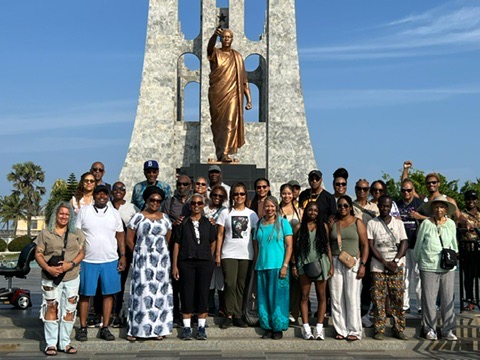
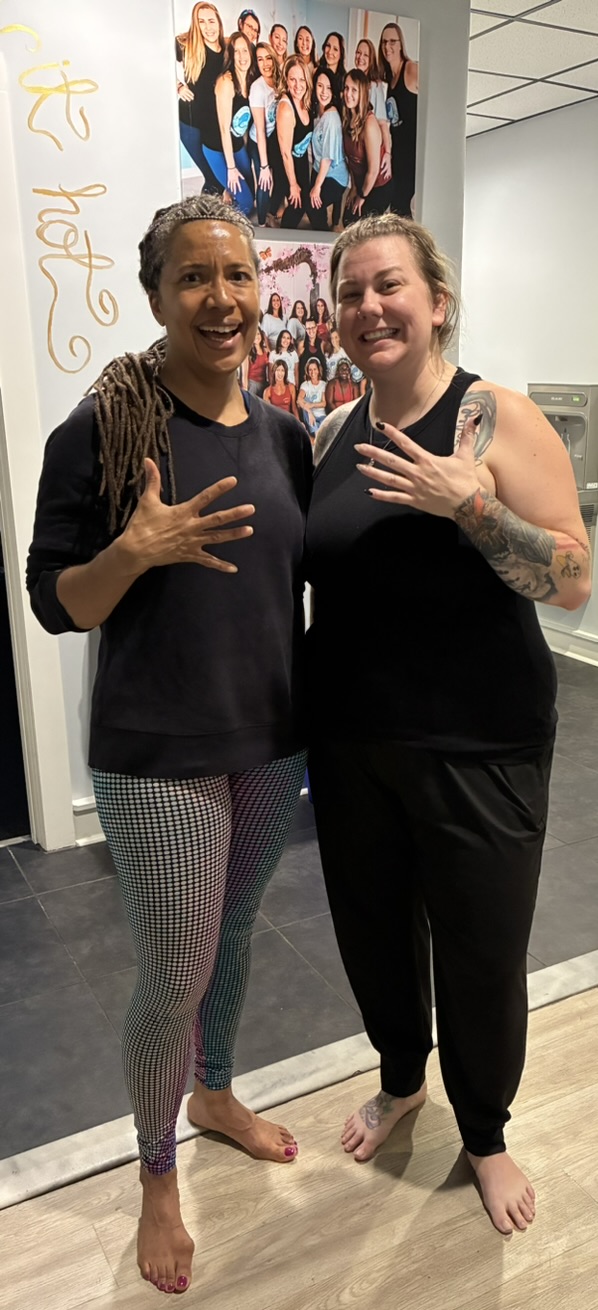
4: Ghana Trip | Dancing before Food

My sister joined us for the 6 AM morning walk. Yesterday, she was late and never caught up with us. Although we retraced our route from the day before, we experienced less traffic, no walk-of-shame club goers and fewer tour group members. We walked past the doughnut vendor and across the bridge.

I pointed out Black Mickey Mouse. Most had walked right past him yesterday without noticing. Honestly, it was challenging to see everything on such a busy urban walk.

This time around, we finished the last leg of our walk, sipping fresh coconut water.

After breakfast, professor and writer, Kwesi Yankah, AKA Kwatriot, shared more Ghanaian background with us:

  • Queen mother may be a mom or sister to the chief.
  • Akan is the largest group, consisting of several other groups.
  • Matrilineal inheritance; therefore, trust sister more than wife.
  • Naming ceremony is important because slaves lost their names.
  • People who commit suicide aren’t admitted to join ancestors in the afterlife.
  • Naming ceremony is the 8th day of newborn’s life. Life remains on stool; child’s firmly seated.
  • “Visitor has very big eyes, but sees nothing.”
  • Put emphasis on the right hand, not the left.
  • Kumasi is conservative.
  • Gap between teeth is African spirit.

(Please click on individual pictures to see the full view, then click on the browser back arrow to return to blog view.)

After ordering my shirt to be made, I had no more interest in looking at fabric, especially since I’d bought fabric from other places where I’d lived and travelled, which was packed away and hadn’t seen the light of day in years. So, the only reason I got off the tour bus when we visited a fabric store was to stretch my legs. Others in the group were on a far more serious mission.

We ate lunch at the AMAZING Abajo restaurant which had live drumming and dancing. Par for the course, the food for our large group took a long time to hit the table, but I was so entertained by the music and dance performance, I didn’t care.

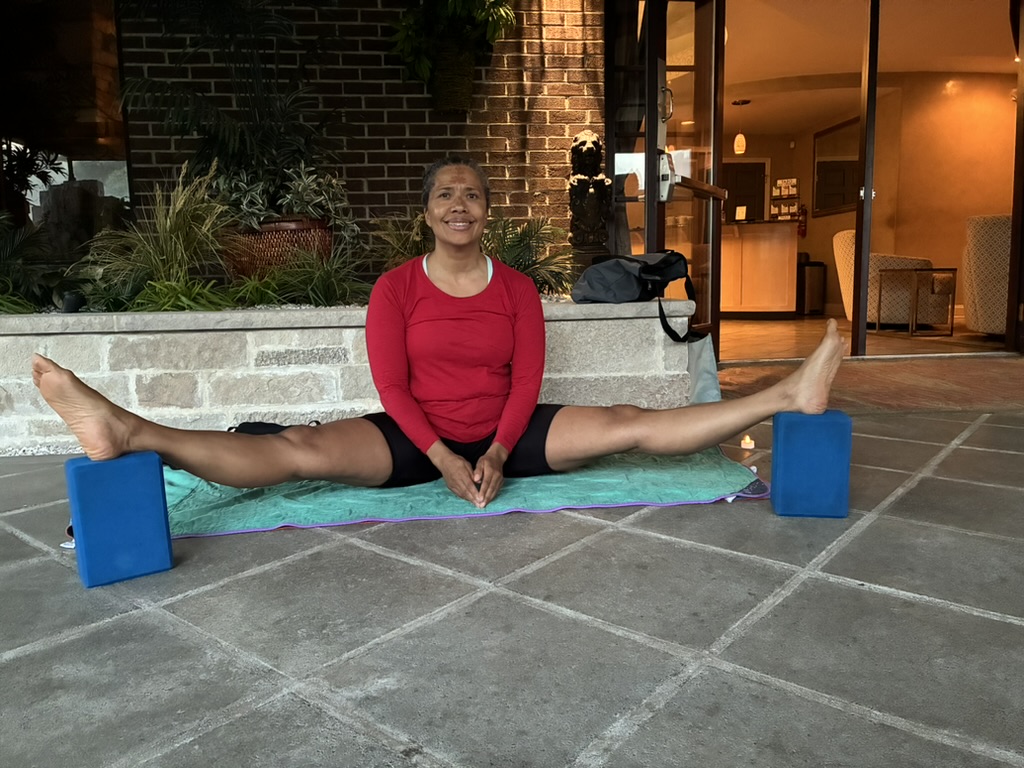
At one point, a band member who was also a contortionist, selected people to dance. He chose my sister. Vengeance was mine. She’d made me line-dance in June during our family reunion despite that being one genre of dances I dislike. She tried her best to get him to recruit me, but I remained seated.

The contortionist also taught four men some dance moves.

I thoroughly enjoyed red red (spicy beans) with kelewele (seasoned fried plantains). Although I’m not a beer-drinker, I sampled Origin, which tasted like cider with an anise after-taste. However, most of the beer-drinkers prefered Club.

Since our tour group had over 20 people, once again, we experienced another production with food coming out and then collecting the tabs. I got lucky when I quickly received the change from paying my drink tab in order to give exact change for the meal tab.

With the post meal production over, the tour group divided into several smaller groups to go shopping. Each small group had at least one support staff escort. Just as my small group entered the market, I witnessed a very frazzled-looking family of nine exiting. They looked as if the market had chewed them up and spat them out.

Thankfully, we had a genius way of shopping. We told our escorts what we wanted to buy and they led us to the appropriate shops. The escorts placed everything we were interested in buying into a basket. At the end of our shopping, the escorts laid out everything in our basket and negotiated the final price. Then, the escort took a picture of everything and then distributed the money to the vendors.

As little as I cared for most shopping, the highlight of my market experience was when four of us ladies sat down in one shop and vendors paraded in and out with things that we wanted. For me: black leather fanny pack, his/her copper bracelets, T-shirts. Others wanted fans, bracelets, dolls, masks, and other things. Best way to shop. Only thing missing was a cup of tea.

After haggling, but before handing the escort the money, I told him that he had to hug me first. He hugged me and gifted me a decorative African continent magnet as well. Once I escaped from the market, I told Dr. Kofi that I was ready for a drink.

For dinner, I ordered a local Ghanaian honey-based whiskey called Black Rock. The buffet offered delicious, traditional food, which most tour members found too spicy except for me.

In the bathroom, I found this common sense, straightforward COVID poster. I’d heard that the pandemic hadn’t devastated Ghana as much as in the States. Then again, at one point, the Insane Clown Posse had more stringent COVID restrictions to attend their concerts than the US federal government.

5: Ghana Trip | Musical Dialogue

After returning the room key and placing my suitcase in the bus, I headed to breakfast by 7 AM. Other tour members were waiting in the lobby for 7:30 since that was the breakfast start time on our agenda. They followed me because I announced that breakfast should have already started. The agenda also showed that we were going to be on the bus by 8 AM. We needed to get a jump on breakfast to meet that departure time.

Miraculously, we boarded the bus on time, but began the five-hour journey on Ghanaian time. Dr. Kofi explained that since the highway was under construction, the rules were “open” because everyone improvised their progression along the highway.

We passed a group of goats grazing in the middle of the dusty highway. A lone goat, tied to the top of a sedan, car surfed expertly as its owner maneuvered in the opposite direction. We clapped prematurely for our bus driver after navigating us through construction once we hit smooth road. After three seconds, we returned to rough highway.

During our first rest stop, I passed out those extra napkins I’d received from the restaurant at the JFK airport to women who’d left their toilet paper on the bus. I knew they would come in handy. Of course, I also had a pack of wet wipes in my purse.

(Please click on individual pictures to see the full view, then click on the browser back arrow to return to blog view.)

One phenomenon I’d noticed while living in Tanzania was the ubiquitous stray medium brown dogs. Knowing that all canine species derived from wolves, I wondered why all of the strays I’d seen looked mostly like the one pictured below. I always thought that without human-manipulated breeding, canines would appear more wolfish.

At our second rest stop, for two cedis, people used the executive bathroom, which was clean, and had soap, water, and toilet paper. So, I should’ve charged two cedis apiece for the women who I gave a napkin to at the last stop. I’d never been much of an entrepreneur.

By this time, we needed snacks. I got an international mix of prepackaged food: Pringles labelled in both Spanish and English from Jackson, TN; cheese potato chips from China; and cashews from Ghana.

Since I sat by the window, my sister pestered me to take a picture of the red soil, which reminded her of where our mother’s side of the family hailed from, Cascade, VA. Not sure how common red dirt is, but she was so excited to see it in Ghana.

When we walked into the ladies’ room at our third rest stop, I was initially taken aback at the row of sinks that looked like small toilets for kids. Were they actually urinals? We’d entered the women’s bathroom. Perhaps they were for little boys who were escorted by their female caregivers? Moments like those made me wonder if I actually understood what I saw.

Beyond that room were the toilet stalls, which we women used. There were sinks at waist level for us to wash our hands.

There was no misunderstanding the bathroom signage.

One of the snacks my sister had bought reminded us of Oreos. I’d enjoyed those cookies since childhood. Before popping one into my mouth, I noticed that the design was different. We compared cookies then read on the package that they were stamped with symbols from Minecraft.

Another snack my sister offered me looked like gerbil food. Those coconut-ginger flakes were sweetened by honey, which made it hard to remove from the bottle. Interesting texture and I loved the burst of ginger.

For our traveling pleasure, the driver played a variety of music. The bus trip became long when Sisqo’s “Thong Song” came on.

We rode past several small towns that all hosted sidewalk markets in front of more permanent establishments.

Koo Nimo Village: Musical Dialogue. Once the drumming began, a male dancer slowly performed around the space as if warming it up. At one point, Ghanaians and Dr. Kofi gave two fingers like the peace sign, signifying that the dancer was doing an excellent job. Later, a female dancer joined the male dancer. After a while, the guy left and she performed her solo.

When we were invited to participate, one guy jumped up first, then sat back down because he’d recruited so many people that there was one too many. I danced at least three times.

One move was a samba step where the left foot turned to the left by pivoting on the heel quickly, then the right foot just stepped forward. The professional dancer seemed impressed that I knew how to do that.

Quite a few moves involved a heel-ball-change, followed by some other familiar steps with unfamiliar arms. All of them started off at regular speed, which was a little too fast for most of us, coupled with the arm movements. The pros usually slowed things down to basic footwork and showed us how to move our arms.

In all the African dance classes I’d attended in the States, the instructors advised us to learn a move from the feet up. Once you understood the footwork, the foundation, then you built your way up.

Koo Nimo patiently posed for pictures with all of us before we left for lunch.

I told Dr. Kofi that today would probably be the best day for me out of the entire trip. He confidently stated, “Just wait.”

Dinner consisted of a buffet with a variety of traditional foods with some different things such as meat pizza and salmon rings. For dessert we ate very soft strawberry ice cream.

When we checked into our hotel, we received a key which had no correlation with the floor number. The only logic behind the numbering I thought of was that the owners had retained the original numbering when new additions were built.

As soon as RC plopped down on her bed, she screamed because the bed was so firm. I asked, “Rediscover your coccyx?”

In the middle of laughing at her, I screamed, “NAAAW,” when I entered the bathroom. There was an empty light socket above the sink. Would we have to be in the dark while using the bathroom? Then, I saw a ceiling light.

I had a shorter learning curve, figuring out the hot water strategy: turn on the electrical switch, then turn on the water, followed by the water heater itself. Finally, adjust how much hot water mixed in with another knob.

The one TV channel I wanted to watch had no sound. Every other channel had sound, but were either in a language I didn’t understand or showed subject matter that didn’t interest me. The radio channel came in loud and clear.

Many thought it was too soon to go to bed, but I “made” the bed by putting a Balinese wrap over the fitted sheet since bed didn’t have a top sheet. She looked right at home.

The electricity blinked off twice before I showered and dressed for bed. Since I didn’t pack a headlamp, I brought my phone into the bathroom, thinking that if the electricity blinked out again, I’d be able to grope in the dark for my phone without injuring myself nor damaging the phone. Luckily, I never had to put that theory to the test.

One good thing about staying in at night: not spending any money. I had not quite spent half my money yet. I didn’t want to blow through all my money the first week. One member of tour group had already asked about getting more money from an ATM. I’d bought the rest my souvenirs yesterday, so I should be good.

Despite having showered and dressed for bed early, we didn’t bother to turn off our lights until the church music from a nearby service had stopped blaring past 9 PM.

6: Ghana Trip | Earring Memories

Perhaps that blaring church music from last night affected me more than I realized. Thursday was actually the 17th!

As I figured, our rural morning walk was wonderful. Less traffic, less noise and no air pollution.

I saw a bar adjacent to a pharmacy and asked aloud, “Which one has the cure?”

(Please click on individual pictures to see the full view, then click on the browser back arrow to return to blog view.)

During our walk, I learned that the upstart short woman touring with us had been a nurse for 41 years. I surprised her by guessing that she’d been a cheerleader in high school. She never answered my question about which type of nurse she’d been: Florence Nightingale or Nurse Ratchet. Beloved or feared.

We saw fewer roosters on the rural walk than on the urban one. Perhaps the country setting provided far more places for roosters to strut around than their urban counterparts.

Initially, I thought those towering red mud structures were termite hills, like I’d seen in Tanzania. Someone said they were ant hills. Either way, I didn’t get close enough to inspect the structure to see which insect had constructed it. Once I returned to the States, I researched that Ghana’s capital city, Accra, was the Akan word for “ant.” I also read that Ghana has both ant and termite hills.

During breakfast, we had an amusing conversation about those beads that women drape around their waist. I’d always heard that women wore them to appear more alluring for seduction. However, some women in the tour group had been told at the market that they were for weight management. One could tell they were gaining weight when those beads fit tightly. I thought that was a clever marketing pitch for overweight tourists such as the average American.

For a country swinging in spicy food, there was no hot sauce for my omelette. However, I enjoyed the side dish of cooked cabbage, mixed with carrots. That was the first time I’d ever eaten purple dragon fruit.

While eating, I kept looking at a framed painting of a market. I wondered how dated such a scene was. After living and traveling around developing countries for years, I knew that there were usually pockets of modernization along with pockets of anachronism.

We rode through the Knust area, which had good roads since regular traffic was not allowed.

Employees from the Frema Restaurant came aboard to take lunch preorders, but only had two menus, so the process still took a while to complete. I immediately focused on the “horse oeuvres” choices, but was disappointed that fried calamari wasn’t available.

Instead, I ordered a Black Star with beef. When asked if I wanted it steamed or fried, I chose steamed. The employee stated that Ghanaians normally ate it fried. I smiled, thinking I’d just had a “yes, we have no bananas” moment. I got the dish fried.

Even though we visited the kente cloth capital of the world, I bought NOTHING because I already had so much cloth packed away at home. Instead, I helped my sister negotiate her purchases.

A few cloth designs were called “Obama.” I never got the explanation behind why more than one design was attributed to the first Black POTUS, but knowing human nature, I hypothesized that more than one weaver wanted to honor him.

Speaking of weavers, seeing them in action brought another level of respect for their craft and skills. Using a combination of pictures and video, I attempted to capture the complexity of the process. Watching them work the loom with their bare feet in conjunction with their hands, I wondered what was more challenging to learn: double clutch driving or working a loom.

As usual, I finished touring around the kente workshop much sooner than the shopaholics. My sister and brother-in-law led the group for who could buy the most stuff while on vacation. So, I was taken aback when we stopped at yet another shop to look at cloth.

I didn’t step into the store. Why would I after seeing the fascinating process of how the cloth was made?

As I milled about in the street, I ended up in a negotiation with one of the children who was selling jewelry. Initially, he wanted a whopping $10 for a very cheaply made pair of earrings that had bead colors, representing the Ghanaian flag, with a cowrie shell at the end. I paid $2.

I had wanted to buy earrings as a souvenir for myself, but this was more of a purchase for the experience. The child was so politely persistent, including the flattery of calling me his “auntie.”

I took the earrings out of the small pouch and discovered that one earring didn’t have a hook. The other child vendors immediately told my seller, who’d moved on to another potential buyer, what had happened. I saw an ankh earring and took that to go with the cowrie shell and bead earring. I handed him the hookless earring in exchange.

He didn’t seem too happy with the mismatch, but I knew, a) whoever made the earrings could even out the two sets; and b) whenever I wore those earrings, I’d remember this story, which got fleshed out at lunch.

Besides, the photo op with my earring seller was priceless.

At lunch, I told the story behind my mixed earring set. One man at my table, stated that he’d bought something from one of the kids because they had the same name as his. Another man at the table said the same thing had happened with him, coincidentally having the same name as a child vendor. When I showed them the picture of my earring seller, he was the same boy! I concluded that kid would own the country when he grew up.

Next stop: Ntonso, an Adinkra printing village located in the Ashanti region. The view from my side of the bus showed a soccer field with school kids.

On the other side of the bus, we learned how print ink was made from tree bark. First, they soaked the bark in water, then beat it to a pulp with a large mortar and pestle. They boiled and concentrated the pulp multiple times over a week. The color changed from light red to black.

After our tour guide and the printing expert demonstrated how to beat the wood pulp, we were invited to try. My sister, ever so enthusiastic about trying new things, was my partner. We had to sing “Miss Mary Mack,” so she could get the rhythm.

Before entering our lunch venue, I saw the statue of the horse and jockey. I recalled the menu I’d seen in the morning. So, “horse oeuvres” wasn’t a typo, but a play on words?

During lunch, some thought we had already run out of decent table conversation. One of the men talked about killing chickens. I reminisced about the time my grandfather had killed a chicken. My sisters and I wouldn’t eat it. At the request to change the conversation, we then discussed the horrors of American education.

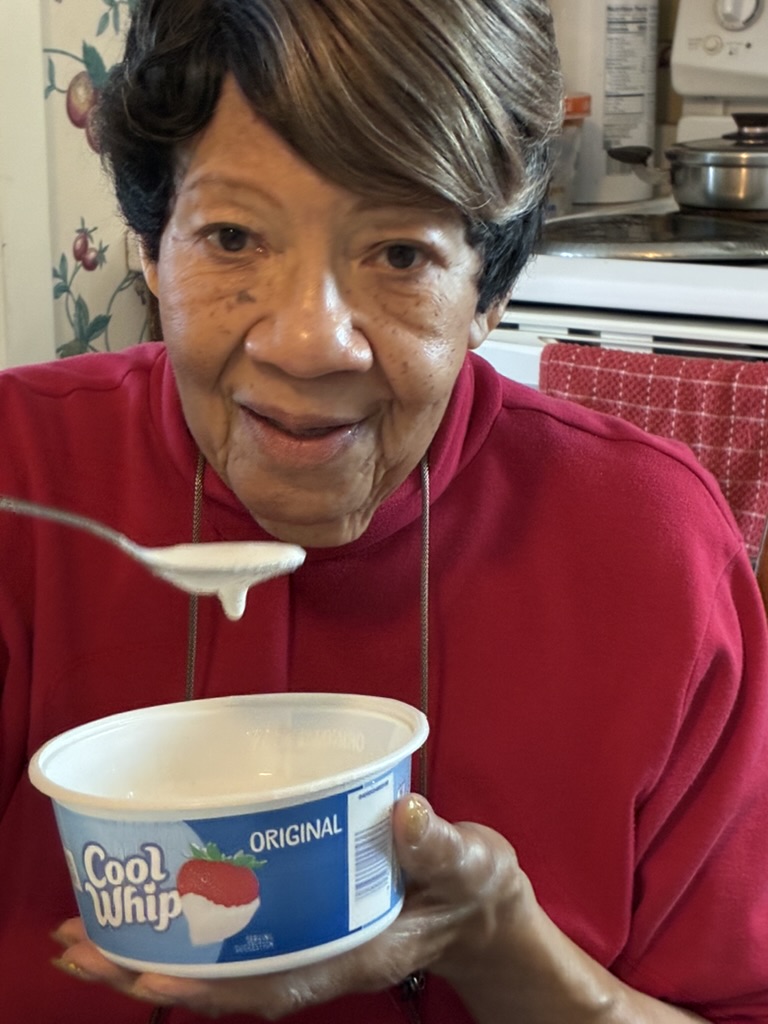
I paired my fried Black Star and salad with Alvaro, a pear-flavored non alcoholic malt drink.

After lunch, I got the opportunity to take a few pictures of our fashionable nonagenarian.

En route to the mall, I asked our tour guide if we could buy postcards. He made a face, confirming what I thought: postcards weren’t much of a thing in Ghana. However, he stated that at Labadi Beach, we may be able to find postcards.

Then, he gave me a mini history lesson. The area and people were called “La.” When colonizers arrived, Ghanaians referred to them as “the bad people,” which transformed into “Labadi.” NEVER refer to nationals as “Labadi.” They are the La people.

Refuelled by lunch, the shopaholics were ready to tackle another type of market, The Kumasi City Mall. They dutifully followed Dr. Kofi into one of his favorite stores to look at even more fabric and premade shirts. They were warned not to haggle.

I only used the bathroom and bought a small tupperware container to replace the broken liquid soap travel bottle. My nieces found a coffee shop.

On our way to the hotel, an advertising for noodles reminded me of The Incredibles.

One silver lining for buying a plastic container at the mall was receiving a lot of change. The designs evoked thoughts of freedom, justice, food staples and beautiful landscapes.

Once we returned to the hotel, a mudcloth vendor and designer shirt/dress vendor were there. I wasn’t tempted in the least, especially since there weren’t any fanny packs among the mudcloth backpacks and duffle bags.

After dinner, Dr. Kofi invited us to introduce ourselves, including what we did for a living and why we were on this trip. Most stories were either funny, poignant or both. Many of us were in the medical or education field. We were all one degree of separation from Dr. Kofi.

One support staff member caught everyone’s attention when he said that one of his hobbies was “mischief.” He explained that he enjoyed saying controversial things to get a better understanding about something.

After all the introductions, one tour member shared that his daughter had had an accident that day and asked for us to keep her in our prayers. Then, my sister announced that our father had passed out today, but he woke up. She asked that he also be kept in prayer.

Once the group prayer had concluded, my tailor arrived with the shirt I’d ordered. Fit like a charm.

After showering, I talked to my parents. The connection wasn’t the best, but it was good to hear their voices. Mom explained that some people forget to breathe, which sounded like a strange explanation since breathing was automatic, but I was happy to hear that dad’s vital signs were normal. As one of my aunt’s once said, “No matter how old you are when you lose your parent, it’s too soon.”

7: Ghana Trip | Reclaiming Treasures

My head was full of prayers for Dad during the morning walk. I thought about my leave-the-country curse. Just before I had left the States to serve as a Peace Corps Volunteer in Tanzania, my maternal grandfather passed. A few days before I returned to the States after completing my PCV service, my paternal grandmother passed. Shortly after I’d left South Korea after teaching ESL for 14 months, the Asian market crashed. A month after I left the States to teach in Egypt, 9/11 happened. About a week after I relocated back to the States after teaching in Honduras for three years, that country had a coup.

So, yes, I was a bit superstitious. In that same unscientific vein, I hoped to see Dad again since I wasn’t relocating to Ghana. I hadn’t been vacationing in those other instances when bad things happened.

Few things distracted me from thoughts concerning Dad, but I’d love to know the colorful story behind this outer house decoration. Reminded me of a griot enlightening African royalty.

While at breakfast, a registered nurse in our group sat down beside me. I explained to her that Dad had “forgotten” to breathe or held his breath until he passed out. She asked, “Does he have Alzheimer’s?” When I agreed, she told me that sometimes that part of the brain which regulates breathing, stops communicating.

That made far more sense. When that started happening, she explained, patients soon die. She wasn’t that abrupt with the prognosis, but it was still the same conclusion no matter how it was worded.

Today’s first destination: The Royal Museum of the Kings of Ashanti. I jotted down as many notes as I could while taking pictures. May have been easier to document the visit using video, but I didn’t want to use a lot of storage space on my phone.

  • Kings are the strength, carried on men’s shoulders. Queens are the soul, carried on four men’s heads.
  • Most common wood: mahogany, which queens are carried in. Kings carried in a wicker basket.
  • Prempeh I, King of the Asante Empire, spent 28 years in exile in Seychelles, then returned to a home given by the British, but he didn’t accept it. He paid out right to own the home. He lived in it until 1971, then turned it into a museum. The home became the meeting place of the Asante with three telephones for communicating.
  • Asante is a nation, not a tribe.
  • 1935 flag colors of Asante made of gold (wealth), black (people) and green (forest)
  • A rich Black man living in his forest.
  • Eagle, crocodile, python. No matter where you are, you’re supposed to be strong.
  • Pronounced “Ah-SAWN-tay” without the “h,” which was what the colonizers mispronounced it.
  • Kings are embalmed, then ceremonially buried.
  • Ceiling fan was 100 years old. Enjoyed the royal breeze. Sounded like a twin engine.
  • Radio was 75 years old.
  • TV: had to make an appointment to see it back in the day when that technology was scarce.
  • Mirror of Independence presented to the king by Nkrumah.
  • Gramophone no longer works.
  • Chessboard with customized Ghanaian pieces.
  • Gold ore (unprocessed) presented to the 15th Asantehene (King), Otumfuo Opoku Ware II.
  • Second living room for prime ministers and other dignitaries.
  • 1931-1970 the 14th Asantehene, Otumfuo Nana Sir Osei Tutu Agyeman Prempeh II, at Kumasi airport with eight wives and twenty-one children.
  • 1945-1977 Nana Amma Serwaa Nyarko. The king’s sister ruled as queen from same bloodline (NEVER a husband and wife).
  • Asante King’s children can never be the king. Only queen’s children since she knows 100% that all the children she births are hers.
  • King selects new queen; queen selects new king.
  • Queen sits on the left side of the king because that’s where the heart is.
  • Thrones are spiritually-charged. If a man sits on them, he gets erectile dysfunction and women become barren.
  • If a Black man drinks akpeteshie (Ghanaian spirit distilled from palm wine or sugarcane juice) every day for three months, he then becomes a white man, then dies.
  • Clay bowl with three heads, holding hands, symbolizing unity.
  • Israeli fridge 75 years old, never repaired it and still works.
  • Kenté is over 300 years old.
  • The stool is a symbol of power. Once the king dies, stool is blackened with sheep’s blood, wooden ash and sets for 42 days.
  • Kings are alive in the spiritual world.
  • 42 days in Asante calendar month.
  • King Otumfuo Opoku Ware II (lawyer, Italian ambassador (1970-1999)).
  • Feet on footstool to protect king from evil intentions.
  • 1977-2016 (Queen) Nana Afia Kobi Serwaa Ampem II lived until 111 years old.
  • Current King 75 years old and Queen is 99 (brother and sister)
  • Asantehene is a chancellor at Nkrumah University.
  • In 1874, the British invaded and destroyed Kumasi along with palaces and looted and placed inside British Museum. After 150 years, Ghana finally got some of their artifacts back, but some Ghanaian treasures are on loan from the British.
  • Because of the Antiquities Law, the British cannot be prosecuted for what they stole because it was “legal.”
  • The British exiled King Prempeh I in Mahé, Seychelles along with chiefs because the Asante people kept walking to wherever the royalty were on land. For 28 years, King Prempeh I educated himself in English.
  • 65-year-old Nana Yaa Asantewaa, Queen Mother of Ejisu, credited with leading five thousand Asante people in March 1900 against the British who wanted the Golden Stool. The stool was hidden. The war lasted nine months. Nana Yaa Asantewaa kept Golden Stool with her. The British used enforcement from Northern Ghana, Nigeria and Sudan to eventually defeat the Asante, but the British never captured the Golden Stool.
  • In 1695 the Golden Stool was heavenly made, not human-made. Humans aren’t allowed to sit upon it.
  • Otumfuo Osei Tutu II (Barima Kwaku Dua) became Asantehene in 1999.

(Please click on individual pictures to see the full view, then click on the browser back arrow to return to blog view.)

Many in my tour group wanted to raid the British Museum, Eric Killmonger style, and recapture looted Ghanaian artifacts after hearing the consequences of the Antiquities Law. Imagine stealing another country’s treasures, then passing a law to declare that the theft was legal after the fact.

Fortunately, the museum grounds offered a refreshing break from the consequences of history. Peacocks roamed around as I tried my best to hold onto a rubber tree. The tree definitely won.

The World Peace Bell reminded me of Korean bells I saw and heard when I lived in South Korea, especially during the Buddha’s birthday celebration.

Even with pre-orders, lunch at Ike’s took over two hours and hardly anyone had their drinks with their meal. I had delicious kelewele with groundnuts with an the Everlian salad, which consisted of chopped fried chicken with breading, french fries, greens, and tomatoes. Once again, I had enough leftovers for breakfast.

The ginger maiden (ginger, OJ and cranberry) came very late, but was refreshingly cold and sweet.

As we were about to leave, a young man inquired about my “daughters.” I told him they were my nieces. He said they were very beautiful. He asked one of them where they were from. Then, he attempted to pass his phone to one of my nieces to input her number. I intercepted his phone and told him she and a boyfriend.

For the first time since touring Ghana, I noticed what was written on the side of our bus in English. How I wish I could take a film crew around. I’ll have to get a film crew together first. I realize there’s no expiration date on dreams, but life has a way of getting in the way.

Despite the fact that we went to the mall yesterday, enough people clamored to return today for snack-shopping. One of my nieces wanted to go to jewelry store because someone had bought an inexpensive gold bracelet.

We spent less time at University of Nkrumah than at the mall. Fewer people exited the bus to tour the park. We had seen a few statues while bus traveled around campus before stopping at a small park that hosted a menagerie of statues. Part of me wanted to know the meaning behind the statues; however, my brain couldn’t really absorb and retain more information at that point.

Dinner had the lowest turn out to date. Even the tour guide wanted to skip it. The highlight of the meal was my sister reporting that Dad was in better spirits.

8: Ghana Trip | Door of Return

I woke up minutes before the 6:15 alarm. I needed that extra time to eat leftovers. The two pieces of yam were frozen. I nibbled them a little before abandoning the effort. I ate all the kelewele (fried plantains), which had the added joy of groundnuts sprinkled throughout.

Groundnuts vs. Peanuts: groundnuts have three nuts to a shell instead of two. Whether cooked or not, groundnuts taste similar to raw peanuts.

We didn’t have a morning walk nor a formal breakfast since we traveled this morning. Staff passed out bags of breakfast that included mango juice, dragonfruit, pineapple and watermelon slices, an omelette, bread, onion/green bell pepper/ carrot mix, oatmeal, brown sugar packet, tea creamer packet, one slice of toast, cut diagonally.

(Please click on individual pictures to see the full view, then click on the browser back arrow to return to blog view.)

After a few minutes on the road, our tour guide received a call from the hotel, telling him that one of the guests had left their airpods. A hotel representative raced to rendezvous with the bus and return the property. Talk about above and beyond service.

Tour staff collected cedis for the lunch buffet in another time-saving effort.

Our first rest stop had a beautiful lawn with lizards. Next, the police stopped our bus at a checkpoint. No police boarded. Instead they inspected around the bus. We were on our way in under five minutes.

I definitely didn’t eat my money’s worth during the lunch buffet although I thoroughly enjoyed the fresh mango and pineapple. Most of the food was deliciously seasoned, but once again, I was one of the few who appreciated the spiciness. The small salad bar had the longest, slowest queue because servers only replenished enough for two-three people at a time despite the crowded dining room. The lamb involved a lot of work. If I were at home, I would’ve picked it up and cleaned the bone with my teeth.

Of course, the clean stocked bathroom was a big hit.

Next stop: Cape Coast Castle. How does one mentally prepare to visit the site where one’s enslaved ancestors departed from the African continent?

Captives were shaved, fed and treated with shea butter to make them look more attractive. Except for when they were branded with hot metal dipped in oil. The biggest dungeons were located underground. Enslaved Africans were held in crowded, claustrophobic conditions until they were murdered, died due to inhuman conditions or transported across the Atlantic Ocean.

The Portuguese constructed the Cabo Corso (Short Cape) in 1555 along with Elmina (The Mine) AKA St. George’s Castle in 1482 originally as trading posts in the gold trade. In 1653, the Swedish built the fort on the same site. The Danish and Dutch briefly had possession of the fort. Eventually the British corrupted the name “Cabo Corso” to “Cape Coast,” and used the site to greatly expand slavery in the 1660s.

Enslavers used five dungeons to groom Africans to see who was physically, psychologically and spiritually sound.

The Haitian rebellion (1791-1804) helped spur the abolition movement. The British ended slavery in 1833. Captain George Maclean blocked the tunnel at the end of legal slavery in 1834. In 1888, Brazil was the last country in the Western Hemisphere to abolish slavery. The last country in the world to abolish slavery was Mauritania in 1981.

After Ghana achieved independence from the British in 1957, part of the castle was used as a prison for Africans for 33 years, from 1959 until 1992. The British had converted the castle into a prison, but not in the same place as the dungeons.

As we stooped to enter a tomb/dungeon AKA the “Cell of No Return,” I thought of the irony that people also entered the pyramids at Giza the same way out of deference to a deceased pharaoh who was ritualistically buried.

However, there was no deference given to the captured Africans by enslavers. Although this room was called “Cell,” “Suffocation Chamber” would have been more appropriate.

Enslavers starved, dehydrated, and suffocated Africans who fought for their freedom. After 24-48 hours, their bodies were removed, then laid out as a deterrent for others.

I silently prayed while entering the male slave dungeon, which consisted of a few rooms. Each small chamber had held 100-200 people with only three small holes at the top of the high walls to allow cool, fresh air. The windows were far too high to see out of or escape through. Enslaved Africans spent one to three months in a dungeon.

A trench bisected the floor, which collected human waste that flowed into the sea.

Sand had been thrown on top of vomit, blood, and sweat. Stratified layers of compacted bodily fluids caked the dungeon floor.

An altar was built in 1973. Although deceased Africans were put to sea, some believed that their spirits lingered within the castle itself.

Africans lost their rights, identity, and name. They were insured as property. Some enslaved Africans had never seen the ocean before. If one jumped into the ocean, then others went with them because they were chained together.

A hole in the dungeon’s ceiling opened to a church, so enslaved Africans could hear the gospel service. Anglican church goers could hear the enslaved Africans as they entered and exited their place of worship. Elmina had a Catholic church above its dungeons.

I marveled at how any so-called Christian could walk past that gaping hole, knowing the egregious conditions and misery that humans at the other end of that opening suffered, and still think of themselves as good religious folk.

Fortunately, a Black sorority donated money to help repurpose the former Anglican church into a children’s library.

The governor’s place, located above ground, had windows, allowing natural light and breezes.

Palaver Hall used to be the marketplace.

The women’s dungeons were above ground, and used to rape African women for breeding. A trench lined around the walls. Women squatted, leaned, but not lie on the floor to sleep.

The Gate/Door of No Return was situated between the women’s dungeons.

So named because once enslaved people exited through that door, they never returned to the land of their birth.

Yet, with so many of us Black Americans visiting every year as we learn about our history before slavery, the other side of the Door of No Return had been named “The Door of Return.”

As we reentered, I experienced a sense of optimism. There was no undoing of the past, but we could share our experiences and encourage others to learn history and travel.

A seawall was built in 2022, so ocean isn’t as close as it used to be.

Finally, a reminder that we were always welcomed, Akwaaba.

This was the hardest destination to experience. Definitely wanted to capture the moment, but I wrestled with the appropriateness of smiling like a typical tourist. Would that disrespect the memory of what my enslaved ancestors endured?

Or was part of the healing and reclamation of the past found in celebrating Black Joy? There is joy in continued progress, even with setbacks along the way. Surely, as Maya Angelou once wrote, we are our enslaved ancestors’ hopes and dreams.

My head was still heavy from our visit when a black goat darted in front of the bus just minutes prior to reaching our hotel. I wondered if there were any superstition to a black goat, versus a black cat, crossed one’s path.

After filling out a registration form, we were escorted to dinner since no golf cart arrived to take us to our room, which was located across the sprawling hilly grounds. Dinner consisted of the usual local food, enhanced by treating myself to a shot of Bailey’s. Much after the fact, servers brought out a salad, which had to be replenished before I got any.

I never figured out how Ghanaians ate salad because there was always a question of salad dressing. Either mayonnaise was brought out or nothing ever arrived. Once I got some salad, without dressing, I combined fresh pineapple and mango with the salad to lively it up.

None of my hot water strategies worked: flipping the lit switch, turning the extra knob in the back of the shower, fiddling with the hot/cold knobs. Afterwards, I learned that the water heater took a LONG time to do its job. I still washed that Cape Coast visit out of my hair in an impressive-looking shower, using tepid water.

Par for course, we retired for the evening watching an old American movie while I twisted my locks.

9: Ghana Trip | Nana Adwoa Akyene

After warming up enough to sleep, I dreamt that I was back in NC to inspect a newly installed ceiling fan. While home, I questioned why the kitchen counters had been covered. My sister said because Mom was finally converting the dishwasher area into a cabinet.

When I told Dr. Kofi my dream about returning home, he interrupted, telling me that Ghana was my home. I then restated that NC was my OTHER home.

Since Dr. Kofi wasn’t familiar with the area, he had three locals join us for our morning walk. They set a very fast pace.

This morning’s excursion was the first time I saw the rising sun during one of our walks.

The area was so quiet, we heard the buzzing electricity. Even so, no one was foolish enough to enter an unauthorized area.

Some knowledgeable walkers, both local and tourist, pointed out the nim tree. According to them, one boiled its leaves to support immunity.

Another medicinal plant, the soursop tree, grew near one of the hotel buildings. The leaves and fruit were used to treat high blood pressure, inflammation, and parasitic infections.

(Please click on individual pictures to see the full view, then click on the browser back arrow to return to blog view.)

When I received my waffles, I was initially excited to see that it had been garnished with strawberries, but upon closer inspection, I saw that the red fruit was watermelon. Still delicious, just an unusual choice for the average American palate.

I returned to the room for final freshening up after breakfast, which was perfect timing. As soon as I’d rolled my luggage to the building’s common area, a hotel van was about to leave. Both my luggage and I rode to the bus. During that short ride to the tour bus, I learned that the hotel was 30 years old, and had started out as a private residence.

Although the road was blocked because of construction, our tour guide knew a work around. Once again, communicative honking helped to negotiate through traffic. Safety triumphed. We Americans underutilize the horn for such purposes and become aggressive with excessive honking.

We freshened up at Yaa Nyarkoa Lodge, Prof. Kwesi Yankah’s place. The slow-moving bathroom queue allowed tour members to pose with Dr. Kofi who was dressed in his traditional attire as the Chief of Development.

At the naming ceremony, the linguist (okyeame) served as an intermediate between the chief and the people. One can’t look or speak directly to the chief in order to prevent spiritual or psychological attack. The linguist sat with a staff adorned with two eagles atop, symbolizing the balance between the physical and spiritual worlds. One of the duties of the linguist was to shake hands with people. The position can be inherited or appointed.

I was randomly chosen to be in chief’s lineage, but everyone was named after good people.

Drummers provided music for the two dancers. Then for the opening of the ceremony, an elder poured of schnapps on the ground as blessing.

Everyone received a new name. Traditionally, the father provides the surname and mother provides the first name. Elder mothers performed the ceremony, using a leaf of wisdom, the water of purity, and spirits for strength. All of us had to taste both water and schnapps to know the difference.

My Ghanaian name: Nana Adwoa Akyene [nah-nah ah-JUWAH ah-CHEE-nay]. “Nana” is an optional honorific title to denote being named after a chief. “Adwoa” is the name given to girls born on a Monday. Finally, the chief’s surname, “Akyene,” means sensitivity to the arts, especially drums. My family reacted as if that last name suited me well although my artistic talents lie in writing and performing.

The precious beads, made of glass, formed the necklace and bracelet. They were heavy and noiseless as one moved, which allowed the wearer to introduce themselves rather than the sound of the jewelry.

More drumming and dancing followed after the ceremony. The dancers invited us to join in. Several of us jumped up to dance with Dr. Kofi and remained much longer after he sat back down.

When we returned to Prof. Yankah’s place, the Kwesi Yankah youth band, consisting of high school marching band instruments and an African bass drum, played a song which had a refrain that sounded like the opening bars of “Joy to the World.” One of our tour guide support staff also played a trumpet in the youth band.

We received fresh coconut water, which had a slight sweetness. Our light early dinner included Ghanaian-styled doughnuts, pineapple, mango, watermelon, bananas, strawberry and vanilla ice cream. We ate under a rectangular pergola with tiled floor while youth band played on.

Later, we rolled up to our hotel, which had overflow rooms across the street. RC threw a sour look in the direction of the narrow spiral staircase to the second floor where our room was located.

Before the hotel employee left our room, we asked him about the hot water strategy. He entered the bathroom, looked into the shower stall and informed us there was no hot water. Instead, he brought us an electric tea kettle.

A bucket with a dipper were already in the shower stall.

I practically danced around the room, getting ready for my bucket bath. RC was amazed by how happy I was.

And why not? I’d spent two and a half years as a Peace Corps Volunteer taking bucket baths, so I knew exactly what to do. I poured the heated water into the bucket, mixed in cool water from the shower faucet until it reached the desired temperature.

First, I washed and rinsed my face while allowing water to drizzle down my body. After wetting the rest of my body, I lathered, shaved my legs and underarms. Then rinsed off.

As wonderful as my bucket bath was, closing/opening the bathroom door was a harrowing experience.

We could only close the bathroom door if the person outside the bathroom pushed against door while person inside the bathroom turned the hook knob. We did that once. I made too many attempts for my personal comfort to unhook door. RC wouldn’t dare try it.

We found an easier way to close the door without the risk of accidentally imprisoning oneself. The person on the outside of the bathroom pushed the door closed and secured it with a piece of carry-on luggage. The person inside the bathroom could easily push the door open.

I found a bonafide movie channel with sound and watched “Ironman” as a disco across the street raged on. RC requested that I turn down the TV. I advised that she could either hear the movie or disco, muting the TV for her to compare. She chose the TV. I was tempted to wear earplugs except I wouldn’t hear the 5:15 alarm for our morning walk.

While we had our bucket bath adventure, which RC admitted was far more enjoyable than she originally thought it would be, other tour members were at the restaurant with the raging disco. Apparently, those with specialized diets, like my sister, brother-in-law and niece, just wanted food. Not sure if anyone actually danced.

Nonetheless, I didn’t mind going to bed early, given the early wake up time. I stared up at the decorated ceiling until I drifted off to sleep to the sounds of the disco.

10: Ghana Trip | Dancing Like Kids Again

We experienced a slight drizzle during this morning’s walk. I used my umbrella for the first time, which I referred to as my “anti-rain stick” since I had carried it before and it had not rained. Had the rain made it easier for the chickens to find food? Maybe just a coincidence we saw them out and about on a rainy day.

During our walk, I confirmed that no one had danced at the disco last night, but everyone ate at the restaurant, especially the pescatarians, vegans and anyone who generally found the traditional food too spicy.

The disco was over much earlier than the one in Accra; so, no walk of shame.

Flipping through the TV channels, I enjoyed the gospel performances. Then, I landed on a Charlie Chaplin movie. Of all things.

For the first time since vacationing in Ghana, the breakfast had no fruit, but there was bacon. Service started off slower than usual because there were no place settings. Once the tea bags and hot water were brought out, some of us started to enjoy breakfast. Others who had requested butter for their bread were baffled at the bowl of frozen butter the server brought.

At least the hotel provided my top three creature comforts: hot water, a movie channel with sound and soft mattress.

Our first stop of the day was the Methodist Basic School in Agona Duakwa, which consisted of a primary and junior high schools. The school started in 1987 with kindergarten, which grew to include older students as well in 2010. Overall, the school staff numbered at 20 with 690 students.

Dr. Kofi’s food taster, who started when she was six, met us at the school.

Dr. Kofi had visited the school since 1992. The restroom facility was one of the many gifts that he, donors and other tour members had given the school.

In the middle of the school courtyard, they had lined up five teachers’ desks, which members of my tour group covered with soccer balls, backpacks, folders, 3-ring binders, candy, hand sanitizer, glue sticks, glue, highlighters, pencils, pens, loose-leaf paper, notebooks, reading books, scissors, clips, crayons, colored pencils and black socks.

In addition to the donated items, we gifted a cash donation, which the head teacher accepted.

(Please click on individual pictures to see the full view, then click on the browser back arrow to return to blog view.)

Student drummers and a dancer from naming the ceremony performed, followed by an opening prayer.

During the primary girls’ dance, I recognized the familiar drum breaks, signaling to change repeated dance moves. Some of the dance moves we had learned days ago. We lost it when the girls put their hands on their hips and started shaking their hips in such a grown up way.

The head teacher welcomed us.

Kindergarteners performed a Fanti dance while older girls sang. Someone captured the beauty and innocence of two of the little girls after their performance in the picture below.

Of course, the school invited us to join them dancing. We did our best to follow along.

I loved the juxtaposition traditional with contemporary. After all, why not chill out in between dance performances?

The students performed a skit about the naming ceremony. The real ceremony uses water and alcohol in the Fanti naming ceremony. The person for whom the child was named after gifted two thousand cedis wrapped in blue cloth. The rest gave money to the baby.

A multi-age battle dance ensued where the rhythm kept speeding up.

I joined the naming ceremony dancer from yesterday. I barely kept up with what she was doing. At one point, she left the courtyard to encourage other tour members to dance and I broke into a samba, which was a big hit while attempting to mimic her arm movements. When in doubt, samba it out!

The drummer, who used the fat red drum, had recently graduated and awaited test scores. The naming ceremony dancer had also recently graduated.

We shook hands with the staff, along with the head teacher, and took a picture with her. A student took the initiative to shake hands with me as I was leaving.

One of my nieces learned the hard way about how to use a squatter stall: first raise your pant legs closer to your knees, then lower your pants to squat. Initially, she was preoccupied with not urinating on herself rather than getting another’s pee on her pant legs. Fortunately, our luggage was on the bus. She placed her soiled pants into plastic bag and put on clean pants.

En route from the school to a restaurant, I snapped a picture of an interesting work of art, which was under an overpass. In the States, a sizeable area like that would have been used as a makeshift camp for an unhoused population.

We ate a delicious lunch in a private dining room on the second floor of a building. Of course many of us got ice cream afterwards since we had to enter through an ice cream parlor on the first floor. Very good marketing ploy.

I made the astute observation that strawberry ice cream was widely available, but I’d never seen fresh strawberries anywhere on the street or offered as part of a fresh fruit plate.

Another thing I FINALLY paid attention to was that The Big Six were on the money. During one of the lectures, where I was sleep-notetaking, I missed the Ghanaian founding fathers’ names. I later corrected my notes when I happened to look at a cedi note while waiting to pay for lunch. I took a picture, enlarged it and jotted down their names.

Now, could I have looked up the six leaders from the United Gold Coast Convention (UGCC) whose combined actions helped the country achieve independence from British colonizers in 1957? Of course, since Ghana had wi-fi and I had a smartphone. Yet I liked the moment when I discovered the answer on the money.

Upon arriving at the Labadi beach hotel, I needed my passport. I irritated one of the bellhops who wanted to gather all of the luggage and get it sorted out as efficiently as possible. I, of all people, appreciated his effort, but I had not caught on by then that posh places required a passport.

I dug through my luggage, which I partially opened because I knew that the passport was inside the zipper compartment. One hotel desk employee photocopied my passport. Then, I should’ve signed the registration form underneath RC’s signature, but another hotel clerk snatched the paper away from me and confused things by having another tour member sign. All of this was such a blur of confusion at what turned out to be the nicest hotel we stayed at.

For dinner, we enjoyed a beautiful buffet spread by a swimming pool at another place. Some of us shared a bottle of merlot with Dr. Kofi.

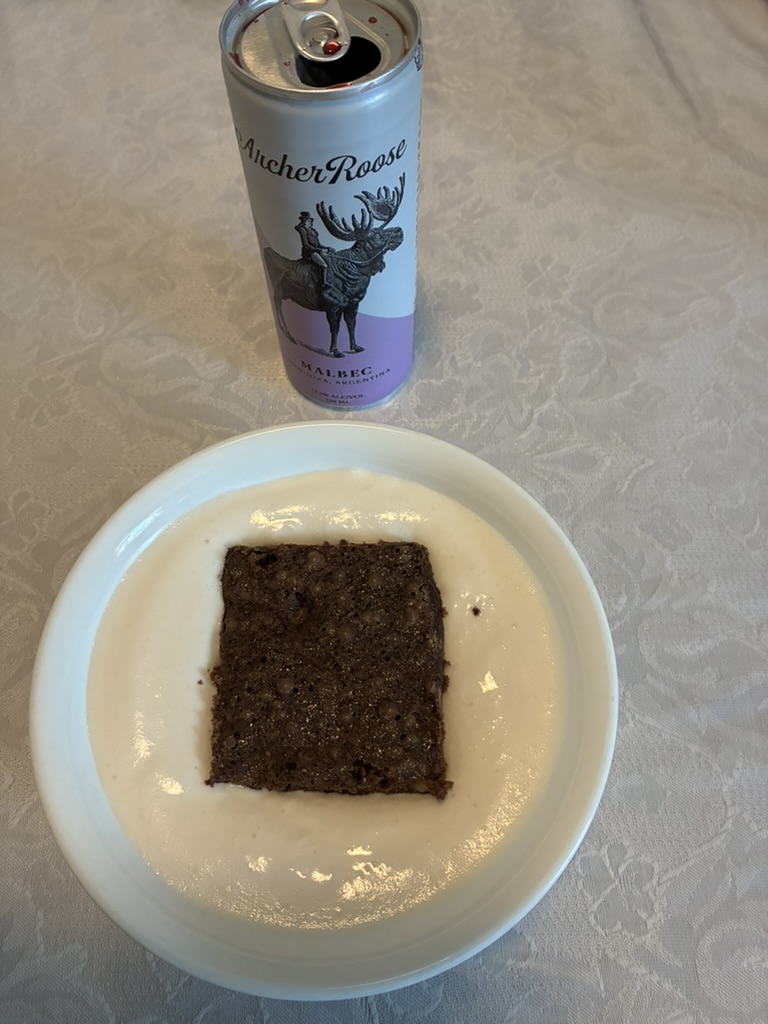
Back at the hotel, I apparently bought the last bottle of malbec, which we split among six of us. We sat under a covered area near the pool due to the rain.
While sipping wine, I spied across the way, my sister who had said that she was too tired to hang out with us for a small happy hour. Obviously, not too tired for some nighttime shopping. Looking obvious in a bright yellow shirt.

I took a glorious hot shower with added bonus of a washcloth. As much as I enjoyed the experience, one would’ve thought that I hadn’t done that in a long time. I had only been out of the States nine days.

11: Ghana Trip | Resort Life

Since I’d slept in my bathing suit last night, I put on a cover up shirt and skirt once I woke up. I shared with RC that I came to rock the beach, not walk the beach.

Tiny off-white sand crabs scurried along the beach. We took a longer walk than normal because we had a free morning.

As if in a surreal dream, a man approached us on horseback. None of us took him up on his offer to ride along the beach, but this was the first time I’d seen such a thing out of all the beaches I’ve ever visited.

We posed by a rock formation before walking back to the resort.

By far, this was my favorite morning since all I had to do was rinse the sand off my sandals and feet, then enter the dining room for breakfast. The fruit buffet included pears and a prune compote. The “pancake station” actually served up crepes. Coffee drinkers boasted about sipping the real thing.

Didn’t expect to see a table full of US military wearing fatigues at breakfast. I wanted to ask them if they were stationed in Ghana since they were in their casual uniform, familiar to me since I grew up as a military brat. Yet, I wasn’t ready to suspend my vacation away from the US as such an encounter might have done.

While at breakfast, one tour member stated that he could’ve done all of our past excursions from that current luxurious accommodations. I countered that if we’d only remained there, we wouldn’t have appreciated staying there as much as we did. I then added: when he told others about this trip, he’d recount things we did the first week, including our hotels. “War stories” were the best.

Since a touristy day was planned, RC and I wanted to wear sandals, but her ankle brace was still wet. I suggested using the blow dryer to speed along the evaporation process rather than not taking it at all.

The search was on. After not finding the blow dryer in the bathroom nor in the closet, we went on an easter egg hunt. RC finally discovered it in a drawer already plugged in, underneath the coffee machine. Go figure.

Once reunited with SF, she told me about her horse ride. As she was about to mount the horse, the guy attempted to help. She was apprehensive. He reassured her, “I’m strong,” then he hoisted her onto the horse in one swoop.

“Here’s your 100 cedis.” She promptly handed him the money. She confessed that it had been a long time since a man had done that.

Since this was a five-star resort, I wanted to make the most of the accommodations, including the balcony. I turned a blind eye to the parking lot that peeked between the lush foliage. Not too hard to do since I spent most of my balcony time writing in my journal.

Of course, that didn’t last too long since my sister, who believe she’s my mother, called, inviting/ordering me to join her and her family poolside.

(Please click on individual pictures to see the full view, then click on the browser back arrow to return to blog view.)

Soon as I rolled up poolside, my sister told me that another light-skinned woman of color was mistaken for me. Truly a compliment to me since that other woman was at least 20 years younger.

The infinity pool was surrounded by literal lounge lizards, which scurried in between and around the lounge seats. Some people were wary of them, but I welcomed anything that helped keep the bug population in check.

I wasn’t in the mood to join the impromptu water aerobics led by another tour member, but they looked as if they had a fun work out.

Soon, we ordered food. I thought “chicken shawarma” with fries and coleslaw would be a light lunch. I was mistaken.

Another bug-repellent strategy was placed on our table in the form of a burning candle.

Afterwards, we visited the Artists Alliance Gallery at Omanye House. Although the gallery had a very interesting collection, I didn’t buy anything because I wasn’t a homeowner. My souvenirs were in the form of pictures.

Our tour guide was so excited to escort me to the postcards, which unfortunately were damp and overpriced. I’d searched for postcards since day one, but there was truly no market.

I beat all the tour staff back to the bus for a nap while listening to my audiobook. Other tour members stayed so long, I worried perhaps I was missing some demo about an artistic skill such as printmaking. Not at all. Just the usual slowness of the group who enjoy shopping/browsing. Had I known how close the gallery was to the resort, I would have walked back.

I immediately decked out in cover up and headed for pool. I did several leg exercises that felt especially good on my low back. I contemplated getting an hour long massage at the resort spa, which was just $60.

The decor of our dinner restaurant reminded me of an Austin art gallery exhibit.

The restaurant had the food ready as soon as we sat down. Platters upon platters of food. The platters were huge; our individual plates were small. An embarrassment of food that potentially went to waste because we slowed down, then stopped eating altogether. Servers packed up the leftovers at tour members’ request. I think the food was given to the bus driver, his attendant and perhaps other staff.

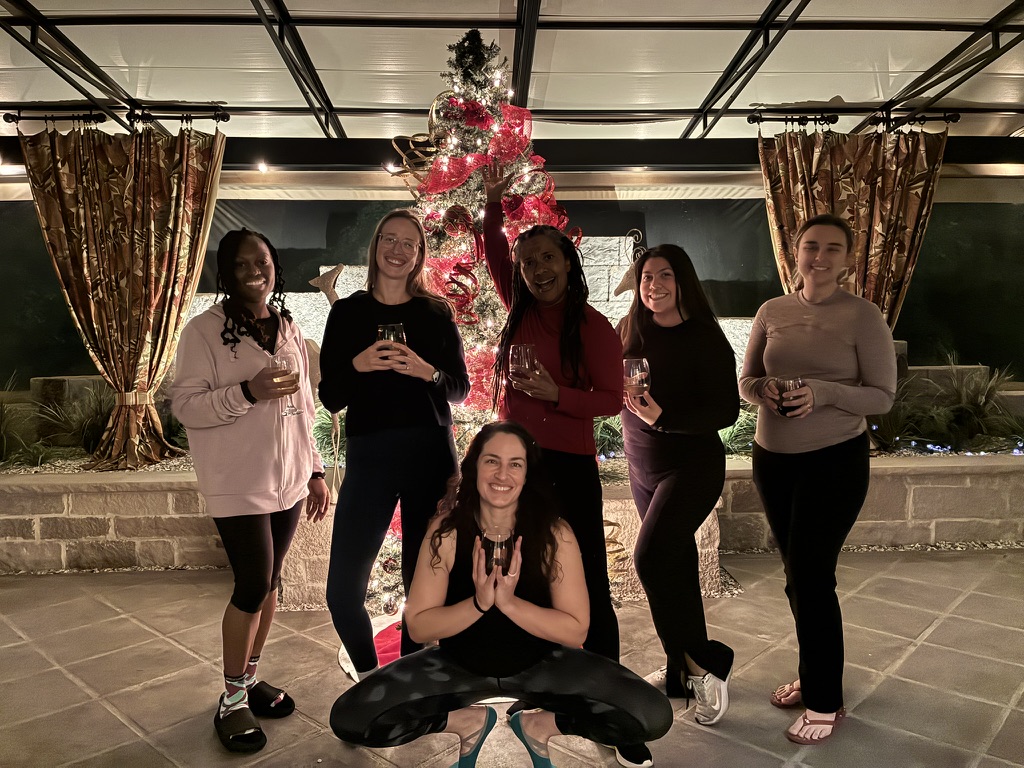
Rain Goddess had splurged at the mall. Although I don’t care for sweet wines, I chalked it up as liquid dessert. I retrieved the wine from her room and went upstairs to host a small happy hour in my room.

When I changed into my pajamas, RC said that my attire signalled, “Hurry up and leave before you get here!”

We sipped both red and a bottle of the pink blush, which was even sweeter. RC provided pumpkin seeds to go along with the wine. An unusual pairing that worked.

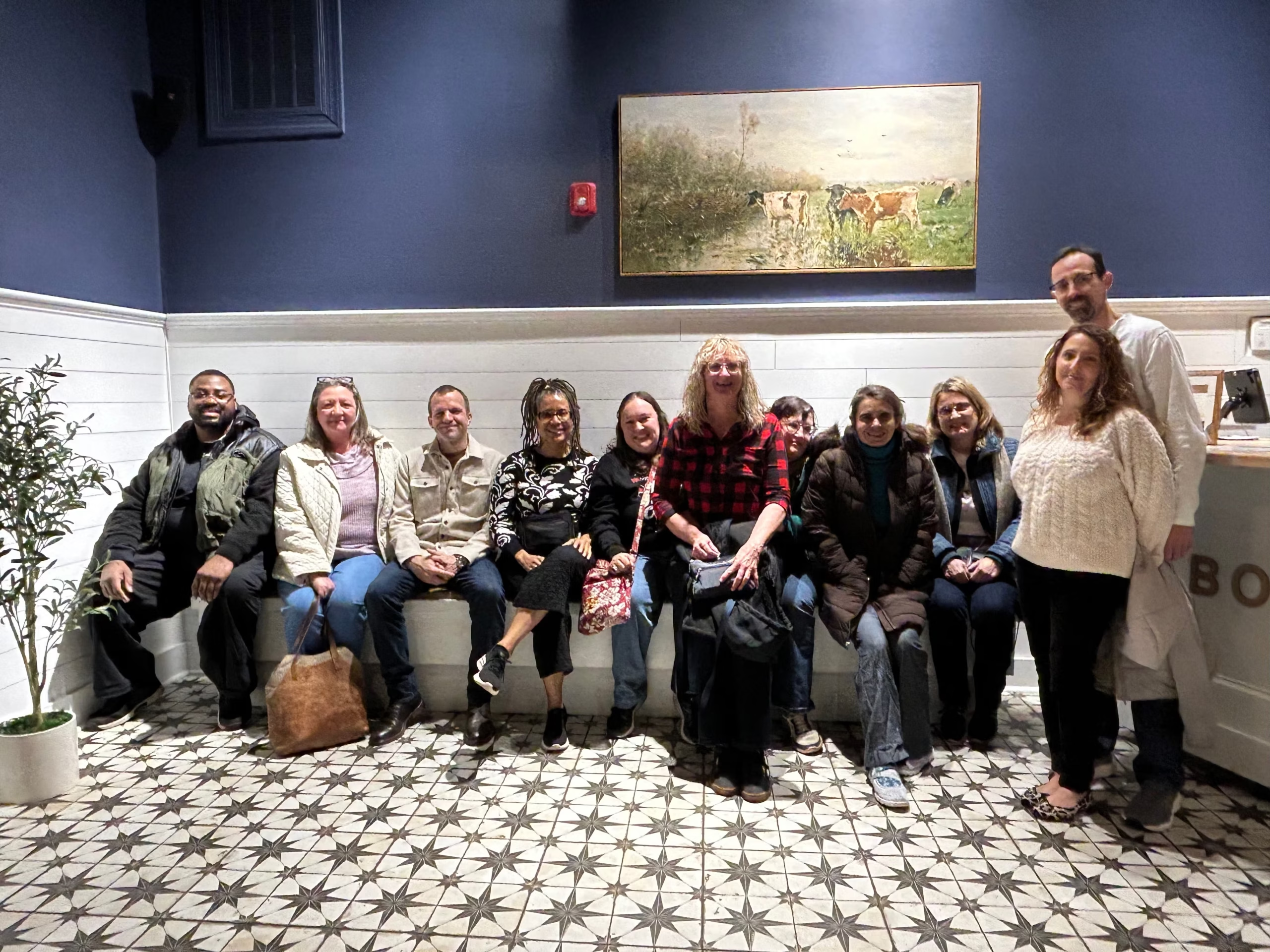
We took the first of several “Strange Happy Hour” group pictures. My great grandfather, Jesse Strange, was emancipated at age 13, had married twice and fathered a total of 12 children.

We Jesse Strange descendants, out of nearly 1000 living relatives, were blessed in so many ways. Too bad all the laughter wasn’t captured in our group picture.

12: Ghana Trip | Reappearing Women

Ever have one of those days where it seems as if the universe itself conspired against you? As if the same sour note keeps being replayed throughout the day. This was that day.

We all got a bonus shower during our morning walk, leading me to found a new superstition: “Rain Goddess.” Anytime a certain cousin joined us for a walk, it rained. I vowed to carry an umbrella as part of my walking gear, especially when she joined us.

We walked in the opposite direction, which had more hotels and trash, than yesterday. At the turnaround point, we took our group picture at a boat. That miserable look on my face turned out to be an accurate predictor of how the rest of the day would unfold, but I was still optimistic then.

I made a complete clothing change, down to my underwear. The second attire worked out better since the prayer beads looked MUCH better with a solid blue shirt.

We received our name bracelet once we boarded the bus. The honorific title “Nana” for all the women had been dropped, but the title had been retained for the men. Someone explained that the title was optional, but couldn’t explain why the option wasn’t retained for all of us women. When I asked a staff member if the “N” could be added, he gave me an exasperated “woman, please” look. I accepted my bracelet, thinking that I’d add the “N” with a permanent marker.

The sankota charm on the bracelet meant “to retrieve” and was associated with the proverb: “It’s not wrong to go back for that which you have forgotten.” I appreciated its appropriateness since I’d been taking notes religiously, knowing that I’d lose so many details over time.

(Please click on individual pictures to see the full view, then click on the browser back arrow to return to blog view.)

Our tour guide stated that the bus ride would take an hour to our destination. Dr. Kofi said 90 minutes. I said two hours. In actuality, I didn’t note the time. It didn’t matter. Like everything else, things would happen when they did.

Visiting the Ancestral Wall did the trick as far as motivating me to learn more about ancient history and the resistance against the colonization machine. From the first pharaoh, Menes, the first doctor, Imhotep, to more modern figures such as MLK, Ali, and Winnie Mandela. American expat Jerry Johnson and his wife, Abomah, had started this educational art exhibit.

(I failed to write down her name during my visit. I had a challenging time finding her name during my research. An article that mentioned her, only stated that she was “Jerry Johnson’s Ghanaian wife.” Fortunately, I was still in contact with our resourceful tour guide who provided her name.)

While waiting in line for the bathroom, I originally thought the nori fruit, shown below, was a frog.

Ghanaians and Black expats, who kept referring to the States as “the plantation,” maintained the The Ancestral Wall. The expats from the States boasted about being deprogrammed from the plantation to being treated like a person. The plantation’s negative narrative led people to believe that African countries had no positive aspects. The plantation used people like cogs in a machine to keep it running.

At the time of our visit, Jerry had returned to the States for a visit. In his place, Abomah and another guy gave us the tour of the exhibit. She, of course, knew a lot about the establishment and the on-going progress of the exhibit, but the man, who had only relocated from the States three weeks prior, took the lead.

He explained only a few paintings, which were done by seven different artists, since it would have been be virtually impossible to give the highlights of all the works. Besides, his strong suit was Ancient Egypt and Biblical figures. Yet, he still annoyed me when he either skipped over or glossed over some of the women depicted on the wall.

I spoke up for Hatshepsut, the only woman to crown herself pharaoh, for having a hieroglyphic of herself pregnant.

I also told people about the Carver museum in Austin when he got to George Washington Carver.

I kept reminding myself throughout the tour that he’d been put on the spot to guide us. So, I took deep breaths when he skipped over voting/women’s rights activist Fannie Lou Hamer and investigative journalist Ida B. Wells. I figured he’d probably received a similar sparse public school education as I had when it came to Black American contributions to history. More erasure so we wouldn’t take pride in ourselves.

When we questioned why Nelson Mandela wasn’t represented, Abomah explained that while Nelson was imprisoned, Winnie had done a tremendous amount of work, but hadn’t received the credit she deserves. Yet another overlooked woman.

The library/reception area was still under construction. Two sisters had donated most of the furniture and African art that decorated the space.

After our tour of the wall and library, we enjoyed the most delicious buffet, including potato salad and guacamole along with traditional food and sobolo with powerful ginger.

During our lunch, the expat shared with us how much more affordable life was in Ghana. As a matter of fact, their quality of life was also higher and they felt much safer without the proliferation of guns, commonly associated with life in the States. About the only thing that one person admitted that they missed was the smoothness of the average road back in the States.

Speaking of driving, after traveling around Ghana for days, I had not yet seen a car accident. The driving may have looked chaotic, but apparently was very efficient. Everyone knew the rules, especially how to communicate through honking. The varying qualities of road meant that drivers had no choice but to slow down. Also, there was a cultural attitude of right of way with no one behaving overly aggressive as if any one individual owned the road.

In the souvenir shop, I finally bought a pair of quality earrings in shape of my favorite adinkra symbol, which means “God is Supreme.”

For the second time, we ate dinner at La Villa, but instead of being poolside, we dined inside a beautiful conference room, decorated with African carvings, masks and other decorative 3D art.

I had fun with the server since I had to order homemade ginger ale three times because he kept forgetting to bring it. Yet, when it came time to pay, I saw the drink on the bill.

“NOW, you remember that I ordered ginger ale?” The server just smiled and I paid up.

Dr. Kofi held a debriefing about the overall trip. For the most part, reviews were positive. Although I was the lone person who enjoyed taking a bucket bath, most expressed that there should have been more warning about the range of hotel conditions. Dr. Kofi spoke of how hotels/restaurants had inconsistent quality, if they were still open the following year.

Again, I was the lone voice about all the shopping and no chocolate tour.

Most agreed that a big dinner wasn’t needed, given the huge, late lunches.

Many praised how the driver’s assistant had done a fabulous job cleaning the bus on the inside and out. My cousin’s husband especially praised how the assistant always helped with my cousin who mostly used a scooter to get around.

Tour members volunteered to collect tip money for all six support staff.

As conscious as I was about always having bottled water, I made a point to marry the bottles. I hadn’t noticed until that night that RC had kept a collection of partially-filled water bottles.

After returning to the resort, RC and I hosted another Strange happy hour. This time both nieces attended. We finished the two wine bottles we’d started the previous night. Again, many shared laughs.

Here’s an alphabetized list of the people who I photographed on the Ancestral Wall (superficially researched online; *thanks to Jerry Johnson for his help to identify some of the hard-to-find people.):

  • Chinua Achebe: prominent Nigerian writer and a key figure in modern African literature, best known for his groundbreaking novel, Things Fall Apart, published in 1958.
  • Sergeant Cornelius Francis Adjetey: Ghanaians mark the anniversary of the 28 February 1948 shooting deaths of St. Adjetey and two other veterans who were unarmed while protesting peacefully against the British colonizers.
  • Akhenaten (Kemet): a 14th century BCE pharaoh who introduced a monotheistic religion centered on the sun god, Aten. 
  • Queen Amina (Zaria/Nigeria): warrior and ruler of Zaria, a Hausa city-state in what is now Northern Nigeria, Queen Amina built walls around the territories she conquered, many of which still stand today. She ruled for 34 years from 1576 until she died in 1610.
  • Muhammad Ali (US): professional boxer and activist, known by the nickname “the Greatest”, and often regarded as the greatest heavyweight boxer of all time.
  • Sonni Alli (Songhai Empire): monarch who initiated the imperial expansion of the western Sudanese kingdom of Songhai, leading Sudanese trading cities established the basis for future prosperity and expansion.
  • Amanirenas (Kush): queen regnant of the Kingdom of Kush from mid to late 1st century BCE, known for invading Roman occupied Egypt and successfully negotiating the end of Roman retaliation, retaining Kushite independence.
  • Ephraim Amu (Ghana): composer, musicologist and teacher. 
  • Yaa Asantewa: Queen Mother of Ejisu in the Ashanti Empire, now part of modern-day Ghana, who commanded the Ashanti Kings in the War of the Golden Stool, against British colonial rule, to defend and protect the sovereign independence of the Golden Stool.
  • Behanzin (Dahomey): the eleventh King of Dahomey, modern-day Republic of Benin, who led the resistance to French colonization of his kingdom, during the Dahomey Wars.
  • Yosef Ben-Jochannan (Ethiopia – US): author of 49 books, primarily on ancient Nile Valley civilizations and their influence on Western cultures.
  • Steve Biko (South Africa): prominent South African civil rights activist, known for his leadership in the Black Consciousness Movement (BCM) during the apartheid era in the 1960s and 1970s.
  • Maurice Bishop (Grenada): revolutionary politician and the leader of the New JEWEL Movement – a party that sought to prioritize socio-economic development, education and true black liberation.
  • Edward Wilmot Blyden (St. Thomas-Liberia): educator, writer, diplomat, and politician who was primarily active in West Africa and known for pan-Africanism. 
  • Bai Bureh (Sierra Leone): ruler, military strategist, and Muslim cleric, who led the Temne and Loko uprising against British rule in 1898 in Northern Sierra Leone.
  • Amilcar Cabral (Guinea Bissau): agricultural engineer, political organizer, and diplomat, was one of Africa’s foremost anti-colonial leaders, pan-Africanist and intellectual nationalist revolutionary poet.
  • *Jonas Carboo (Sierra Leone): one of the founders of the New Ningo districts, one of 29 in the Greater Accra region.
  • George Washington Carver (US): agricultural scientist and inventor, particularly for developing hundreds of uses for peanuts, sweet potatoes, and soybeans. 
  • Aime Cesaire (Martinique): poet, playwright, and politician, who cofounded Negritude, an influential movement to restore the cultural identity of black Africans.
  • Cetshwayo (South Africa): the king of the Zulu Kingdom from 1873 to 1884 and its Commander in Chief during the Anglo-Zulu War of 1879. 
  • John Chilembwe (Malawi): early figure in the resistance to colonialism in Nyasaland, opposing both the treatment of Africans working in agriculture on European-owned plantations and the colonial government’s failure to promote the social and political advancement of Africans.
  • John Henrik Clarke (US): African-American historian, professor, prominent Afrocentrist, and pioneer of Pan-African and Africana studies and professional institutions in academia starting in the late 1960s.
  • J. J. Dessalines (Haiti): the first Haitian Emperor, leader of the Haitian Revolution, and the first ruler of an independent Haiti under the 1805 constitution.
  • Cheikh Anta Diop (Senegal): historian, anthropologist, physicist, and politician who studied the human race’s origins and pre-colonial African culture, whose work is considered foundational to the theory of Afrocentricity.
  • Lat Dior Diop (Senegal): The Warrior King Who Defied France.
  • *Teye Djangmah I (Ghana): one of the founders of the New Ningo districts, one of 29 in the Greater Accra region.
  • Eve, Mother of Humanity: the biblical Eve, the first woman and mother of the human race in the Book of Genesis, and “Mitochondrial Eve,” the scientific term for the most recent common matrilineal ancestor of all living humans.
  • Frantz Fanon (Martinique): French West Indian psychiatrist, and political philosopher, whose works have become influential in the fields of post-colonial studies, and critical theory.
  • Marcus Garvey: political activist who founded the Universal Negro Improvement Association and African Communities League, through which he declared himself the Provisional President of Africa.
  • Naa Gbewaa (Ghana): the founder of the Kingdoms of Mamprugu, Dagbon, and Nanug, in present-day northern Ghana, which established a stable and prosperous kingdom.
  • Fannie Lou Hamer (US): voting and women’s rights activist, community organizer, and leader of the civil rights movement, she was the vice-chair of the Freedom Democratic Party, which she represented at the 1964 Democratic National Convention.
  • Fred Hampton (US): activist and revolutionary socialist, he came to prominence in his late teens and early 20s in Chicago as deputy chairman of the national Black Panther Party and chair of the Illinois chapter.
  • Hatshepsut (Kemet): her successful reign as one of Egypt’s few female pharaohs, a period marked by a focus on trade, monumental building projects, and economic prosperity, best known for sponsoring a major trading expedition to the land of Punt, which brought back valuable goods like gold, ebony, and incense. 
  • Asa Hilliard (US-Ghana): also known as Nana Baffour Amankwatia II, was an African-American professor of educational psychology who worked on indigenous ancient African history, culture, education and society.
  • Imhotep (Kemet): polymath who served as a vizier and high priest for Pharaoh Djoser, who designed the Step Pyramid at Saqqara, worked as a physician, where he is credited with pioneering medical texts like the Ebers Papyrus and was later deified as a god of medicine. 
  • Apoka Karenyane (Ghana): Warrior Queen who fought and rebelled against European enslavers.
  • Dedan Kimathi (Kenya): leader of the Kenya Land and Freedom Army during the Mau Mau Uprising against the British colonial rule in Kenya in the 1950s.
  • B. B. King (US): blues singer, guitarist, songwriter, and record producer who influenced many electric guitar blues players, who’s often called the “King of the Blues” and credited with inventing the modern blues/rock guitar style that uses whole tone string bends. 
  • Martin Luther King, Jr. (US): Baptist minister, civil rights activist and political philosopher who was a leader of the civil rights movement from 1955 until his assassination in 1968.
  • Fela Kuti (Nigeria): musician and political activist, who is regarded as the principal innovator of Afrobeat, a Nigerian music genre that combines West African music with American funk and jazz.
  • Toussaint Louverture (Haiti): general and the most prominent leader of the Haitian Revolution.
  • Patrice Lumumba (Congo): politician and independence leader who served as the first prime minister of the Democratic Republic of the Congo from June until September 1960, following the May 1960 election.
  • Wangari Maathai (Kenya): social, environmental, and political activist who founded the Green Belt Movement, an environmental non-governmental organization focused on planting trees, environmental conservation, and women’s rights, who became the first African woman to win the Nobel Peace Prize in 2004.
  • Antonio Maceo (Cuba): second-in-command of the Cuban army of independence and commonly known as “the Titan of Bronze,” he was one of the outstanding guerrilla leaders in nineteenth century Latin America.
  • Samora Machel (Mozambique): socialist politician and revolutionary who served as the first President of Mozambique from the country’s independence in 1975 until his death in 1986.
  • Samuel Maharero (Namibia): paramount chief of the Herero people in German South West Africa (today Namibia) during their revolts and in connection with the events surrounding the Herero and Nama genocide.
  • Miriam Makeba (South Africa): nicknamed Mama Africa, she was a South African singer, songwriter, actress, and civil rights activist, associated with musical genres including Afropop, jazz, and world music, and she was an advocate against apartheid and white-minority government in South Africa.
  • Winnie Mandela (South Africa): prominent anti-apartheid activist and a political figure who became a symbol of resistance, often called the “Mother of the Nation.”
  • Bob Marley (US): reggae pioneer, who blended elements of ska, rocksteady, and reggae into a rock-influenced style whose music gave voice to the struggles of Jamaica’s poor and oppressed. 
  • Nzinga Mbande (Angola): paramount ruler who ruled as a warrior queen of the Ambundu Kingdoms of Ndongo and Matamba, located in present-day northern Angola, who led her people in a 30-year resistance against Portuguese colonization and the slave trade.
  • Mkwavinyika (Tanzania): renown for his remarkable victory over German colonial forces at the Battle of Lugalo on August 17, 1891and for seven years following this triumph, he continued to lead a steadfast resistance against the Germans until his death by suicide in June 1898 to avoid capture.
  • Eduardo Mondlane (Mozambique): revolutionary and anthropologist who was the founder of the Mozambican Liberation Front and served as the FRELIMO’s first leader.
  • Garrett Morgan (US): inventor, businessman, and community leader whose most notable inventions were the three-position traffic signal and the gas mask (also called the safety hood).
  • Felix Moumie (Cameroon): anti-colonialist Cameroon’s People Union leader
  • Robert Mugabe (Zimbabwe): revolutionary and politician who served as the leader of Zimbabwe from 1980 until he was deposed in a coup in 2017.
  • Elijah Muhammad (US): religious leader, black separatist, and self-proclaimed Messenger of Allah who led the Nation of Islam from 1933 until his death in 1975, who mentored Malcolm X, Louis Farrakhan, Muhammad Ali, and his son, Warith Deen Mohammed.
  • Nanny of the Maroons (Ghana-Jamaica 1686-1755): also known as Queen Nanny, was a leader of the Jamaican Maroons, who escaped slavery and led resistance against the British in the 18th century, freeing over 800 enslaved people.
  • Menelik II (Ethiopia): king of Shewa from 1866 to 1889 and Emperor of Ethiopia from 1889 to his death in 1913, who expanded the Ethiopian Empire to its greatest historical extent and defeated Italian colonial forces at the Battle of Adwa in 1896.
  • Menes (Kemet): first pharaoh of ancient Egypt, credited with unifying Upper and Lower Egypt around 3100 B.C.
  • Nehanda (Zimbabwe):  spiritual leader, along with Kaguvi, were who inspired the Zimbabwean revolution against the British colonial rule where under their guidance and leadership, united local ethnic groups to fight in the first Chimurenga (War of Liberation) during 1896-1897.
  • Agostinho Neto (Angola): politician and poet who served as the first president of Angola from 1975 to 1979, having led the Popular Movement for the Liberation of Angola in the war for independence.
  • Kwame Nkrumah (Ghana): politician, political theorist, and revolutionary who served as Prime Minister of the Gold Coast from 1952 until 1957, when it gained independence from Britain, then served as the first prime minister and then the president of Ghana, from 1957 until 1966.
  • N’nonmiton Amazon Warriors (Dahomey): elite all-female military unit was a powerful fighting force in West Africa from the 17th to the late 19th century, known for their discipline, bravery, and ferocity in battle where their name means “our mothers” in the Fon language. 
  • Julius Nyerere (Tanzania): politician, anti-colonial activist, and political theorist who governed Tanganyika as prime minister from 1961 to 1962 and then as president from 1962 to 1964, after which he led its successor state, Tanzania, as president from 1964 to 1985.
  • John Okello (Zanzibar): leader of the Zanzibar Revolution in 1964 where this revolution overthrew Sultan Jamshid bin Abdullah and led to the proclamation of Zanzibar as a republic.
  • Piankhi [Piye] (Kemet): Kushite king and founder of the Twenty-fifth Dynasty of Egypt, who ruled Egypt from 744–714 BC after leading a successful military campaign against the fragmented Egyptian city-states, asserting control over Upper and Lower Egypt. 
  • Sengbe Pieh [Cinqué] (Sierra Leone): led a revolt of many enslaved Africans on the Spanish slave ship La Amistad in July 1839. 
  • Qalidurat (Nubia): king of the Makuria, a 7th century Nubian kingdom, who is known for successfully leading his forces against the Rashidun Caliphate in the First and Second Battles of Dongola, which led to a treaty rather than a surrender.
  • Walter Rodney (Guyana): historian, political activist and academic whose notable works include How Europe Underdeveloped Africa, first published in 1972.
  • Thomas Sankara (Burkina Faso): military officer, Marxist and Pan-Africanist revolutionary who served as the President of Burkina Faso from 1983 until his assassination in 1987.
  • Sekhukhune (South Africa): paramount king of the Bapedi people in the 19th century known for his resistance against Boer and British expansion.
  • Haile Selassie (Ethiopia): Emperor of Ethiopia from 1930 to 1974 famous for his role in African unification, modernizing Ethiopia, resisting the Italian invasion, establishing the Organization of African Unity (OAU) and his deification by Rastafarians.
  • Shaka (South Africa): king of the Zulu Kingdom from 1816 to 1828 who was one of the most influential monarchs that ordered wide-reaching reforms that reorganized the military into a formidable force.
  • Togbui Sri I (Togo – Ghana): first king of the Anlo state credited with uniting the people.
  • Oliver Tambo (South Africa): anti-apartheid politician and activist who served as President of the African National Congress from 1967 to 1991.
  • King Tackie Tawiah I (Ghana): reigned during the “Golden Years” of Accra (1862-1902) and praised for being progressive and enterprising.
  • Queen Tiye (Kemet): a powerful and influential Egyptian queen who was the Great Royal Wife of Pharaoh Amenhotep III, the mother of Pharaoh Akhenaten, and the grandmother of Tutankhamun who was known for her intelligence and political acumen, she wielded significant influence in court and in foreign affairs, even being addressed directly by foreign rulers.
  • Samory Toure (Guinea): established a Muslim empire in western Africa, from Sierra Leone to the Ivory Coast region who conquered and enslaved African enemies to finance his military resistance to French colonial expansion and defend the territory he acquired.
  • Sekou Toure (Guinea): political leader and African statesman who was among the primary nationalists involved in gaining independence and was the first president of Guinea from 1958 until his death in 1984.
  • Harriet Tubman (US): abolitionist and social activist who escaped slavery, who made around 13 missions to rescue approximately 70 enslaved people, using the network of antislavery activists and safe houses known collectively as the Underground Railroad.
  • Kwame Ture (Trinidad – Guinea): activist who played a major role in the civil rights movement in the United States and the global pan-African movement.
  • Osei Tutu I (Ghana): one of the founders of the Ashanti Empire, who led an alliance of Asante states against Denkyira, defeating them at the 1701 Battle of Feyiase.
  • Booker T. Washington (US): leading African American voice, author, orator, and founder of the Tuskegee Institute, which emphasized vocational education for African Americans, who believed economic self-sufficiency and industrial skills were key to racial advancement, though his “accommodationist” approach.
  • Ida B. Wells (US): investigative journalist, sociologist, educator, and early leader in the civil rights movement, who was one of the founders of the National Association for the Advancement of Colored People.
  • Frances Cress Welsing (US): psychiatrist well-known for her 1970 essay, “The Cress Theory of Color-Confrontation and Racism,” which theorized the origins of white supremacy culture.
  • Malcolm X (US): charismatic leader and human rights activist who founded Muslim Mosque, Inc. and the Organization of Afro-American Unity who advocated for Black empowerment “by any means necessary.”
  • *Zabeth (Haiti): courageous enslaved woman who inspired others for daring to escape numerous times despite the physically painful consequences.
  • Zumbi (Brazil): quilombola leader and one of the pioneers of resistance to enslavement of Africans by the Portuguese in colonial Brazil.

13: Ghana Trip | Wine & Chocolate

I awoke with a thought: either the spices, the amount of food consumed, or brushing my teeth with tap water throughout this trip had kept me regulated. Sometimes twice a day, but not diarrhea. A healthy digestive track is SUPPOSED to eliminate after every meal. Could it be that even down to my bowels, I know I’m free? No longer having to hustle and bustle as a cog in the plantation wheel of the States. No contorting my body and entire lifestyle to keep the economic machine afloat.

I brought my umbrella for this morning’s walk. No Rain Goddess, no rain. We walked the rained-out route to see it without squinting. Another member caught up with us after we’d left, stating that she’d been with us the whole time.
My brother-in-law and I both rushed to pick up what looked like one-cedi coins. As soon as our fingers felt the plastic, we immediately dropped the trash.

As we passed the shell of a resort, Dr. Kofi explained that the funding for the project had run out about 20 years ago.

Dr. Kofi suggested that Ghanaians still associated the ocean with slavery, which was why they didn’t visit or spend leisure time there.

We witnessed trash wash up on the beach via the waves. One tour member stooped over a pile of washed up trash, hoping to find some writing that gave her a clue as to where it was from. An intriguing endeavor, given the network of ocean currents.

Even if the source of the trash could be traced back to the country of origin, could the Ghanaian government charge the culprits to clean it up? Realistically, pollution was a worldwide problem when other people’s trash harmed another country.

A Ghanaian man working on the beach greeted my sister, niece and me, asking us if we were Americans. We agreed. He asked what we were going to do to help Africa. I kept walking. They stopped to engage with him. If he couldn’t see the connection between our tourist dollars helping the country, then surely I couldn’t explain the complicated story of how our consumer dollars helped when we were back in the States. As a matter of fact, being in Ghana meant more of my money compensated workers versus the importers when we purchase products in the States.

Instead, I spoke with another tour member about the benefits of self-selection. Of all the things for two women to talk about while rinsing the sand off our feet. I proposed that explicitly telling people they may have to take a bucket bath at some places, but may take a hot shower at other places would help manage expectations.
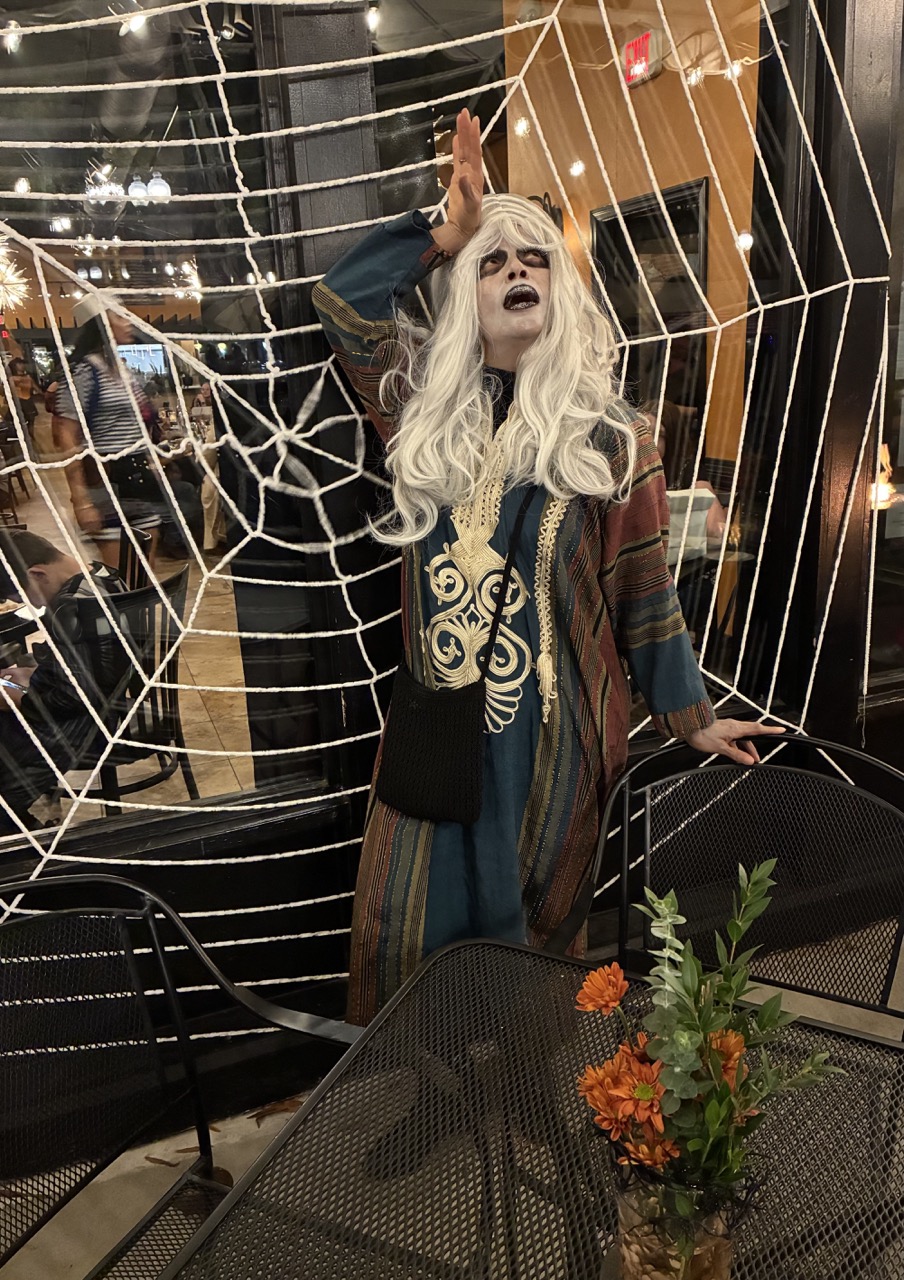
The other member cautioned that some people would opt out of a wonderful experience over something like that where the overall benefits outweighed any temporary inconvenience.

I thought I had to eat breakfast alone, but three other members joined me later. Another member sat by himself, relishing his alone time. He wanted coffee and a muffin before heading back to his room. He had been the first one at reception, ready to walk.

We met the Ghanaian mother-in-law of a cousin who wasn’t vacationing with us. She was fabulous and referred to my cousin’s mother as “Mama BJ.” We visited with her for a few hours. Fortunately, one of the tour support staff joined us. He took our group pictures.

Also, he and the Ghanaian mother-in-law advised my two cousins, RC and Rain Goddess, and me about where to buy locally-made chocolate. I was a little disappointed to discover that the best place to buy local chocolate was at a regular grocery store where expats shopped. On the other hand, I didn’t want to tour the chocolate factory because it seemed too time-consuming and pricey.

Then the support staff member suggested going to a high-end grocery store. Both his and the Ghanaian mother-in-law’s eyes lit up as they spoke of it. RC downloaded an Uber app and our ride was just a minute away. The support staff member rode with us.

Being in a small sedan versus a large bus made the whole experience 3D. I shared traffic videos with one of my sisters back home. She was blown away by all the near misses and no traffic lights in sight.

We thanked our support staff member for escorting us there and back since that was better than him being part of the rescue team.

Before shopping for chocolate, we first ate at a restaurant that was on par with Hard Rock Cafe with a lot of pictures of famous musicians. After eating a lot of local Ghanaian food, I broke down at this place and ordered a burger and fries. Contrary to popular belief, not all Americans love ketchup. I asked the server for hot sauce before the food even hit the table. Besides, it’s never a good idea to go grocery shopping hungry. We treated our support staff member to his meal of a very spicy medium-sized pizza.

(Please click on individual pictures to see the full view, then click on the browser back arrow to return to blog view.)

Properly sated, we entered the grocery store that was a combination of Whole Foods and the Sears appliance section. I steered my two cousins past the appliances. No browsing for irrelevant things. This shopping trip was dedicated to three things: wine, chocolate and other wine snacks. We hit the motherlode all the way in the back, the direct opposite of where we’d entered.

And wouldn’t you know it, the wine section was beside the chocolate area. Someone was truly thinking.

For the first time ever, I saw fresh strawberries. Cost nearly a whopping $12 a carton. A picture was all I took, but someone must be wealthy enough to enjoy that luxury fruit.

For years, my dessert at home was a piece of dark chocolate and malbec. So, I confined my selection to that.

On the other hand, my sister had given me $80 to stock up on a variety of chocolate for her family. I chose at least one of every kind I saw, especially the vegan chocolate. I bought several of those bars for my niece. I knew that everyone would want to sample it, so I bought enough for her to share.

Once we were ready to go, our support staff member had us wait on the sidewalk nearest to the grocery store while he went outside the gate to the main street to hail a taxi. As fate would have it, my seat was the only one that didn’t have an “oh shit” bar to hang onto like my cousins.

We returned to Lizori’s Place for dinner. Our appetizer consisted of spicy sweet groundnuts. Yet, the atadwe milk (tigernut pudding) was the intriguing dish of the evening. Made with tigernuts, dates and rice, the pudding straddled the line between a sweet and a savory.

One member had requested a singer en route to the restaurant. So, another member started singing a bad rendition of “Do-Re-Mi.” Returning to the hotel, several members broke out with an even worse “Wheels on the Bus” singalong with the wrong lyrics.

Then, for the umpteenth time we heard the song, “Countryside,” by Sarkodie, featuring Black Sherif, where that word was repeated many times during the chorus. We finally had a decent singalong.

While at dinner, many spoke of local chocolates and were invited to our room to sample some. The enticement of chocolate scored us a non-Strange to join us for happy hour.

We tried five different chocolates with malbec and Rain Goddess bought a sweet white for my sister. Again, lots of laughs as we swapped stories, viewed new earrings and discussed caring for aging parents.

Adding to the night’s entertainment was my sister and me trying to figure out how to open the mini fridge. I wish I could say that it was the alcohol.